
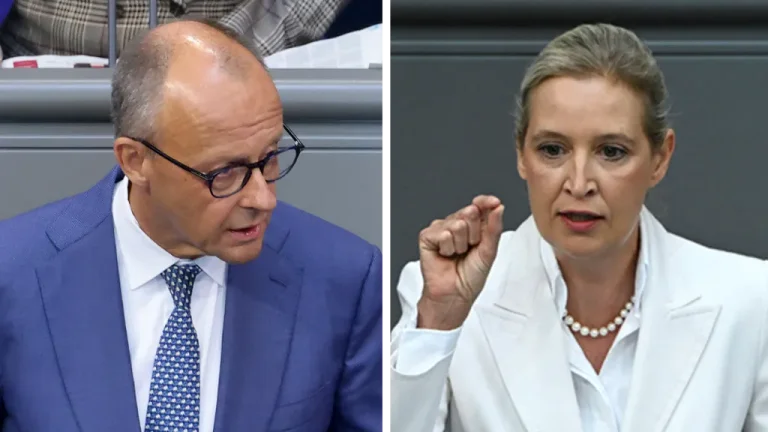
German Chancellor Friedrich Merz clashed with AfD leader Alice Weidel in parliament, calling her party a “destructive force” with a migration policy that, he said, amounted to “ethnic cleansing” of skilled workers, the BBC reports.
Merz was addressing the Bundestag after the anti-immigration party’s landslide victory in the eastern state of Saxony-Anhalt, where it won almost 44% of the vote, while the chancellor’s conservatives halved their result.
Weidel told lawmakers that voters had shown Merz’s centre-left coalition was a total failure and that his time was over.
Merz hit back, saying the AfD had harmed German interests by supporting Russia, while its policy of “remigration” would affect millions of people.
It is still unclear whether the party will be able to form a government in Saxony-Anhalt, as it fell three seats short of an absolute majority. No far-right party has come to power in any of Germany’s 16 states since the Second World War, while Merz has acknowledged that the “earthquake” result has changed Germany, the BBC article continues.
The AfD’s success was welcomed by US President Donald Trump, who said, “The Populist Party in Germany just had a really big night,” linking the victory to “absolutely terrible immigration rules and policies.”
The AfD in Saxony-Anhalt has been classified as “right-wing extremist” by Germany’s domestic intelligence agency, while the party has promised an offensive for “deportation and remigration” targeting irregular migrants, the BBC further reports.
Trump had planned to hold a phone call with the German chancellor on Wednesday, on the 25th anniversary of the 11 September attacks in the US, but a government spokesperson in Berlin said the call had been postponed, without giving a reason. No new date has been set.
As AfD lawmakers repeatedly interrupted him, the chancellor told Weidel that one in six skilled workers has an immigrant background and that, if her party implemented its policies, they would amount to “nothing other than ethnic cleansing in skilled professions, based on skin colour and origin.”
He said the government understood that some deportations were necessary, but that it carefully distinguished between people who contribute to German prosperity and those who do not have permanent residency.
AfD lawmakers’ interjections became so loud that, at one point, Bundestag President Julia Klockner threatened to start removing people from the chamber.
“We are not on a football pitch,” she said.
Weidel said mass migration had meant Germans faced knife violence and attacks on trains and at stations every day, but Merz warned that the AfD’s plans would mean that no care home, hospital or restaurant could operate.
Weidel, the leader of the main opposition party in the Bundestag, opened the session by telling Merz that his Christian Democrats had been “pulverised” in Saxony-Anhalt, having won just 17.2% of the vote. She also accused his government, in coalition with the Social Democrats, of driving Germany towards bankruptcy.
Merz said her party had not won an absolute majority in Saxony-Anhalt and would not achieve one in Germany either.
“You are and will remain a destructive force,” he said, accusing the party of misleading voters by saying before the election that its candidate for state premier, Ulrich Siegmund, would govern only if he won a majority, but deciding just hours after the vote to seek a majority through cooperation with another party.
The AfD has opened the door to cooperation with another party, perhaps the left-wing populist BSW, as long as it supports Siegmund for the post of state premier.
Siegmund’s deputy in Saxony-Anhalt has even suggested that Merz’s CDU could cooperate with his party if it abandons the so-called “Brandmauer” (firewall), the policy under which no mainstream party cooperates with the far right.








