
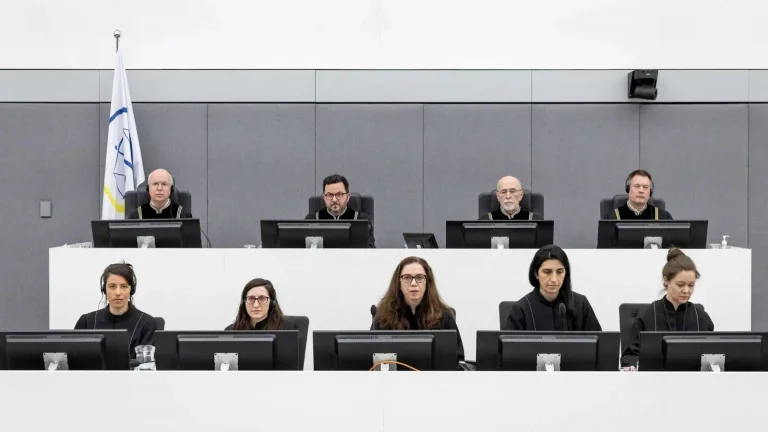
On September 16, the Trial Panel of the Specialist Court sentenced Hashim Thaçi, Kadri Veseli, Jakup Krasniqi and Rexhep Selimi to a total of 81 years in prison.
For two of the three judges who issued this ruling, the road to that courtroom had begun much earlier in Kosovo. Through EULEX.
The Trial Panel that convicted the former KLA leaders consisted of Charles L. Smith III, Christoph Barthe and Guénaël Mettraux.
Two of them had previously held roles in EULEX structures, the failed European Union mission that for years exercised executive functions in the field of justice in Kosovo.
Charles Smith III did not first come into contact with Kosovo's judicial system when he was appointed to the Specialist Chambers. He had been an EULEX judge from 2010 to 2013. During this period he was also part of the Supreme Court of Kosovo, while in 2011–2013 he also served as Vice President and President of the EULEX Assembly of Judges. Smith was appointed a judge of the Specialist Chambers in The Hague in 2017.
Mettraux also had a role in EULEX structures. He was president and a member of the EULEX Human Rights Review Panel, the mechanism established to examine allegations of human rights violations by EULEX during the exercise of its mandate in Kosovo.
Thus, two of the three judges who took part in the most important ruling in this process on September 16 had a history previously connected to Kosovo and the European Union's international justice mission.
But they were not the only ones. A large number of Specialist Chambers personnel had previously served in EULEX.
What did they see in The Hague that they did not see during their time in EULEX?
Smith was an EULEX judge precisely during the years when some of the most important judicial proceedings against former KLA members were taking place in Kosovo. He was in Kosovo when EULEX had the authority to prosecute and try war crimes cases, and when such cases went through courts where international judges served.
And he does not have a good record in trying these cases.
This is confirmed by an email dated January 29, 2013, in which Smith told EULEX's head of judges, Malcom Simmons, that “[the Kleçka case] should be scheduled for trial as soon as possible. There are a number of reasons for this… most of them political”.
Indeed, according to Simmons, Smith went further, saying that the defendants should be convicted because that was what the EULEX mission expected.
Smith engaged in politics through court cases, in violation of the law. Something that is strictly prohibited and punishable in every democratic country.








