
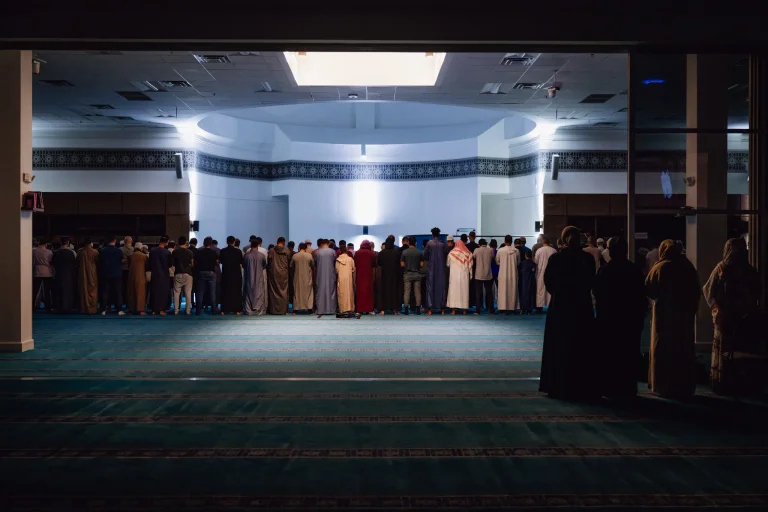
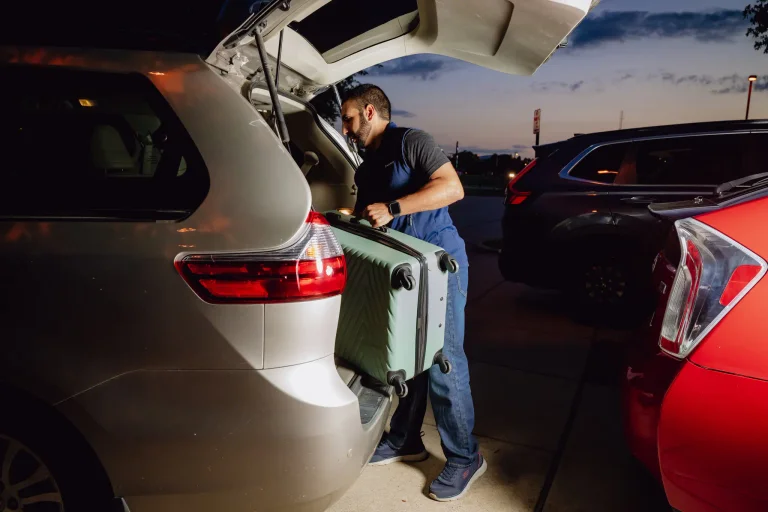
Ghulam Kehar rose before dawn in early June to attend the first prayer of the day at his local mosque in Irving, Texas, before leaving for a several-month deployment with the U.S. Coast Guard.
He had been deployed before, but this time was different.
He felt anxious about leaving his wife and four children behind in Texas, even for a short time.
Rhetorical attacks on Muslims by Texas’s top leaders had become more pronounced, and they seemed to be spreading to other people, too.
At his mosque, Valley Ranch Islamic Center, as well as at mosques across the state, worshipers and religious leaders exchanged stories about insulting comments directed at them while they prayed in public or spent time in public parks.
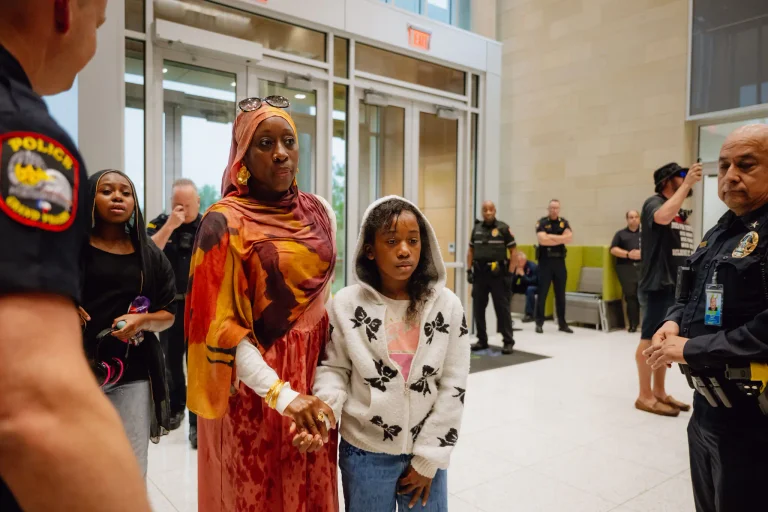
In recent months, a man was arrested and charged with making a terroristic threat at a large new Islamic center in Houston.
Not far away, in Conroe, a woman told Muslim shoppers at a grocery store that they “were not welcome in this state or this country” — after losing her job, she received about $250,000 from supporters when a video of her comments went viral.
In McKinney, a Dallas suburb, a woman grabbed a former mayor and tucked a letter with an anti-Muslim message into his shirt during a tense City Council meeting about expanding a mosque.
“Leaving my family alone in this environment would be a little concerning,” Mr. Kehar said of his family. “It’s just the fear of what’s being said out there.”
He arranged for his family to join him on his deployment near the Canadian border.
Mr. Kehar, who grew up in California, is among a growing number of Muslims who have moved to Texas over the past few decades in search of good schools, affordable homes and a thriving community of worshipers.
The Dallas-Fort Worth area has been especially attractive to families like his. Dozens of mosques have opened.
Some are expanding.
Others, like DeSoto House of Peace, a gleaming center south of Dallas, aim to create new hubs of support for Muslim communities in Texas.
“This is where American Muslims need to be,” said Tammam Alwan, who moved to Irving from Detroit after discovering the community through religious videos online.
“I made a prayer: Please, God, send me to Irving.”
But as the communities have grown, so has resentment toward Muslims.
The promise to fight “radical Islam” has long been part of Republican politics.
The rhetoric has intensified even further at the national level, as Muslims like Zohran Mamdani, New York’s democratic socialist mayor, and Abdul El-Sayed, the progressive Democratic Senate candidate in Michigan, have won important races.
But politicians in Texas have gone beyond words, using the state’s power against some Muslim groups.
An important turning point came in early 2025, after members of the East Plano Islamic Center unveiled plans for a real estate development centered on a new mosque on farmland east of Dallas. The opposition was immediate and fierce.
State leaders, including Gov. Greg Abbott and Attorney General Ken Paxton, have since launched investigations into Muslim institutions across Texas.
They have tried to block the development project and investigate religious counseling on divorce.
Mr. Abbott threatened to cut state funding to Texas airports that offer ritual washing spaces for Muslim travelers, ordered the cancellation of a party at a private water park to mark a Muslim holiday and designated the Council on American-Islamic Relations, a national civil rights organization, a terrorist group — a step the Trump administration has not taken so far. (Florida followed Texas in giving CAIR the same designation.)
State Republican leaders’ efforts to restrict Islamic practices have coincided with an effort to expand Christianity’s role in public life.
In June, Texas became the first state to mandate Bible readings in public schools, where lawmakers had already called for prayer time and the posting of the Ten Commandments.
For many conservative voters in Texas, Islam has replaced the border as a major concern since the beginning of last year, Republican consultants have said.
Anti-Muslim activists and far-right candidates have increasingly described Islam as incompatible with American values.
They warn that the United States could soon look like Europe, where the Muslim population is larger.
“I will not rest until every Muslim has been driven out,” Bo French, a Republican candidate for statewide office, wrote this summer on social media.
Muslim leaders in Texas have debated how to respond.
Some have advised reaching out and communicating with other communities.
Others were dismayed by the return of rhetoric that had been largely dormant since the Sept. 11 attacks, despite years of efforts to foster interfaith understanding.
“We kept trying to refer to what we had done and hope that our results would naturally speak for themselves,” Dr. Omar Suleiman, a prominent Muslim scholar, said in an interview at Valley Ranch mosque.
“We tried that, and it got us nowhere.”
This moment called for a “strong” stance, Mr. Suleiman said, as well as a vigorous legal defense against what he described as false attacks.
“We need to make lying really costly, legally and politically, for these people,” he said. “We need to stand up to them.”
He cited the religious protections guaranteed by the U.S. Constitution as the basis for such a defense.
But recently, hard-line conservatives have sought a way to deny those protections.
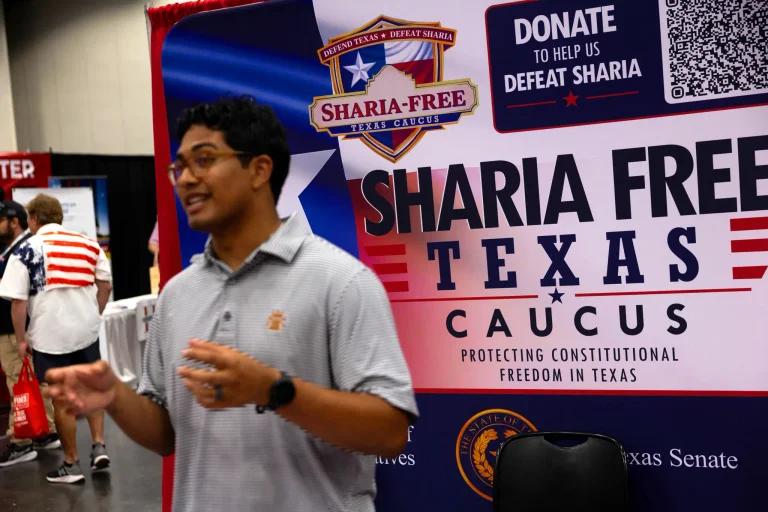
In what would be a first, one of the approaches being considered in Texas is using state law to ban or regulate certain Islamic cultural practices, such as tribunals for marriage and other matters governed by religious rules, which often refer to Sharia law.
Some want to do this as soon as the Texas Legislature meets next year.
“One of the first things we’re going to try to do is define what a religion is,” said State Representative Alan Schoolcraft, a Republican from San Antonio.
“Islam itself is not just a religion. It’s much more than a religion.”
Texas’s Muslim population remains small, about 1 or 2 percent of all residents.
Exact figures are difficult to establish because the census does not ask about religion, but Pew Research Center surveys and state officials’ estimates put the Muslim population between 300,000 and 500,000 people.
Among the states with the largest populations, only New York and Illinois have a higher percentage of Muslims than Texas.
The Dallas-Fort Worth area has been a favored destination.
In recent years, one of the growing communities has been in Irving, centered around Valley Ranch Islamic Center, the city’s second mosque. Founded in 2009, the mosque has a large campus and is planning a 31,000-square-foot expansion with a café and a basketball court.
At a recent evening prayer, families struggled to find parking.
“We’re growing faster than we expected,” said Sheikh Yaser Birjas, who has led the community since 2010.
Birjas said the mosque’s success was due in part to its early embrace of technology.
New people discovered its services online.
Some moved to Texas to join the community.
One indication of the community’s growth comes from census data on international migration from majority-Muslim countries to the United States.
This population in the Dallas-Fort Worth metropolitan area grew to more than 159,000 people in 2024, up from about 79,000 a decade earlier — growing five times faster than the population as a whole.
Another indication can be found in the growing number of Muslim communities.
In Dallas-Fort Worth’s four largest counties, the number of mosques nearly tripled, reaching 76 by 2020, up from 28 two decades earlier, according to data from the Association of Religion Data Archives.
In Collin County, a rapidly growing suburban area north of Dallas, the number quadrupled, from three to 12.
The growth was notable, but the number of mosques remains small. By comparison, there are more than 3,000 evangelical Christian congregations in these four counties.
How Islam Became a Focus for Republicans
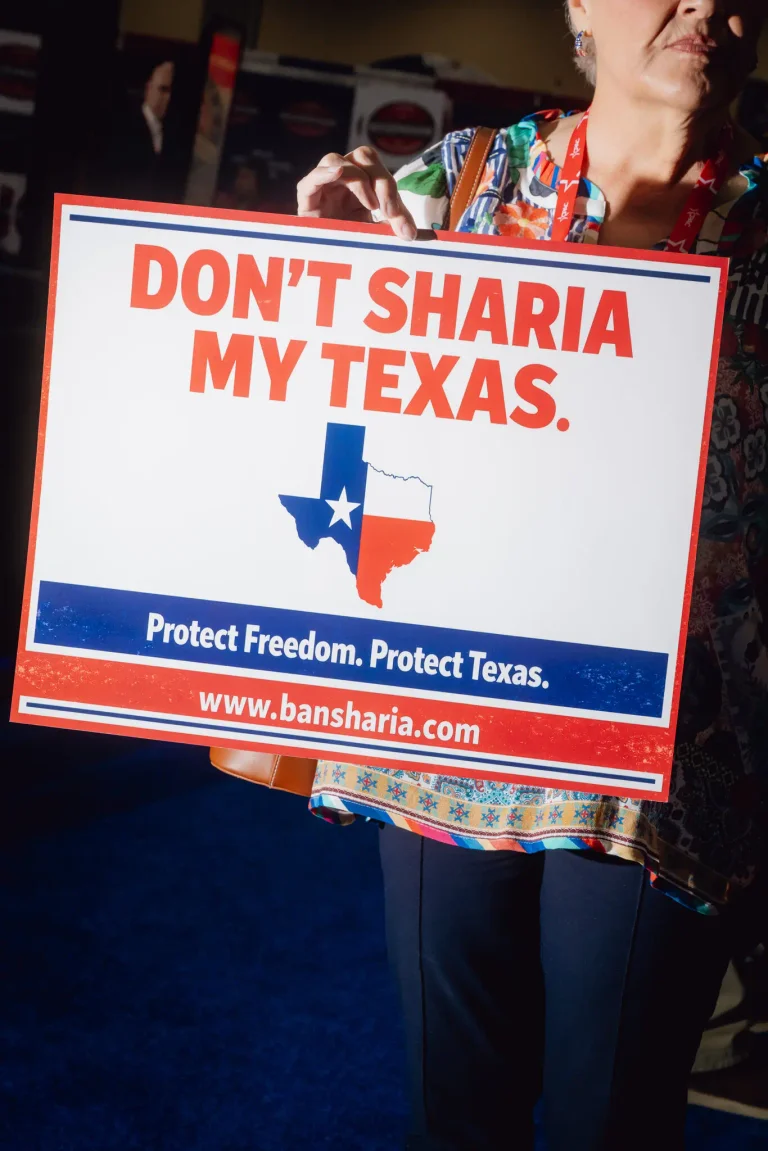
Nearly every speech at the Texas Republican Convention in June included some expression of anti-Muslim sentiment. Some panels at the conference warned of a Muslim invasion. The fight against Sharia law — the Islamic code that guides practicing believers — was declared one of the top legislative priorities.
In the convention hall, the Texas House’s new Sharia-Free Caucus had a booth. Amy Mekelburg, a prominent anti-Muslim influencer, showed a video warning that Texas barbecue restaurants were being replaced by “Arab shopping centers” — as part of a “coordinated takeover.”
The focus on Muslims gained new ground during President Trump’s first run for the White House.
In 2015, Irving Mayor Beth Van Duyne drew national attention by attacking Sharia law. (She is now a member of Congress.)
Two years later, Texas Republicans passed anti-Sharia legislation, as part of a wave of bills pushed by the Center for Security Policy, an extreme right-wing think tank based in Washington.
For a time, the party moved away from the issue of Islam to focus on immigration, the pandemic and gender politics.
But some on the far right began to focus on a different and more divisive message: that Islam is not a religion, but a political ideology.
Then came a proposal for a real estate development with a mosque outside Dallas, known at the time as EPIC City. “This is how the West falls,” Ms. Mekelburg wrote on social media in February 2025.
Her rhetoric caught Mr. Abbott’s attention, and he soon launched state investigations into the proposed project and the mosque community, the East Plano Islamic Center, or EPIC, that supported it.
Anthony Holm, a Republican political consultant, said concerns about Islam were an extension of Republican voters’ fears about illegal immigration — and helped explain Mr. Abbott’s focus.
“Everything he does is determined by polling,” Mr. Holm said of the governor.
Mr. Abbott has used his designation of CAIR as a terrorist group to try to restrict other Islamic groups as well. The council is challenging the designation in court.
“We experience waves of Islamophobia,” said Shaimaa Zayan of CAIR’s Austin chapter.
“This is the worst wave.”
What Does “Assimilation” Mean?
Farhat Shaikh, a doctor who lives in Frisco, north of Dallas, stood outside a polling place during the hard-fought mayoral runoff in June.
For many on the far right, Frisco — with its large South Asian and Muslim population — was the epicenter of the battle over Texas’s future.
Dr. Shaikh urged voters to support Mark Hill, a former school board member who had pledged to unite the city. Mr. Hill’s opponent, Rod Vilhauer, spoke of the need for Muslims to assimilate into American culture, while some of his supporters warned of a Muslim “takeover.”
Mr. Hill won the election. Still, for Dr. Shaikh, the divisive campaign put Muslims like her in a kind of difficult position.
“Assimilation means becoming part of institutions and being ‘part of the decision-making,’” she said. “I’m part of the P.T.A., I volunteer for my community, I’m a practicing doctor. I’m assimilating.” But, she said, being active could also be attacked as an effort to “take over.”
The question of assimilation has galvanized Texas lawmakers like Mr. Schoolcraft and fueled calls for a definition of religion in Texas law. Mr. Schoolcraft hoped that such legislation would encourage Muslims to assimilate more fully and not create enclaves like the EPIC City project.
“I’m not saying you should completely abandon your culture,” Mr. Schoolcraft said.
“But try to become a citizen of the country where you live. Otherwise, there will be conflict.”
Texas Republicans have warned that Muslims are trying to create a parallel justice system.
Some have pointed to a small organization, founded about a decade ago and based in Dallas, Islamic Tribunal, which offers religious counseling to women seeking a divorce, including women in abusive marriages. Mr. Paxton launched an investigation.
A lawyer for the organization said its religious guidance — like that of a Jewish rabbinical court or a Catholic tribunal — was protected by the First Amendment.
“We are not a court,” said Taher El-Badawi, who founded Islamic Tribunal.
Portraying Islam as a political ideology would be unprecedented as a legislative strategy, said Asma T. Uddin, a religious liberty lawyer, and would be “a way to win the religious freedom battle before it even starts, by pushing the other side outside of that category.”
American courts have long avoided defining what religion is. In 2010, residents of Tennessee tried to block the construction of a new mosque, arguing that it should not be treated as a place of worship because Islam was not a religion.
In a filing, the Justice Department responded that “Islam is clearly a religion” protected by the First Amendment. Whether the department under the Trump administration would take the same position remained an open question.
For now, local Muslim institutions have defended themselves on the basis of constitutional and legal principles and have vowed to continue their work.
“The Muslim community is a very large community in Dallas, and they need help,” said Mr. El-Badawi of Islamic Tribunal. “We provide religious assistance. That’s all.”








