
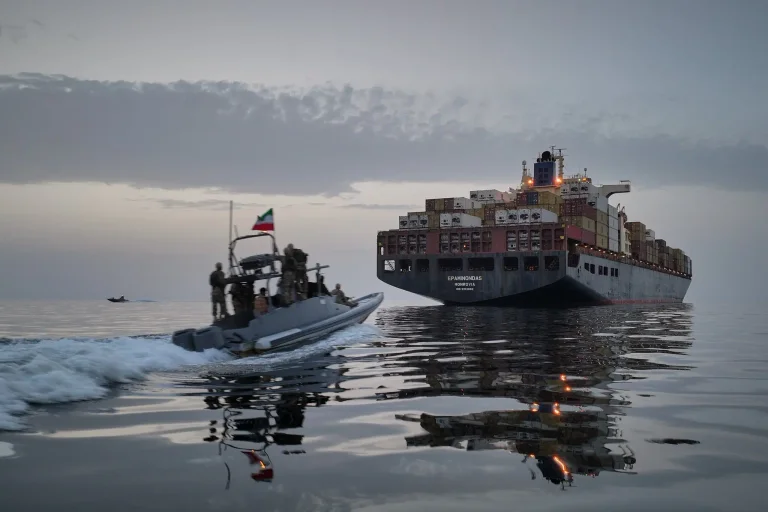
Stranded aboard a merchant ship anchored 7 kilometers off Iran’s coast, around 20 merchant sailors are entering their fourth month of living under the watch of Iranian guards.
Iran seized the ship, MSC Francesca, as it was trying to pass through the Strait of Hormuz on April 22.
Its sailors are from Montenegro, Indonesia, the Philippines and other countries.
They are all far from home.
They have no idea when they might be released and have very little contact with the outside world.
The sailors “have no means of communication except for 30 minutes of internet every few days,” wrote a person familiar with conditions aboard the Francesca.
The crew members of the Francesca are a subset of a much larger group of sailors at risk in the Middle East. Attacks by the United States and Israel on February 28, followed by Iran’s closure of the Strait of Hormuz, immediately stranded around 1,500 ships and approximately 20,000 sailors, according to the International Maritime Organization.
Many ships have sailed out of the Persian Gulf, making their way through the strait when conditions have allowed.
Around 6,000 sailors remain stranded, according to the International Maritime Organization.
They live in danger, carrying out maintenance, keeping watch and inspecting cargo, with no safe way home.
Iran has enforced its claim of control over the cargo with attacks on ships, prompting U.S. retaliation. And the conflict has spread throughout the region.
The pace of crossings through the Strait of Hormuz has recently slowed to just over a dozen a day, a tiny fraction of the prewar average of around 130 ships a day.
Civilian sailors rarely have to work on the front line of armed conflict. But that is what has happened to these sailors in the Middle East, at times with deadly consequences.
Since the start of the Iran war, 17 sailors have been killed in 63 attacks around the Strait of Hormuz. Most of the deaths have resulted from Iranian strikes, but three sailors died after the U.S. Navy struck a ship in June. Yemen’s Houthi militia has targeted ships in the Red Sea, and last week, two ships caught fire after an explosion at an Egyptian port.
The Francesca sailed into the Persian Gulf on February 22.
It is owned by Geneva-based MSC Mediterranean Shipping Company, the world’s largest container shipping company.
Some of the Francesca’s sailors had boarded the ship weeks earlier, according to a crew list reviewed by The New York Times. MSC has not commented on the case and did not respond to requests for comment.
Founded in 1970 by Gianluigi Aponte, an Italian ship captain, MSC today has more than 1,000 container ships transporting goods from one continent to another, sailing on 300 trade routes.

Aponte, whose fortune is estimated at more than $50 billion by Bloomberg, transferred ownership of MSC to his son and daughter, Diego and Alexa Aponte, last year.
In 2022, MSC overtook Danish giant Maersk to become the largest container shipping company after a boom during the pandemic era. Flush with cash, the company expanded its fleet and business lines, buying hospitals, ports and a high-speed train company in Italy.
Despite being located in one of the world’s most unstable regions, the Strait of Hormuz had been a busy, vital and relatively conflict-free trade route. Every month, thousands of ships passed through the strait, and one-fifth of the world’s oil supply depended on it. That has changed dramatically. Attacks by Iran have prompted ship operators to avoid the strait.
Representatives of sailors have said that ship operators should not attempt the crossing until it is clearly safe to do so.
“Trade is important, but we must not risk the lives of innocent people,” Arsenio Dominguez, secretary-general of the International Maritime Organization, said in an interview.
The Francesca sails under the Panamanian flag, and Panama has led negotiations for the release of the ship and its crew, in accordance with maritime convention.
“There has been some improvement,” Ginette Testa, Panama’s ambassador to the International Maritime Organization, said on July 21. She said she could not comment further or provide details that could compromise ongoing negotiating efforts.
Two sailors, both Croatian, have been released from the Francesca, according to Croatia’s Ministry of Foreign Affairs. A government spokesperson said they could not comment further because of the sensitivity of the matter.
The sailors aboard the Francesca were treated well and had adequate access to food, said Romano Peric, a coordinator for the Croatian seafarers’ union, who was in regular contact with the families of the two Croatians before their release. At first, they had fairly regular access to their phones, but their use was later restricted, he said.
In Switzerland, where MSC is headquartered, “diplomatic channels are being used” to secure the release of the Francesca, Swiss government spokesperson Pierre-Alain Eltschinger said last week, declining to provide further details.
On the same day that Iran seized the Francesca, it took another container ship, the Epaminondas, which is being held in waters near the Francesca, according to satellite data from Tanker Trackers. The Epaminondas is part of MSC’s fleet under a lease agreement, and sails under the Liberian flag.
Some sailors from the Epaminondas have been released, according to the Philippines’ Department of Migrant Workers. Filipino sailors underwent medical and psychological assessments “after their difficult experience,” the department said in a statement.
“The sailors feel completely abandoned, completely unprotected,” said Mohamed Arrachedi, the International Transport Workers’ Federation’s coordinator for the Arab world and Iran, referring to sailors stranded in the Persian Gulf. He added that their finances, sleep and mental health had been affected by this ordeal.
Some of the sailors left stranded in the Persian Gulf, with limited food available, say they eat only rice and lentils once a day, Mr. Arrachedi said. One sailor said he was sleeping in his clothes so he could be evacuated easily if his ship was hit.
Crew members can request to leave their ships and be transported to nearby ports to be flown home. But such evacuations are rare, in part because they require the cooperation of immigration authorities in neighboring countries, said Helen Sampson, a professor at Cardiff University who has studied sailors’ working conditions.
Many crew members are on short-term contracts and may hesitate to refuse a dangerous voyage for fear of being blacklisted by employers, Ms. Sampson said.
“They know that if they appear to cause any kind of trouble on board, they won’t get another contract,” she said. “So for a sailor to object or request repatriation while on a ship, that will almost certainly be the end of his career at sea.”
Before the two MSC ships were seized in April, nearly 30 ships had already fallen victim to attacks, including, just days earlier, a container ship owned by MSC’s French rival, CMA CGM.
The fate of the Francesca and the Epaminondas remains unclear.
Natasha Brown, a spokesperson for the International Maritime Organization, said on Monday that the Francesca and the Epaminondas remained in Iranian waters with the sailors on board.
“Discussions are ongoing between the relevant parties for their release, but they are complicated by the broader geopolitical conflict,” she said.
After the ships were seized in April, Iran’s Revolutionary Guards Navy said the two ships had traveled “without the necessary permits,” according to a statement distributed by a semi-official Iranian news agency. The statement said the sailing ships had headed toward Iran’s coast. According to maritime firm Tanker Trackers, the ships remain in Iranian waters.








