
Iceland has voted against resuming talks on membership of the European Union, 13 years after they were suspended.
Iceland’s public broadcaster RUV reported that 52.8 per cent, or more than 225,000 votes, were against the government’s proposal, while 47.2 per cent were in favour. The difference between them was around 12,600 votes.
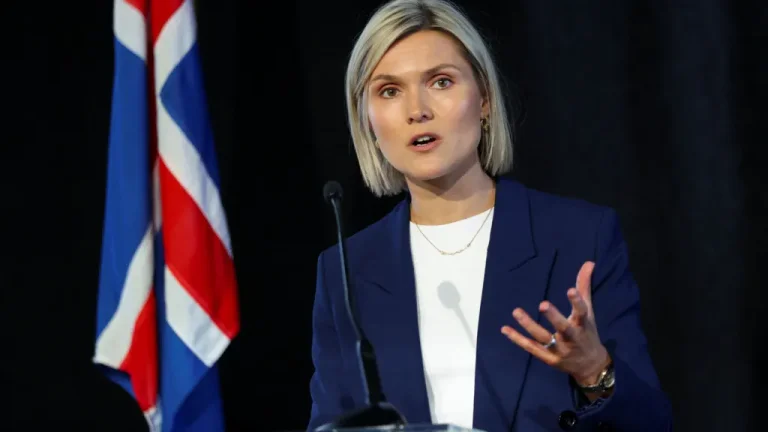
Prime Minister Kristrun Frostadottir’s centre-left government had promised to hold a referendum in 2027, but brought it forward because of international tensions, including US President Donald Trump’s threats toward Greenland, the BBC reports.
However, debate in the island nation of around 400,000 people focused more on the fishing industry than on security concerns.
With around 270,000 eligible voters, RUV reported that turnout of 82.5% was the highest in any Icelandic election since 2009.
Iceland is already part of the EU single market and the Schengen area without border checks. Full EU membership would bring Iceland into the customs union and, ultimately, the eurozone monetary union.
Iceland began its application for EU membership in 2009, following the 2008 financial crisis and the collapse of the Icelandic banking system.
Its application was already at an advanced stage when a eurosceptic government came to power in 2013 and suspended the talks.
Fishing rights were the biggest obstacle to Iceland’s membership at the time – and remain so today.
Iceland successfully fought to protect its fishing industry from foreign fishermen during the so-called Cod Wars with the United Kingdom in the 1970s – shortly after gaining independence from Denmark. The fishing and maritime industries still account for almost 40 per cent of the country’s exports.
Many of the voters who voted against, the BBC writes, feared that EU membership would mean giving up some control over lucrative fishing grounds, under the bloc’s policies that determine how much fish a member state can catch.
“The No side was much more capable of appealing to Iceland’s national political identity, which emphasises formal independence, born out of a long struggle for independence from Denmark,” Eirikur Bergmann, professor of politics at Bifrost University, told the BBC.
“And so, they were able to appeal to people’s very basic feelings.”
On the other hand, the pro-membership campaign “ran an overtly technical campaign, never really explaining the purpose or passion behind why Iceland should join the EU”.
The referendum campaign prompted debate about Iceland’s place in the world, Kristrun said after voting in the capital on Saturday.
She said at a press conference on Sunday afternoon that the issue of EU membership would not be brought back for consideration while her government was in office.
One of her ministers denied that the result was a blow to the government, referring to the high voter turnout.
There was a significant geographical divide in how people voted: the capital, Reykjavik, supported EU membership talks, while rural areas were mostly against them.
The question on the ballot was “Should Iceland resume membership negotiations with the European Union?”.
A Yes vote would not have been a final decision on EU membership, but a step toward a membership agreement, which would then have to be approved through a second referendum.
Similarly, a No vote does not rule out the possibility of Iceland resuming talks at some point in the future.
While economic concerns dominated the referendum campaigns, security issues were also part of the debate.
Iceland is a founding member of NATO, but has no army and relies on allies for its defence. EU membership would have given it full access to the bloc’s shared defence infrastructure.
Iceland has supported Ukraine during Russia’s full-scale invasion, while Icelandic officials have also been alarmed by the increase in Russian naval manoeuvres near the island.
But Trump’s expressed interest in bringing another Arctic island, Greenland, into US territory has recently raised concerns.
Iceland’s Foreign Minister, Katrin Gunnarsdottir, said at Sunday’s press conference that following the referendum she would seek to strengthen the country’s defence relations with other states.
However, Bergmann said: “The debate was entirely domestic, it was called before Donald Trump’s second term, and the turmoil in the world did not really penetrate this debate.”
Jacob Funk Kirkegaard, senior fellow at the European policy institute Bruegel, told RUV that the EU had failed “to sell itself”, even though it “clearly would also like to see itself as a security actor, especially in the Arctic”.
He said the result “will be seen as a missed opportunity – certainly for Iceland, but also for the EU”.
An unnamed EU diplomat appeared to agree with this assessment. He told the Reuters news agency that the result was “a clear blow to Brussels”, noting that fishing and independence issues had been decisive.
The No camp’s victory was greeted with applause by eurosceptics in other countries.
Reform UK leader Nigel Farage, one of the leading supporters of the United Kingdom’s departure from the EU, said Icelanders had voted “to preserve their independence”.
Marine Le Pen of France’s National Rally said the result showed a “clear truth: membership of the European Union is not the natural horizon for every European democracy”.








