
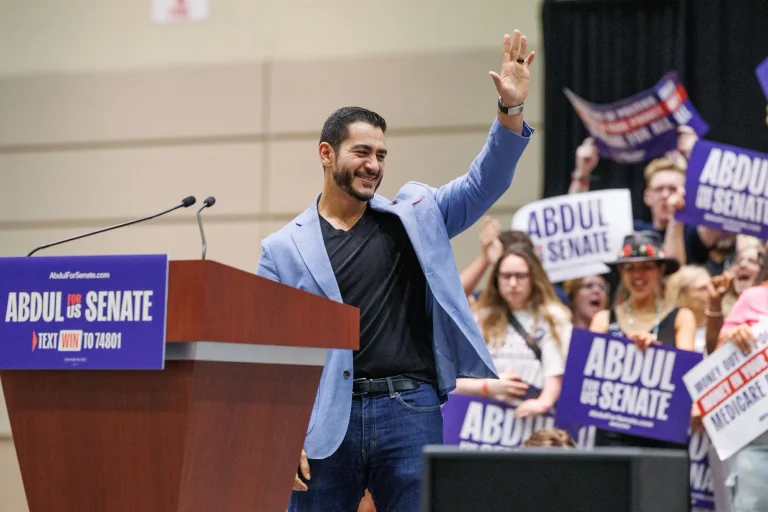
Progressive Abdul El-Sayed is narrowly leading Representative Haley Stevens in Michigan’s pivotal Democratic primary in the race for the US Senate.
Both candidates addressed their supporters after midnight on Tuesday. Stevens said she was “feeling good” about the race, but urged them to prepare for a long night.
El-Sayed also acknowledged the close race: “I wish I could tell you that I was declaring victory right now,” he said.
Whoever wins will face Republican Mike Rogers in the November Senate race.
But who is El-Sayed, who has set the Democratic race alight?
El-Sayed, 41, is a doctor by profession and, if elected in November, would become the first Muslim senator.
El-Sayed is the son of Egyptian immigrants. He was born in Michigan, and his first language was Arabic. As a young man, he struggled to fit in. After the September 11 attacks, he faced anti-Arab insults.
Dr. El-Sayed, a former podcaster and CNN commentator, is a fluent communicator. His opponent, Stevens, has acknowledged that he is a “talented guy,” but has portrayed him as a “showman candidate.”
Throughout his campaign, El-Sayed has frequently connected the Israel-Gaza war to what he unabashedly calls genocide. The roots of these worldviews date back long before this campaign and run through Egypt, where El-Sayed spent childhood summers with his father’s family.
El-Sayed credits his grandmother with teaching him, calling her the wisest person he has ever known.
As a student, he was a starting defenseman on the University of Michigan lacrosse team and vice president of the Muslim Students’ Association. He studied at Oxford, attended Columbia’s medical school and eventually went into public health rather than private practice.
“He was always the smartest guy, the brilliant guy who could own the room,” said Mohamad Issa, a head and neck cancer surgeon in Ohio, who knew El-Sayed during his college years. “The first person there. The last person to leave.”
Issa recalls approaching El-Sayed after a basketball game as an anxious freshman, after receiving disappointing grades in his first science classes. El-Sayed, then a student athlete, spent months mentoring him, offering study strategies that Issa says transformed his academic career. Two decades later, Issa says he still teaches those techniques to the students he mentors today.
“He’s a brother,” Issa said. “That’s all you need to know.”
After years of research and work as an instructor, El-Sayed led Detroit’s health department after the city’s bankruptcy, then took over that of Wayne County, where he helped cancel about $700 million in medical debt affecting 300,000 Michigan residents.
The Democratic race, however, has divided the party between those who support El-Sayed and those who back his opponent.
Chuck Schumer, the US Senate minority leader, and outgoing Senator Gary Peters have endorsed Stevens, reflecting the party leadership’s preference for the more conventional candidate. El-Sayed, meanwhile, has assembled a diverse coalition, recently winning the support of figures such as progressive Representative Alexandria Ocasio-Cortez and Bernie Sanders.
El-Sayed has also faced resistance in Michigan. Lon Johnson, a former chair of the Michigan Democratic Party who supports Stevens, argued that El-Sayed’s politics could ultimately cost Democrats one of their best chances to retake control of the US Senate.
“There’s a real concern that Abdul won’t be able to beat [Republican Mike] Rogers and then ultimately cost us a chance at a Senate majority,” Johnson said.
Outside groups, led by the pro-Israel lobbying network AIPAC, have poured about $30 million into the race on Stevens’ behalf, making Michigan one of the most expensive Democratic primaries in the country.








