
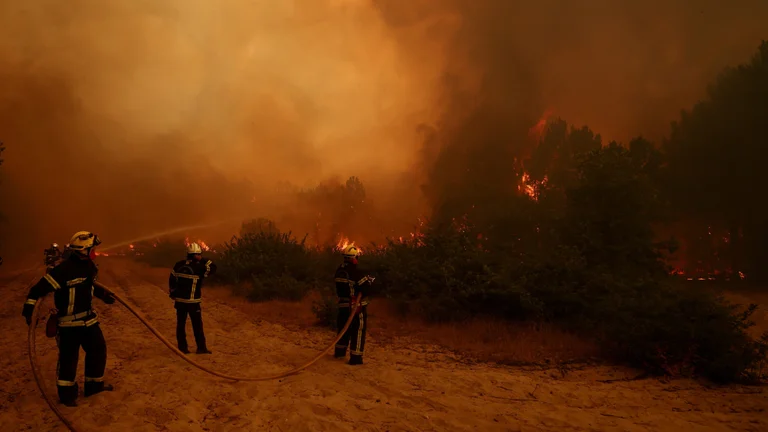
The European continent is facing some of the largest fires and highest temperatures ever recorded. Residents are leaving their homes, leaders are struggling to respond, while a climate expert warns that “things will only get worse.”
A dense yellow-orange haze covered Bordeaux on Sunday, hiding the sun and blurring the cathedral towers in this French city. Fine ash particles stung the eyes and made it difficult to breathe. About 32 kilometers west of the city, a giant forest fire burned with such intensity that it even created its own weather system.
“We have never seen anything like this,” said Roger Peuron, 89, a retired engineer born before World War II, who was forced to leave his home because of the approaching flames. He could have been speaking on behalf of millions of Europeans.
Relentless fires. Scorching heat waves. Unusual storms. The summer of 2026 has already broken meteorological records in several European countries. On a continent that has endured centuries of upheaval—devastating wars and deadly pandemics—it is now the weather itself that is bringing Europe to the breaking point.
It has forced more than 300,000 people to leave their homes in France and Spain, where the biggest fires in the modern history of these countries have led to the largest peacetime evacuations. Entire villages have been destroyed and hundreds of thousands of hectares have burned.
Millions more are desperately seeking relief from temperatures that regularly exceed 40 degrees Celsius.
The heat wave has forced the cancellation of concerts and festivals, shortened the final stage of the Tour de France cycling race, and prompted the Louvre Museum and the Eiffel Tower to close early. It also brought forest fires to the Scottish Highlands, led organizers in London to cancel a conference on coping with extreme heat, and caused at least 10,000 heat-related deaths in June alone, a figure that could turn out to be even higher.
“Europe is the epicenter of the impacts of climate change,” said Johan Rockström, a Swedish scientist and director of the Potsdam Institute for Climate Impact Research in Germany.
“The year 2026 is only the beginning,” he added. “It will inevitably get worse. It will get worse and worse, to the point where, I fear, we will exceed the limits of adaptation.”
Of course, Europe is not alone. Heat waves have swept across Australia and Japan this year. Floods have devastated Kenya and Angola. A snowstorm paralyzed the eastern United States. Developing countries in the Southern Hemisphere remain even more vulnerable to climate change than wealthy Europe.
Nevertheless, no continent has warmed faster than Europe, at a rate almost twice the global average since the mid-1990s. This has forced Europeans to confront the reality of a changed climate more directly, especially in summer, when once-mild days have been replaced by scorching heat.
Although it remains cooler than regions such as the southwestern United States or the Persian Gulf, Europe finds it harder to cope with the temperatures because many buildings lack air conditioning and were built to retain heat. In addition, many forests composed of the same tree species, planted during wetter and cooler periods, have become extremely flammable during fire season.
“With this heat wave and these fires, you could say the situation is becoming unbearable,” said Sonia Seneviratne, a Swiss climate scientist at the Swiss Federal Institute of Technology in Zurich.
Whether this will lead to drastic measures—either to mitigate climate change or to adapt to it—remains to be seen.
In Spain, Prime Minister Pedro Sánchez declared a “climate emergency,” saying a state agreement is needed to “structurally tackle the root of the problem.”
In France, President Emmanuel Macron pledged to reforest the large pine forests burned in the Gironde region with tree species better suited to a hot, dry climate.
“The situation we find ourselves in today is the most difficult we have ever recorded, the most serious since World War II,” Macron said.
Yet despite the urgency, Europe’s commitment to reducing carbon dioxide emissions—which scientists consider the only way to curb climate change—risks being weakened. This month, the European Union proposed changing some rules, allowing certain industries to pollute a little more and for a longer period.
“Net zero emissions” policies, which aim to balance greenhouse gases emitted with those removed from the atmosphere, have become a target of attacks, especially from the right, which sees them as a luxury Europe cannot afford amid weak economic growth and energy insecurity.
Moreover, whatever Europe does, the global direction also depends on China and the United States, where President Donald Trump has called climate change a “hoax,” as well as on developing countries with high energy demand.
“We are watching Ursula von der Leyen fight to preserve the current commitment,” Rockström said. “What is happening in France and Spain should push us to raise our ambition, not lower it.”
According to him, one way to do this is to educate the public about the cause-and-effect connection between global warming and last week’s catastrophic fires.
First, record heat waves dried out the soil and vegetation, which had grown after a wet winter. Then the fires near Bordeaux and Madrid found ideal conditions to spread.
Previous heat waves also exposed other weaknesses in Europe. At the end of June, rail operators canceled services, while France temporarily shut down some nuclear reactors to avoid discharging excessively hot water into rivers that had already warmed. Meanwhile, drought lowered water levels in the Danube and Rhine rivers, hampering river transport.
Europe’s status as the fastest-warming continent is linked both to changing atmospheric patterns and to its proximity to the Arctic, where melting snow and ice create darker surfaces that absorb more heat.
The continent is already 1.6 degrees Celsius warmer than it was three decades ago, and the rise is so rapid that it can be observed within a single generation.
By the beginning of this week, France had recorded 53 heat waves since 1947, of which 28 have occurred in just the past 15 years.
According to the French meteorological service Météo-France, Bordeaux recorded no days with temperatures of 39 degrees Celsius or more between 1921 and 2000. This summer alone, that has happened seven times, while the season has not yet reached its halfway point.
Bordeaux wine producers, already hit by the heat, worry that smoke could damage their famous vineyards.
Friederike Otto, a German climatologist at Imperial College London, said that wind patterns known as “jet streams” and high-pressure systems once brought pleasant summer days to Europe. Now, the same mechanisms produce extreme conditions because they occur in a much warmer climate.
According to scientists, the most frightening part of this summer is that, in the future, it may seem mild compared with what is to come.
The planet is already on course to exceed the main target of the 2015 Paris Agreement: limiting global warming to no more than 2 degrees Celsius above pre-industrial levels.
Some experts say the pace of warming is not only failing to slow down, but may actually be accelerating.
The French meteorological service has outlined a grim scenario: by 2050, heat waves could be five times more frequent, while temperatures could reach as high as 48 degrees Celsius.
At a large exhibition center in Bordeaux, where thousands of evacuees took shelter on Sunday, that future seemed to have already arrived.
Céline Lartigue, 51, a social worker, said she had to reach back into European antiquity to describe the ash and orange sky she saw as she left her home on the outskirts of Saint-Médard-en-Jalles, where the factories producing propellant for French nuclear missiles are located.
“It was like Pompeii,” she said.








