
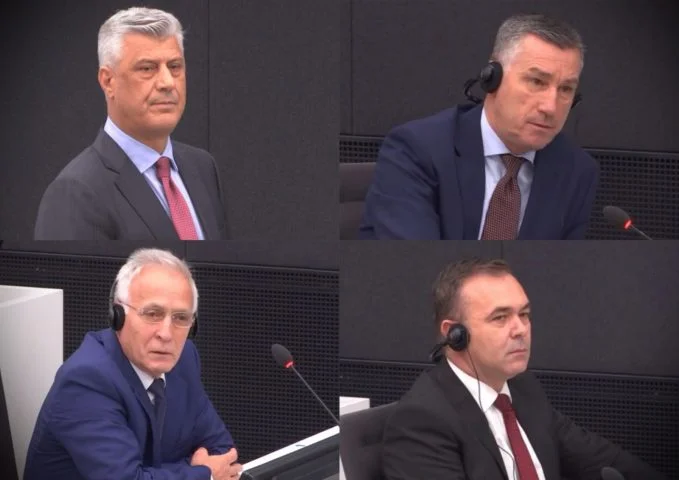
The court cites the large volume of evidence and the complexity of the proceedings as reasons for postponing the verdict against former KLA leaders.
Delays have become the norm at the Specialist Chambers.
For the second time, the panel of judges has postponed the delivery of the verdict in the case against former leaders of the Kosovo Liberation Army.
The panel has sought to justify this decision by saying that the case requires more time because of the extraordinary volume of evidence and the complexity of the proceedings.
In a notice published on Wednesday, the trial panel says the deadline for delivering the verdict has been extended to September 16, 2026, while the public hearing for its delivery has been scheduled for that date at 10:00.
Although they say they are aware of the lengthy time the KLA leaders have spent in pre-trial detention—more than 5 years—the Specialist Chambers say that an additional extension of nearly 60 days “will not cause unjustified harm to the accused.”
According to them, the extension is justified “by the need to ensure a fair, comprehensive and reasoned assessment of all the evidentiary material and by the requirement for a reasoned written opinion that accurately reflects this material.”
“The Trial Panel is satisfied that no shorter extension would enable it to discharge its responsibilities adequately,” the decision states.
Initially, the verdict against the KLA leaders was scheduled to be delivered on May 19, but was later postponed to July 20. Now it has been postponed again.
According to the court, the postponement is “absolutely necessary,” as a large amount of evidence has been admitted during the proceedings. The panel notes that it has reviewed the testimony of around 270 witnesses, admitted 5,467 exhibits into evidence, and that the transcript of the proceedings consists of 29,238 pages.
The panel maintains that the additional time is needed to conduct a full and fair assessment of all the evidence, as well as to prepare a reasoned written judgment that reflects all the evidentiary material.
“The Trial Panel considers that a further extension is absolutely necessary within the meaning of Rule 159(1). The Trial Panel recalls that, as set out in the Order Extending the Time Limit for the Delivery of the Trial Judgment: (i) it has received the testimony of around 270 witnesses (orally and in writing); (ii) it has admitted 5,467 exhibits into evidence; (iii) the transcript of these proceedings is 29,238 pages…”, it says.
“…and (iv) the complexity of the proceedings in this case, namely the fact that the circumstances of the case cover more than a year and a half and involve numerous alleged crime sites and a considerable number of individual incidents. Moreover, the proceedings concern charges against four individual accused, whose responsibility must be examined separately and carefully. In view of the above, in order to ensure a full and fair assessment of the totality of the evidence and to issue a reasoned opinion that takes into account the large volume of evidence and the complexity of the proceedings, the Trial Panel is satisfied that a further extension is absolutely necessary,” it further emphasizes.
Hashim Thaçi, Kadri Veseli, Rexhep Selimi and Jakup Krasniqi have been held at the Detention Centre in The Hague since November 5, 2020.
They are accused by the Specialist Chambers of alleged war crimes and crimes against humanity. All four KLA leaders have pleaded not guilty.
The Specialist Prosecutor’s Office has sought 45 years in prison for each of the KLA leaders. A total of 180 years.
Their trial began in April 2023—more than three years after their arrest. On April 16, 2025, the Specialist Prosecutor’s Office (SPO) announced that it had closed its presentation of evidence against Thaçi, Veseli, Selimi and Krasniqi.
Highly significant international witnesses have testified on behalf of the KLA leaders, including former U.S. Assistant Secretary of State James Rubin, former NATO Commander during the war in Kosovo Wesley Clark, former U.S. diplomat Chris Hill, and others.
Among other things, they have emphasized that the KLA did not have a chain of command, contrary to what the Specialist Prosecutor’s Office seeks to portray.
Several protests have been organized against the way the trial of the former KLA leaders has been conducted, with thousands of Albanians from all Albanian territories demanding justice. The most recent was held in Pristina on February 17. Before that, two more were held in Kosovo’s capital, and one each in Tirana, The Hague, Strasbourg and Skopje.
Legal experts—both local and international—have repeatedly criticized the way the proceedings in The Hague have been conducted. They have been considered biased; evidence from Serbia has been admitted; and concerns have been raised that human rights are being violated and exculpatory evidence concealed.
Kosovo and Albania’s institutions have also called for a fair trial at the Specialist Chambers. On February 12, the assemblies of Kosovo and Albania adopted resolutions in support of the KLA leaders, calling, among other things, for the Specialist Court to ensure an impartial trial.








