
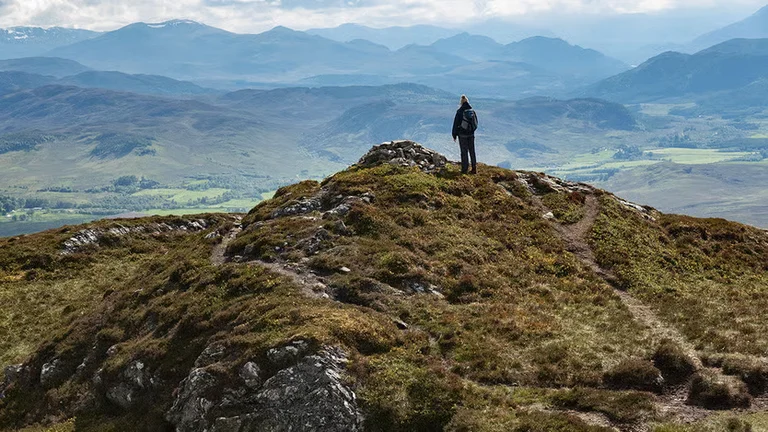
Schotty Boy, as he is known online, is an enthusiastic promoter of hiking. He posts images from the Scottish Highlands—moody, misty photographs of streams, valleys, lochs and hills—for his more than 100,000 followers on Instagram and TikTok. In these posts, he usually wears appropriate hiking gear, such as a backpack, a thermos and a rain jacket. Sometimes, and without any clear explanation, he appears shirtless.
He is one of many young people discovering the pleasures of the outdoors. (As one TikTok video puts it: “Texting is nice, but going for a walk in nature together is even nicer.”) Millions of posts praise this free and accessible form of physical activity. Some influencers recommend scenic trails, stops and shelters. Apps such as AllTrails make it easy to find hiking trails. This is especially useful for a generation that is more used to reading from a phone screen than from a map.
The problem is that followers are following in influencers’ footsteps without fully understanding what a walk in the wilderness can involve. (For example, hiking shirtless is not advisable at all, especially in cold and rainy conditions.) Enthusiastic explorers can easily end up in danger. In the Scottish Highlands, the number of mountain incidents involving people aged 17 to 25 has almost quadrupled since 2022. In 2018, only 15% of those rescued in the Scottish Highlands were in this age group. Last year, the figure reached 25%. It wasn’t always like this: in the early 2010s, middle-aged hikers were the ones most likely to need help.
And this is not just a Scottish phenomenon. In the United States, young people aged 18 to 25 make up an increasingly large share of those who need rescuing. France, Italy and Switzerland have also recorded an increase in calls for help from young people in recent years.
Rescue teams point out that more and more people of all ages are taking up hiking. Ludovic Richard, of the French Mountain Safety Observatory, says the “Instagram effect” leads many young people to venture to dangerous edges just to take a photograph in a picturesque spot. Some have almost none of the necessary equipment and little practical sense. In December, two people in their twenties were rescued on Britain’s second-highest mountain, in temperatures that felt like -15°C, wearing only trainers and tracksuits instead of thermal clothing and hiking boots. Kev Mitchell, a member of a rescue team in Scotland, was called to help another young couple in the Scottish Highlands who had neither a compass nor suitable jackets. According to him, without the rescue team’s intervention, they would have lost their lives.
The benefits of hiking are numerous. The U.S. National Park Service promotes it as “a great full-body workout—from head to toe and everything in between.” In addition to strengthening muscles and bones, hiking is also very beneficial for mental health.
Gen Z has the right idea. It just needs to prove that it knows how to put it into practice, too.








