
Russia is losing the war against Ukraine. According to the author, evidence of this comes from Vladimir Putin himself, who has admitted that things are not going according to plan and made a desperate call for peace talks to resume, as Russian oil refineries burn and bridges linking occupied territories are hit by Ukrainian missiles.
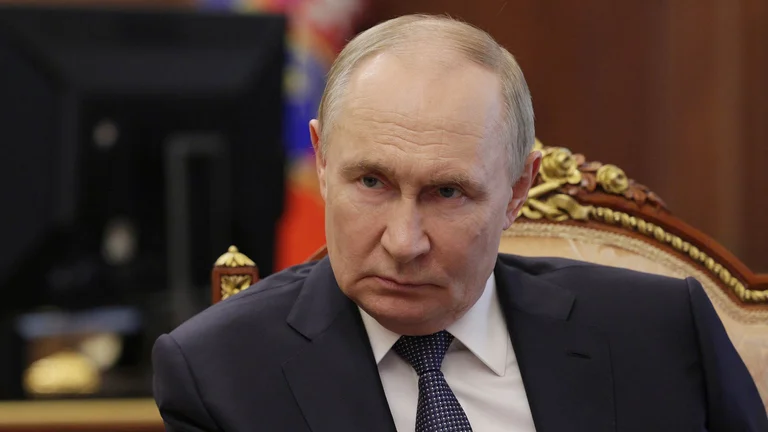
The Russian president appears shaken. Airports have been closed, the military logistics chain has been severely damaged, and public support for the war he himself started is waning. Even Russian state media can no longer generate artificial enthusiasm for the conflict.
In an interview on Sunday, Putin made a rare admission that the country is facing fuel shortages as a result of Ukrainian drone attacks.
His associates have complained that an agreement they believe was reached with Donald Trump at last year's Anchorage summit – which would have given Moscow colonial control over 20 per cent of Ukraine – has been abandoned by the US president.
Trump likes to back winners. So far, he has backed Russia, which launched a full-scale invasion of a European democratic state in February 2022.
According to the author, this may now be the moment for Mark Rutte to explain to the US president that NATO allies are bearing their share of the burden in supporting Ukraine even without US military assistance (with the exception of intelligence).
The author says it is enough to repeat Putin's own words, in which he declared that Ukrainian attacks on Russia's oil and logistics infrastructure are aimed at “destabilising society”.
And, according to the author, Putin seems to believe that this strategy is working.
“Russia, as has been repeatedly stated, is ready for peace negotiations with Ukraine,” Putin said last week, in a statement the author interprets as a plea to return to the time when Ukraine's Western allies believed Kyiv was losing the war and had to accept an agreement with Moscow.
“We are ready to continue on the basis of the agreements reached earlier in Istanbul – agreements that, I want to recall, were initiated by the Ukrainian delegation itself,” he said.
At the time, according to the author, many British diplomats and army officers thought Ukraine should seek peace. He argues that this was a mistaken assessment then, and is just as mistaken now.
The author says further evidence can be found in the ongoing complaints by Kremlin officials that Trump is no longer as enthusiastic about Russia as he was over the past 18 months, a period during which he halted military aid to Kyiv, exaggerated the amounts the US had spent on Ukraine and repeatedly attacked President Volodymyr Zelensky.
In recent weeks, according to the author, the Kremlin has begun a campaign to reinterpret the Anchorage summit, which was once seen by US allies as a capitulation to Moscow.
But now that Ukraine has gained ground, completely dominated the Black Sea and forced Russia to consider banning diesel exports after refineries were hit by long-range missiles, Russian officials seem angry and hurt.
Trump, meanwhile, has focused on the conflict with Iran, a development that, according to the author, has also boosted Ukraine's reputation, as Kyiv has offered anti-drone systems to America's Arab allies.
The author claims that Trump has also failed in the Middle East so far and may now be seeking an easy political victory, which the Kremlin considers an opportunity for Zelensky.
Kremlin aide Yuri Ushakov said last week that only one side had remained faithful to the understanding reached in Anchorage, under which Russia would receive a part of Ukraine in exchange for “peace”.
“The other side, as it now appears, has been unable to fulfil its part of the agreement,” he said, referring to the US and not Ukraine.
Russian Foreign Minister Sergei Lavrov suggested that the Anchorage summit may have been an American manoeuvre to give Ukraine time to rearm.
His deputy, Sergei Ryabkov, also accused the US of having moved away from the “fundamental understandings” reached in Alaska.
“We are also seeing Washington's policy move ever closer to the most anti-Russian policies of its closest European allies – Britain and France,” Ryabkov was quoted as saying by Russian news agency RIA, after the meeting between Zelensky and Trump at the G7 summit.
Crimea, illegally annexed by Russia in 2014, has been hit hard by Ukraine's air campaign.
The Russian-installed governor in Sevastopol, Mikhail Razvozhayev, has declared emergency measures, including suspending public transport after 10 p.m. and closing large shops and cafés at 8 p.m.
Fuel shortages have begun to paralyse Russia's biggest territorial gain in Ukraine, something that, according to the author, Putin himself has acknowledged.
The author argues that Moscow's control over the Russian Federation could begin to weaken as a result of Ukrainian attacks on infrastructure, even near Moscow.
Meanwhile, Britain and its European allies are trying to rapidly increase their defence capabilities without seriously damaging public finances.
Former British Defence Minister John Healey and his deputy Al Carns resigned, claiming that the ministry did not have sufficient funding.
According to the author, this crisis in the British government was seen in Moscow as a victory for the Kremlin's destabilisation efforts.
When Sir Keir Starmer resigned, Russian envoy Kirill Dmitriev wrote on X:
“We did this together by exposing Starmer's warmongering policies and his misguided policies on immigration, crime, energy and the economy. He failed to protect Britain and was destroying Western civilisation.”
The author claims that Russia is already waging hybrid warfare against Britain and Ukraine's other allies, sabotaging efforts to support Kyiv through bomb attacks, arson and disinformation campaigns on social media.
He adds that Russia is spreading false narratives to undermine Western leaders, fuel right-wing extremism and create false perceptions, such as the claim that London is one of the world's most dangerous cities, even though statistics show that violent crime there is at its lowest level in decades.
However, according to the author, there is an alternative for the West: to build on Ukraine's military successes and help Kyiv not only hold the front line but destroy Russian military logistics, so that the Russian front collapses completely.
The author argues that a defeated Russian army poses a risk to the Kremlin itself. Putin, as a student of Russian history, is aware that military defeat in the First World War contributed to the overthrow of the tsar.
He concludes that, rather than accepting Russia's demands for Ukraine's neutrality, permanent military weakening and loss of territory, Ukraine's allies – together with the US – should seize this moment to help eliminate the threat that, he says, the Kremlin poses to the West.








