
Gabriel Péri Street in Saint-Denis is typical of a northern suburb of Paris. Lambs’ heads, their smiles frozen, are lined up in the butcher’s window; in a discount store, T-shirts are on sale for €2, while illegal vendors offer contraband cigarettes on the pavement.
It was right here, in an eight-storey housing complex in the most densely populated banlieue of the French capital, that Jordan Bardella grew up.
The 30-year-old’s journey from a shy, pale-faced teenager to leader of the populist right-wing party Rassemblement National (RN) is extraordinary. On 7 July, his story could take another turn: Marine Le Pen, his mentor, will learn whether an appeals court will uphold her ban on running for public office, following her conviction for misusing European funds. If it does, Bardella will be the RN’s candidate for the French presidency next April.
“I was not at all destined to end up where I am today,” Bardella says over coffee in the European Parliament, where he is an RN MEP. He says it was “impossible” that such a thought had crossed his mind as a teenager. By his own admission, he was “very shy” and spent hours in his room playing Call of Duty or FIFA. He did not attend any of the elite schools that produce France’s ruling class and left university without graduating. In Parisian circles, among peers with names like Charles or Arthur, Bardella says he was mocked for his working-class surname. “I may have grown up just ten minutes from the Paris boundary, but it was a completely different world.”
Bardella’s rise through the RN ranks has been dizzying: he joined the party at 16, became a local activist at 18, led the party’s list in the European Parliament elections at 23, and was elected RN president at 27. It was Marine Le Pen – daughter of the party’s co-founder, Jean-Marie Le Pen – who chose him as her political protégé and promoted him at an exceptionally young age. Today Bardella is treated as a celebrity; he is even dating an Italian princess, a member of the former Bourbon-Two Sicilies royal family. Polls show that if he were the candidate – as he and Le Pen have agreed he would be if her ban remains in force – he would comfortably lead the first round of the election and could win the runoff as well.
In some respects, Bardella’s appeal for the party is obvious. He is the polished face of a party that was once stigmatised as antisemitic and is now seeking respectability. Above all, he does not bear the Le Pen name and, moreover, comes from “the 93”, France’s poorest postcode. He is a skilled speaker who punctuates his sentences with a smile and prepares every appearance “very, very, very methodically”, according to his friend and RN MP Alexandre Loubet. With more than 2 million followers on TikTok, Bardella is as popular among teenagers as he is among pensioners.
Since taking over the party, Bardella has laid out his vision: a MAGA-style nationalism, opposed to immigration, sceptical of green policies and against “woke” culture, based on the principle of “France first”. European diplomats who have met him have been reassured by his calling Russia “a multidimensional threat” and his saying he would keep the French armed forces in NATO operations on the alliance’s eastern flank. Nevertheless, he is firmly opposed to Ukraine joining the European Union and wants France eventually to leave NATO’s integrated military command. German officials have been somewhat reassured by his signals of willingness to cooperate with Berlin, particularly on migration. But Bardella’s ambition to turn the EU into a “union of nations” involves policies – such as sharply reducing France’s financial contribution to the common budget – that would put him directly at odds with Germany. France could become one of the countries blocking the union’s projects.
Bardella describes his relationship with Marine Le Pen as “very close”. He continues to address her using the formal “vous”, while she addresses him with the informal “tu”.
Nevertheless, he stresses: “It is not a relationship of political guardianship.” Recently, he has also begun to express differences with her. Marine Le Pen wants to lower the retirement age; Bardella is less convinced. She advocates a greater role for the state in the economy, a position that finds support in the ruined industrial areas of northeastern France; he wants to win over bourgeois right-wing voters too, and has reached out to business leaders with a pro-enterprise message.
But what does this politician, who describes himself as a “pragmatist”, really believe? He is well prepared on topics ranging from fiscal policy to energy. Yet he becomes more passionate when talking about what he sees as an unfair deal for France in a Europe dominated by Germany.
The issue he cares most about is immigration. “Our continent will no longer be the continent of Europeans if we do not put an end to the wave of migration,” he recently told nationalist allies in Poland. Bardella wants to end automatic citizenship for children born in France and reduce social benefits for immigrants. In June, he came under fierce criticism after linking street violence following PSG’s Champions League victory to “France’s inability to control immigration”.
Behind this nationalism there seems to be an impatience with those who, in his view, do not behave like his parents. Bardella’s mother, Luisa, was born in Turin; his paternal grandfather, who married a French-Algerian woman, also immigrated to France during the 1960s. According to Bardella, that generation “did everything to become French, to learn the language and to respect the country that welcomed them”, whereas today, he says, “such an effort is no longer required”.
He describes Saint-Denis, where his mother still lives, as a place characterised by “drug trafficking, crime, misery and the loss of our values and identity”.
His personal story, however, leaves out some uncomfortable details. His father, who separated from his mother when Bardella was still an infant, ran a small drinks-delivery business and bought his son a car when he was a teenager. Also, the boy who presents himself as a product of a working-class neighbourhood left the public education system early and was sent to a Catholic school in Saint-Denis. Nevertheless, this story works well in populist politics. He says he wants to ensure that “France does not look like the neighbourhood where I grew up”.
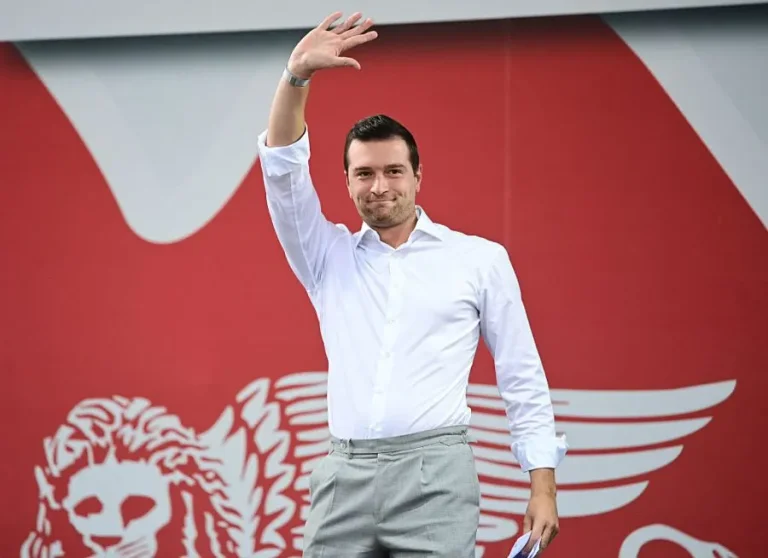
Today Bardella spends more time in corporate boardrooms, embassies or at the Monaco Grand Prix, where he was seen in the VIP stand with his new partner, than on the streets of Saint-Denis. His effort to win the support of the elite carries a risk: he could lose credibility with the anti-establishment base. RN MP and friend Kévin Pfeffer argues that his romance “makes everyone dream”. After all, he would not be the first populist to lead an elite lifestyle. But the French, with their revolutionary tradition, may be less forgiving than others. And Bardella, who meticulously manages his image – to the point of folding his pristine white shirts over sheets of paper inside his suitcase – must know this.
When the court’s decision is announced, tensions will be inevitable. If the court shortens Marine Le Pen’s sentence and allows her to run next year, Bardella will return to her shadow. If the ban remains in force, she will hand over the “family business” – after eight presidential campaigns waged by father and daughter – to an outsider, albeit one of her own choosing. Does this prospect keep him awake at night? Bardella replies: “If I dodged your question, you would think I was lying; if I told you I was worried, I would risk worrying you too. The truth probably lies somewhere in between.”








