
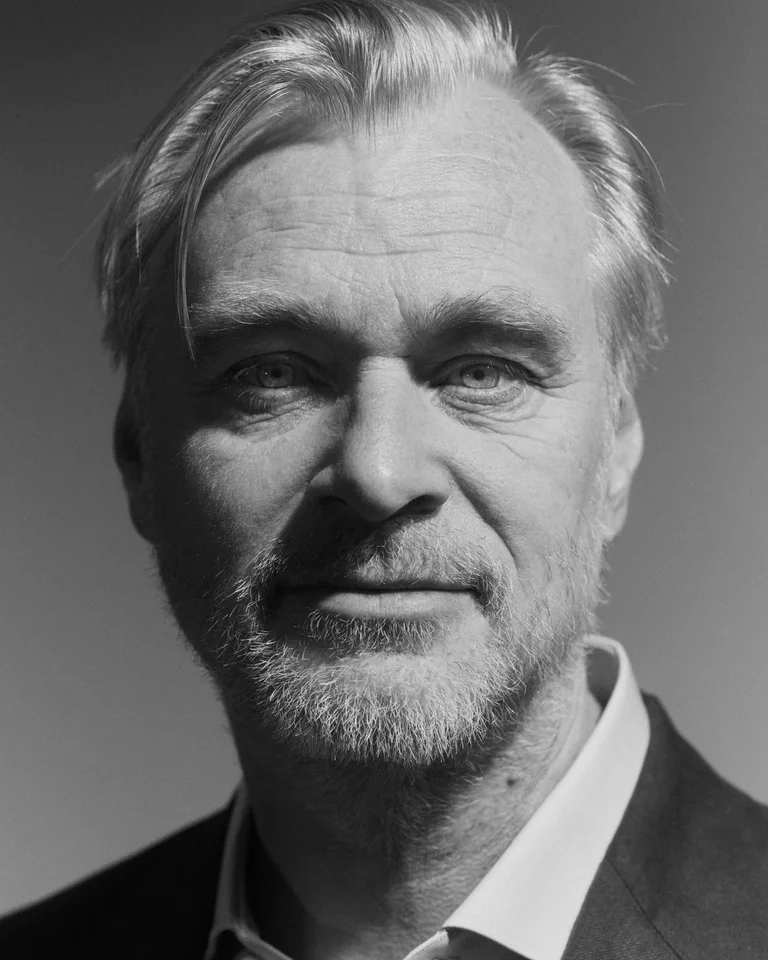
“I’m in that moment of pure terror,” says Christopher Nolan, sitting in a suite at London’s Corinthia Hotel, wearing a slightly rumpled suit, beside a teapot. Outside, crowds are jostling, hoping to catch a glimpse of one of the stars inside – Matt Damon, Tom Holland, Lupita Nyong’o. It is the day before the world premiere of Nolan’s latest film, an adaptation of Homer’s epic poem, The Odyssey, and the final day of waiting before the public decides whether the biggest gamble of Nolan’s career has paid off. The film, which reportedly cost $250 million, needs more than just audiences to turn up. It needs the entire cinema world to do so.
“It never gets easier, because I make films for audiences and audiences tell me what they like,” he says.
“They finish the film. I have nothing to hide behind. I can’t just say, ‘Oh, people don’t get it.’ Those aren’t the kind of films I make. What does the audience think of it? Do they come? Do they like it if they do? And, by the way, I don’t think I’d be doing my job properly if I weren’t terrified every time I put out a film, because you’re trying to challenge yourself, you’re trying to take risks.”
He doesn’t look terrified. He looks as calm and happy as I’ve seen him over the past 20 years. I’ve interviewed Nolan many times, and he is famously careful in interviews, though always polite, having perfected the art of talking about his films while revealing almost nothing about himself – “the most accessible and at the same time most withdrawn director in America,” as he once described himself to me. Interviewing him can sometimes feel like trying to extract information from John le Carré’s master spy, George Smiley.
But whatever the reason – the seven Oscars for Oppenheimer, the happy exhaustion after finishing The Odyssey, filmed over six months in as many locations – something seems to have softened in Nolan. Perhaps it’s his new dog, a chocolate-colored Labrador named Charlie, whom Nolan and his wife, Emma Thomas, got after the youngest of their four children left home.
“They’re all around the world now,” he says.
“We have a dog, and then I decided to make The Odyssey, because it’s the ultimate dog movie. I never had a dog as a child, and we didn’t get a dog when the children were younger because we traveled so much. They’re a little annoyed that we got one as soon as they left home, although they love the dog very much. And then, when it comes to The Odyssey, I’m not joking, but he really is a very important part of that story.”
When Odysseus finally returns to Ithaca after 20 years, he is immediately recognized by his old hunting dog, Argos, who appears as a puppy in Nolan’s trailer.
“A little taste of young Argos was a fun thing to have, and I was glad they did that.”
Conceived in the wake of the success of Oppenheimer, approved by Universal’s Donna Langley and sealed in the moment Nolan was handed the directing Oscar with a hug from Steven Spielberg – “I sort of collapsed into his arms like a runner crossing the finish line,” Nolan says – the film is, in every sense, the child of Oppenheimer.
“I thought: okay, now I have an opportunity to make a film that I otherwise wouldn’t be able to make,” says Nolan.
Thomas, his wife and producing partner, whom I speak to later, puts it even more clearly.
“I don’t think there’s any world in which we could have gone to a studio and said, ‘We want to adapt a 2,700-year-old poem,’ and that would automatically have been considered a big film. We were looking for a big budget to make it. That wouldn’t have happened without Oppenheimer”.
Nine months on the awards campaign meant Nolan couldn’t start writing until April 2024, but the delay only sharpened the long-term thinking about structure, which he had begun as soon as he chose the poem he hadn’t read since elementary school.
“I’ve spent many years in hotel rooms like this, talking about the nonlinear structures of my films as if they were so radical, and then you go back to the oldest foundational text in literature and it has an absolutely radical structure. There are stories within stories, flashbacks within flashbacks. And that was immediately exciting.”
It wasn’t the first time he had taken on Homer. In the early 2000s, after the success of Memento, Nolan was briefly involved in the screenplay project David Benioff was developing for Troy, based on the Iliad, which was later directed by Wolfgang Petersen.
“So, I’d spent a lot of time thinking: how do you present this to an audience that already knows the belly of that horse is full of Greeks?” he says. “How do you make that believable?”
The image that came to mind – the seed of his later screenplay for The Odyssey – was of an abandoned monument on the shore, slowly sinking into the sand.
“It was a desperate attempt, what in America we call a ‘Hail Mary’, an absolutely desperate act that shouldn’t work. That was the first image I had. I carried it with me for 20 years. I’ve always wanted to make it.”
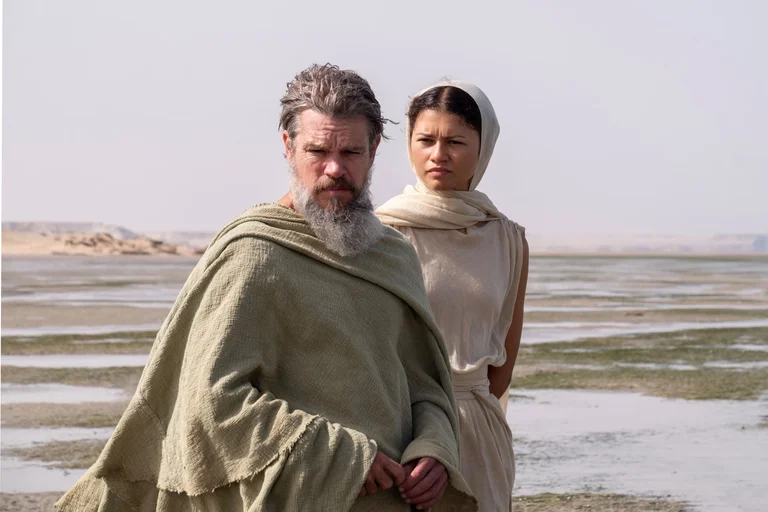
Almost everyone describes it as the toughest shoot of their career – like making seven ambitious films in one, says Thomas. The cast and crew crossed deserts, mountains, seas and Arctic landscapes, often reaching locations only by helicopter or after long hikes.
Cinematographer Hoyte Van Hoytema’s team had to transport 136-kilogram IMAX cameras, weighing as much as a small refrigerator, across terrain where getting people to the set was a challenge in itself.
“At the end of every day, the department heads would have dinner and then we’d collapse, exhausted, into a screening room to watch the footage shot that day,” says Thomas.
“Whenever we got through a challenge, we’d think: ‘Oh my God, we did it.’ And then we’d think: ‘Oh no, next week we have a completely different thing to deal with.’ It was just an unrelenting succession of challenges coming our way.”
Of course, Nolan and hardship are old friends. His tendency to shoot in real locations instead of studios, use “in-camera” effects instead of computer-generated ones and shoot on IMAX – the immersive format that can only be recorded in three-minute intervals and requires a large blimp to muffle the camera noise – makes the rough seas that battered the shoot of Dunkirk seem like slightly bad weather.
Is the difficulty itself the point?
“Not at all,” says Nolan.
“The more we talk about it, the more it sounds like some kind of Herzog-style Herculean ordeal, but that’s not my nature at all. Really, it’s all about The Odyssey. You need things you haven’t seen before. I get bored in studios and on constructed sets, not because I want things to be difficult. It’s because nature and the real world give you a scale, a range of possibilities and a spontaneity that you can’t achieve in a studio. But, yes, it was physically exhausting, and there were times when I felt that maybe I’d taken on more than I could handle.”
If he has ever doubted himself, it hasn’t been on set. It’s been the night before.
“I sleep well because I get so tired,” he says. “But Sundays gave me the chance to read the script again and look at the schedule for the coming week.”
“Then I’d think: ‘Oh damn, how am I going to get through this whole week?’ And that often kept me awake all Sunday night, unable to sleep. So I’d go to the set on Monday exhausted, but I was prepared. I had a way through it.”
One location in particular was a constant source of worry: the ruins of Castello di Santa Caterina, perched above the cliffs of the Sicilian island of Favignana, which he and production designer Ruth De Jong had chosen as Odysseus’s home in Ithaca.
To get there, they had to make a 45-minute hike every day along a steep, rocky path with switchbacks.
“That weighed heavily on me, knowing we’d be in that situation, but we got tremendous energy from the cast and crew. You had Tom Holland going up that path like a gazelle, making me feel very old and very tired, but he was an example to everyone. He was completely committed.”
On the very last day, after filming wrapped at Universal Studios in Los Angeles at around one in the morning, Thomas opened a few bottles of champagne, as she and Nolan usually do.
“For this film, I think it was the first time we’d done that, and it really felt like nobody wanted to leave,” says Thomas. “It was as if we’d bonded through the trauma we’d been through together. You wanted to keep going, to jump out of the plane again.”
Before its release, The Odyssey has generated the usual amount of culture-war noise, as some parts of the manosphere became fixated on Lupita Nyong’o’s casting as Helen and Elliot Page’s as Sinon.
Homer’s epic poem, considered a tale about men’s bravery – “Tell me, Muse, of the man,” are the words with which it begins – has recently been embraced as a kind of fortress by cultural conservatives seeking to resist what they call the “woke” assault.
“Homer is in fashion, gender studies are out of fashion,” one activist recently wrote.
So there is a certain irony in the fact that, in my view, Nolan has written the strongest ensemble of female characters of his entire career.
In his film, Helen, Penelope, Circe, Athena and Calypso are not merely prizes, temptations or divine interventions, but fully realized figures, portrayed with extraordinary power.
“In the original text, they are icons,” says Nolan.
“The problem is that there isn’t much to them beyond these ideals, whatever form they take. What I like about the way the women in this film have played these roles is that they give you a sense of the person hidden behind the icon. When you see Lupita as Helen, you suddenly get an idea of what it would really be like to be the cause of this great war and siege – what that would mean and what it would do to a person. Then Anne [Hathaway] as Penelope – very strong, very nuanced.”
He says that this depth is created in collaboration with the actors and isn’t simply imposed by the screenplay.
“I’ve been on enough sets to recognize that awful moment when, as a screenwriter and director, you’re asked a question you don’t have an answer to. And you have to have an answer. There can be a deliberate ambiguity – the way Anne played Penelope, I almost didn’t want to know what was going on in her mind – but yes, you always have to be ready.”
If history is any guide, this is exactly the time when Nolan begins to feel the first tug toward his next project.
“The first signs are probably about a week after there’s nothing to do; he starts getting really restless,” says Thomas. “That’s when he starts seriously focusing on the thought: ‘Okay, I have to do something.’”
Ultimately, it was precisely this restlessness that took him all the way to Ithaca.
But The Odyssey is unlikely to let him go anytime soon. The film faces a series of premieres around the world – from Mumbai to London – followed by what is sure to be a relentless awards campaign, in every category, until next spring.
“I’m so eager to have a period when I have nothing to do,” he says.
“It feels like it’s been a long time since I’ve had a period like that. It’s true – I get bored very quickly, and that’s one of the reasons I like getting back to work. I get restless.”
He pauses for a moment.
“But for now, all I can see ahead is just trying to get the film out, release it and then take a little break.” (The Guardian)








