
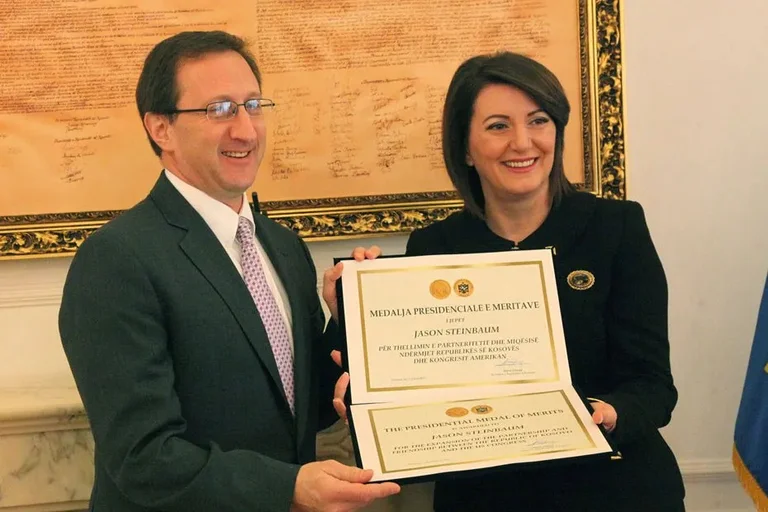
Editorial by Jason Steinbaun, who is an Associate Professor of Government at American University in Washington, D.C. For more than 30 years, he served in the U.S. Congress, as Staff Director of the House Foreign Affairs Committee and as Washington Chief of Staff for former Congressman Eliot L. Engel
The Kosovo Specialist Chambers, also known as the “Special Court,” were created for the wrong reason, in the wrong way, under the wrong law and with the wrong mandate.
That, in a nutshell, is why the Court has failed.
Before the Court was established, the United States government consistently downplayed allegations against the Kosovo Liberation Army (KLA), the insurgent group that fought for Kosovo’s independence during the 1998–1999 war. U.S. officials generally acknowledged that no army is perfect, especially in the fog of war, but maintained that the KLA had, on the whole, behaved reasonably. Some of the most serious allegations — including claims that the KLA was involved in terrorism or drug trafficking — had already been publicly dismissed in a CIA report, prepared in response to an amendment by Congressman Eliot L. Engel, a strong supporter of Kosovo who later became Chairman of the House Foreign Affairs Committee.
A few years later, a new wave of allegations emerged from Swiss parliamentarian Dick Marty. Marty claimed that the KLA had been involved in organ trafficking, primarily in Albania. Doubts grew increasingly acute because Marty offered very little evidence to support his claims. Nevertheless, in January 2011, the Council of Europe adopted Marty’s report almost word for word, lending the call for an investigation the imprimatur of a major European institution.
For several years, the State Department gave Marty’s claims little, if any, credence, even after the Council of Europe resolution. Then, almost overnight, the United States changed its position. American diplomats went from dismissing Marty’s report to insisting, in 2015, that an international court was needed to investigate his allegations. Kosovo, they argued, would benefit by supporting a legal process that would place the new state clearly on the side of justice and accountability.
But the hammer was waiting just behind the door. If Kosovo did not establish the Court, American diplomats warned, it would be created by the UN Security Council, although, of course, that could not happen if the United States used its veto. More importantly, Kosovo was told it had to act without delay because the United States, its strongest and most steadfast ally, was asking — or rather, demanding — that it do so.
Of course, a superpower like the United States has many global interests, and sometimes those interests clash with one another. While Marty’s allegations were simmering in Europe and largely being ignored in Washington, the Obama Administration was pursuing its top international priority: a nuclear deal with Iran. Almost every other foreign policy objective took a back seat to those negotiations, and preserving the international coalition supporting them was essential. That group, known as the P5+1, included the five permanent members of the UN Security Council, as well as Germany.
As a member of the P5+1, Russia had considerable influence over the United States, given the importance President Obama attached to maintaining the Iran coalition. If Russia or another partner requested a diplomatic move, it received serious consideration. This is where the Specialist Chambers enter the picture.
There is no public document showing that Russia, or any European country, threatened to leave the P5+1 over Marty’s report. Nevertheless, many believe that Russia, and perhaps certain European interests, asked the United States — Kosovo’s principal partner — to pressure the new state to establish a court that would investigate and prosecute the allegations.
From President Obama’s perspective, a Kosovo court with international judges and supposedly committed to the highest legal standards was likely appealing because of his legal background and sense of justice. To him, this was an easy concession. The instruction came down to the U.S. Embassy in Pristina and throughout the State Department: Kosovo had to get this done.
So why did the United States call for the creation of the Specialist Chambers? Not primarily to advance justice or accountability for organ trafficking or other KLA crimes, but to serve the wholly unrelated goal of securing the nuclear deal with Iran.
Suddenly, American diplomats in Pristina received new instructions: pressure the Kosovo government to establish the Court and accept no as an answer. Visiting officials were told that Kosovo had to act or face a series of serious consequences. I experienced this firsthand during a visit with Congressman Engel, for whom I worked for 27 years. Ambassador Tracey Jacobson surprised us not only with the sharp change in U.S. policy, but also with the urgency the U.S. government attached to establishing the Court. She strongly pressured Congressman Engel to urge the Kosovo government to pass the necessary law.
Reluctantly, and without knowing the reasons for the policy change, Congressman Engel conveyed to Hashim Thaçi that the United States very much wanted Kosovo to establish the Court. Engel added that, for Kosovo to move forward and succeed — meaning to retain U.S. support — it seemed necessary and important for the Court to be created. Like others, we came to regret the position we took and the sad, pointless mess the Court has become.
But the Court was not only created for the wrong reason. It was also created in the wrong way, on the basis of a deeply flawed law.
American demands were not expressed only through diplomatic pressure. American legal experts also played a major role in drafting the constitutional and legal provisions needed to establish the Court. The result was a body made part of Kosovo’s judicial system, but in name only. No Kosovar judge sits on this Kosovo court, and the Court itself is not located in Kosovo, but in The Hague. Under the laws the United States pressed Kosovo’s Assembly to adopt, the Kosovo government was stripped of every meaningful authority over its own Kosovo court. This framework left Kosovo with no real ownership of what is formally its own Court. The people of Kosovo have almost no connection to this judicial body created under pressure, leaving it with little, if any, popular legitimacy. After the people of Kosovo have been told for years that they are sovereign, taking such important proceedings out of their hands only undermines that message.
Then there is the mandate.
It is an unquestionable principle that anyone who commits war crimes should be prosecuted and tried. Period. This applies to Serbs, Kosovars and everyone else.
But this Court’s mandate is deeply problematic. According to Human Rights Watch, “the vast majority of war crimes in Kosovo were committed by Serbian and Yugoslav forces, for which no one has been held accountable, including the organized transfer of hundreds of bodies to Serbia, where they were dumped in mass graves.” Human Rights Watch further reported that “rape was used as an instrument of war in Kosovo and must be punished as such. The men who committed these terrible crimes should be brought to justice.”
Given the grave crimes committed against Kosovo Albanians, creating a court to try and punish their wartime leaders seemed perverse. Indeed, the Kosovo Specialist Chambers may be unique: a court established to prosecute the victims and victors of a war, rather than its principal perpetrators and defeated aggressors. Kosovo Albanians feel this contradiction directly. Some have told me they believe the United States turned its back on them for reasons they still cannot understand.
They see former leaders languishing in prison for years without being convicted. Among the defendants are Hashim Thaçi, a former president and prime minister, and Kadri Veseli, a former Speaker of the Assembly. These are prominent individuals who voluntarily surrendered when they were indicted. They pose no flight risk and remain innocent until proven guilty. The fundamental principles of international law support their release while investigations and trials continue. If witnesses need to be protected, there are ways to do so without imprisoning people who have not been convicted of any crime.
The Court’s mandate becomes even more puzzling when measured against its original purpose. It was created to investigate the allegations in Marty’s report, which focused primarily on organ trafficking. Yet the indictments do not mention organ trafficking at all. Instead, they focus on leadership responsibility for retaliatory attacks carried out by low-level actors. In other words, the main reason the Court was created no longer guides the judicial process.
It is long past time for justice to be delivered to the victims of the war in Kosovo. Hundreds of thousands of people were driven from their homes. Many thousands were killed. Thousands more were raped. Justice will come when the perpetrators of these crimes are held accountable.
We know that the vast majority of these crimes were committed by Serbian security forces. They are the ones who should be primarily in the dock.
Does this mean that Kosovars who committed crimes should escape accountability? No. But if Kosovars are the only ones held accountable, then something is seriously wrong with the system. Until this imbalance is corrected, the Kosovo Specialist Chambers will bring little peace, little trust between communities and little long-term reconciliation in Kosovo or the wider region.








