
The show of force Russia unleashed on Ukraine early Tuesday, with hundreds of drones and missiles, cannot hide the increasingly visible signs of Moscow’s weakness in the four-year war.
Russia’s advance along the front line in Ukraine has slowed almost to a halt. It has intensified forced mobilization in occupied eastern Ukraine, after recruitment efforts inside Russia failed to produce the desired results. Domestic discontent is growing. Europe is offering new support to Ukraine. Meanwhile, U.S.-mediated peace talks have almost come to an end.
Analysts say all of this shows that Russia is losing momentum.
“Ukraine’s position is much, much stronger now than it was just a year ago,” said Franz-Stefan Gady, a Vienna-based military analyst, in an interview on Tuesday.
Some analysts believe Russia’s recent intensified attacks are an attempt to regain an advantage in possible peace talks and draw the attention of the Trump administration back to Ukraine, after it has focused more on the war with Iran.
However, according to Jack Watling, a senior research fellow at the Royal United Services Institute in London, Ukraine’s gains on the battlefield have changed the course of the war. Although Russian airstrikes may continue “for a long period,” he said Russia’s combat performance is weakening. This has created “growing optimism that Ukraine can force Russia toward a ceasefire.”
This marks a major shift from last summer, when Russian President Vladimir Putin was so confident of victory that he traveled to Alaska to meet Donald Trump and discuss ending the war. Today, it is Ukrainian President Volodymyr Zelensky who is seeking a swift end to hostilities.
In Moscow, Kremlin spokesperson Dmitry Peskov said Tuesday that the war could end immediately if Ukraine withdrew from the Donbas region, where Russia claims territory.
“We remain open to peace negotiations,” Peskov said, while acknowledging that talks are at an impasse.
Gady said Russia is unlikely to gain full control of the Donbas by the end of 2026, as it had planned before returning to ceasefire negotiations. However, he warned that mass air attacks like Tuesday’s show that Russian air power remains significant and that Ukraine “will certainly face more such attacks.”
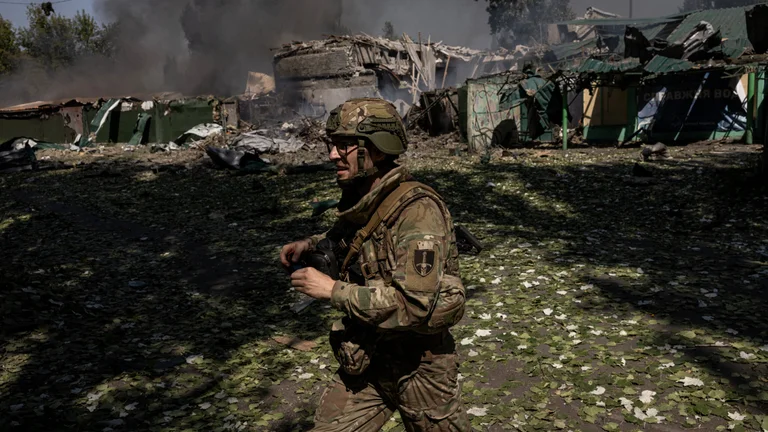
Meanwhile, Ukraine is holding the front line on the ground.
Analysts at DeepState UA, a Ukrainian open-source intelligence platform, reported this week that the Russian army appears to have lost more territory in May than it gained. It was the first month with such losses since Ukraine’s 2023 counteroffensive. This came despite a 37.5 percent increase in the number of Russian attacks. According to the analysts, Russian forces have in some cases been so weakened that attacks are carried out by just one or two soldiers.
“The war is entering a new phase, and it is important for the Ukrainian state not to lose the initiative,” DeepState’s analysts concluded.
Ukraine’s position on the battlefield is also being bolstered by new European military aid, including a weapons package worth around $149 million from Finland and 16 Gripen fighter jets from Sweden, announced last week.
Recent assessments by Western officials suggest that Russia is suffering heavy human losses. Last week, MI5 chief Anne Keast-Butler said that almost 500,000 Russian soldiers had been killed since the war began in February 2022.
“As we continue to support Ukraine, Putin is going backwards on the battlefield,” she said in a speech in London.
In May, U.S. Secretary of State Marco Rubio said Russia was losing between 15,000 and 20,000 soldiers every month.
“Not wounded — dead,” Rubio said on Fox News. “It’s a terrible war.”
For this reason, Moscow is trying to secure more soldiers from eastern Ukraine.
Students in the occupied regions of Luhansk and Donetsk have had their mobilization deferments revoked, while Russian occupation authorities have used mandatory registration, raids, and threats of legal penalties to force Ukrainians to serve in the Russian army.
According to Maksym Beznosiuk of the Jamestown Foundation, the Kremlin’s strategy in the occupied territories aims to fill the gaps created by catastrophic military losses and alter the demographic balance by driving out some of the Ukrainian residents.
On Tuesday morning, Zelensky called the latest attack “a large-scale attack and a completely clear statement from Russia: if Ukraine is not protected from ballistic missiles and other attacks, these attacks will continue.”
Former Russian diplomat Nikolai Sokov warned that the war could spread to Europe if allies continue supplying Ukraine with weapons. He said Russia’s ability to prolong the war should not be underestimated.
“What I don’t see in European policy is an understanding that, rather than accept defeat, Moscow may choose escalation. That is what worries me,” Sokov said.
In his interview with Fox News, Rubio acknowledged that U.S. efforts to negotiate a peace deal in Ukraine “have lost momentum in recent months for various reasons.”
“We hope that soon we will reach a point where both sides engage again,” he said. “We are willing to play the role of mediator and bring this process to a conclusion.”
Rubio added that Russia may have felt “a little more optimistic” recently, as gains from rising oil prices, linked to the closure of the Strait of Hormuz, have given the Kremlin economic support to continue the war.
However, he stressed that “the Ukrainians are feeling increasingly confident about their position on the battlefield.”








