
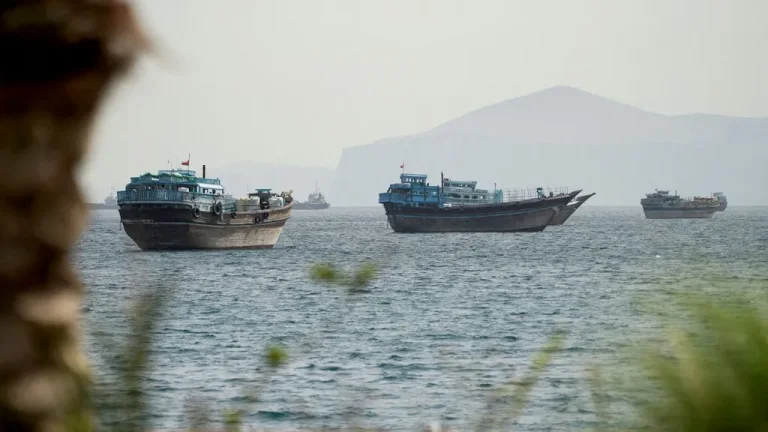
The United States said it struck Iranian military facilities over the weekend, while Tehran said it had responded by targeting a US base, marking the third escalation in a week around the Strait of Hormuz.
US Central Command (Centcom) said it had carried out “self-defence strikes” in response to “Iranian aggressive actions”, which included the downing of a US drone over international waters.
Iran’s Islamic Revolutionary Guard Corps (IRGC) said it had targeted an air base used by US forces for an attack on Iran.
Centcom said two Iranian ballistic missiles targeting US forces in Kuwait were intercepted and that “no US personnel were injured”, the BBC reports.
Earlier, Kuwait said its forces had dealt with “hostile missiles and drones”.
US President Donald Trump urged his critics to “sit back and relax” in a post on Truth Social early Monday, saying everything “will work out well in the end”. He said Iran “really wants to make a deal and it will be a good one for the US”.
The attacks mark the latest exchange between the two sides after negotiations failed to make progress over the weekend on a deal aimed at ending the months-long conflict, with US media reporting that Trump had sought changes to its terms.
The changes concern the Strait of Hormuz shipping corridor and the removal of enriched uranium from Iran, CBS News reported. The White House did not respond to a request for comment.
On Monday, a spokesperson for Iran’s Foreign Ministry said the US was “constantly changing its positions and putting forward new or contradictory demands”, which, he said, would “naturally prolong the negotiations”.
Iran’s chief negotiator said on Sunday that Tehran would not accept any deal unless Iranian rights were fully secured.
The US military said it carried out “self-defence strikes against Iranian radars and drone command-and-control centres” on Saturday and Sunday in the city of Goruk, near Iran’s southern coast, and on Qeshm Island in the Strait of Hormuz.
In a post on X, Centcom said US fighter jets struck Iranian air defences, a ground control station and two drones that, it said, “posed a clear threat to ships transiting regional waters”. “There were no US casualties,” it added.
Iran’s Foreign Ministry spokesperson said the attacks violated the ceasefire.
The IRGC said it had targeted the base that, according to it, the US had used to strike a communications tower on Sirik Island in the Persian Gulf, about 40 miles (65 km) off Iran’s southern coast.
The Iranian military added that its response would be “completely different” if US aggression were repeated, according to IRGC statements reported by the semi-official Fars news agency.
Kuwait’s military said early Monday that it was “confronting hostile missile and drone attacks”, while state news agency KUNA reported that warning sirens had sounded across the country.
Kuwait’s Foreign Ministry subsequently condemned “in the strongest terms… the repeated and despicable Iranian attacks, which constitute a dangerous escalation and a direct attack” on Kuwait.
It said the attacks “undermine” efforts to de-escalate tensions in the region and that the country reserves the right to “take all necessary measures” for its defence.
Tehran targeted an air base in Kuwait last week in response to earlier US air strikes, which, according to Tehran, had been carried out to prevent Iranian vessels from laying mines in the shipping corridor.
Although a ceasefire took effect on 8 April, Trump has repeatedly suggested that the US and Iran are close to a final deal, but no formal agreement has yet been reached.
Trump and his senior advisers met on Friday to make a “final decision” on a framework for extending the ceasefire, but the meeting ended without clarity on the next steps.
The latest terms include a 60-day halt to the fighting and the reopening of the Strait of Hormuz, according to CBS News – the shipping route through which about one-fifth of the world’s oil and liquefied natural gas passes, and whose closure has driven up global oil prices.
They also include a framework for resuming negotiations on Iran’s nuclear programme, which Tehran has always described as peaceful, but Iranian spokesperson Esmail Baghaei said this had not been on the table.
“There have been no negotiations on the details of the nuclear issue. At this stage, our priority is to end the war,” he said.
He added that ending the conflict in Lebanon remains a “fundamental condition” for any deal and that the US and Iran have not yet reached a “final conclusion”.
Iranian Foreign Minister Abbas Araghchi said on X that the ceasefire between Iran and the US applies on all fronts, including Lebanon, and that the US and Israel bear responsibility for the consequences of any violation.
Lebanon was drawn into the conflict on 2 March, when the Iran-backed Hezbollah group launched rockets towards Israel, following an Israeli attack that killed senior Iranian leader Ali Khamenei; Israel subsequently launched an air campaign and a ground invasion in Lebanon.








