
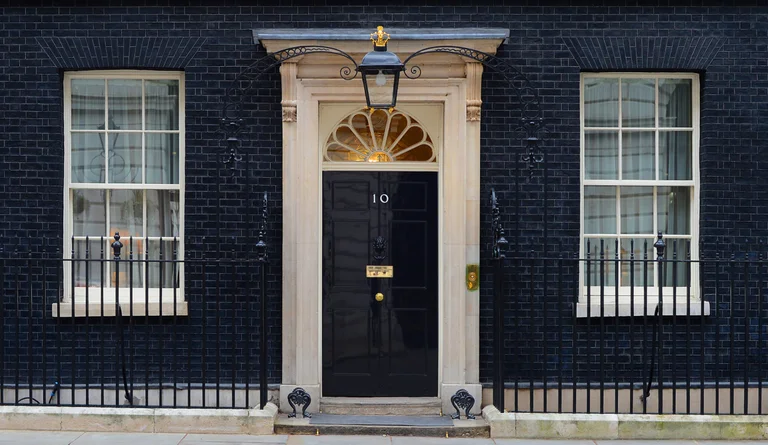
Perhaps Larry the Cat should simply be the keeper of the keys to Number 10 Downing Street.
Since the British voted for Brexit — ten years ago — prime ministers have come and gone at a bewildering pace. For most of that time, the keys passed from one Conservative to another, then another, and another, until they finally ended up with the Labour Party in 2024.
Yet one resident has always remained.
Larry, Downing Street’s chief mouser, has lived at Number 10 since 2011. He has outlasted six prime ministers, countless advisers, several political scandals and a national act of reinvention.
“If this carries on,” read a Monday post from Larry’s famously cheeky social media account, “I’ll stop trying to learn their names.”
Looking back over the past decade, it’s hard not to wonder whether the cat has been the most stabilising presence in British politics. Here are Britain’s prime ministers since 2016, how they fared and how they fell.
KEIR STARMER
July 2024 – until sometime soon
Keir Starmer came to power with a landslide Labour victory, promising change and an end to Conservative chaos.
A former senior prosecutor, Starmer was methodical, cautious and exceptionally disciplined. His achievement was transforming Labour from a party reeling after its 2019 defeat and tainted by allegations of antisemitism against its former leader, Jeremy Corbyn, into a convincing winner in 2024.
But his victory also contained a warning. Although Labour won convincingly, it did so with only a little more than a third of the popular vote. Since taking office, Starmer has faced criticism over policy U-turns, a sluggish economy and the rise of Nigel Farage’s populist Reform UK party.
He announced his resignation on Monday morning. Another name for Larry to forget soon.
RISHI SUNAK
October 2022 – July 2024
Rishi Sunak presented himself as the grown-up who could clean up the mess. A former financier and former Chancellor of the Exchequer, he was a technocrat, cautious and relentlessly focused on restoring economic credibility after the chaos of Liz Truss’s brief tenure.
Markets calmed, and the government once again appeared to be functioning.
But he failed to turn the ship around. The British public was tired of 14 years of often chaotic Conservative rule and, although Sunak may have stabilised the situation, he failed to persuade people to stay on board.
LIZ TRUSS
September 2022 – October 2022
Truss lasted in office just 49 days.
She arrived at Downing Street promising radical economic change. Markets hated her plan. The government’s unfunded tax-cutting agenda sparked turmoil in financial markets. The pound fell and market confidence evaporated.
Her premiership ended so quickly that a British tabloid set up a live stream comparing her political survival with the lifespan of a lettuce. The lettuce won.
BORIS JOHNSON
July 2019 – September 2022
Boris Johnson, one of the best-known faces of the Brexit campaign, came to power promising to end the deadlock over leaving the European Union that had wrecked Theresa May’s premiership.
He turned that promise into a three-word slogan: “Get Brexit Done” and won a landslide victory in the 2019 election.
Charismatic, careless and known for his exaggerations, Johnson forged a connection with voters who don’t usually pay much attention to politics. Johnson himself would no doubt argue that his greatest achievements were finally delivering Britain’s departure from the European Union and managing the country’s initial response to Russia’s full-scale invasion of Ukraine.
Critics, meanwhile, would note that his leadership during the COVID-19 pandemic was accompanied by a string of scandals.
The most damaging of these was “Partygate”, the revelation that parties had been held inside government during lockdowns.
Johnson was a politician who had survived scandal after scandal, but eventually his luck ran out.
THERESA MAY
July 2016 – July 2019
Theresa May inherited a country that had voted for Brexit but had no clear idea how it would break away from the European Union or how regained sovereignty would work in practice.
A diligent and disciplined politician, she became known for the phrase “Brexit means Brexit”, no matter how difficult or contradictory the objectives seemed.
The problem was that nobody agreed on what Brexit actually meant.
Caught between hard-line Brexit supporters and pro-European lawmakers who feared serious economic damage, May spent years trying to find an impossible compromise.
After calling an early election in 2017 and losing her parliamentary majority, her authority began to steadily wane.
She discovered that Brexit was impossible to implement in a way that would satisfy everyone.
DAVID CAMERON
May 2010 – July 2016
David Cameron was brought down by a crisis he had created himself.
The smooth-talking Conservative called the Brexit referendum as a way to end the infighting in his party.
He believed he would win.
Instead, he discovered that anti-establishment anger, distrust of elites and nationalism were far stronger than he had predicted.
A personable and likeable politician, Cameron would have preferred to be remembered for modernising his party through reforms such as legalising same-sex marriage.
History, however, will forever remember him as the man who rolled the dice on Brexit and lost.
He resigned the morning after the referendum, after the British voted 52 per cent to 48 per cent to leave the European Union.
As Cameron walked away from the lectern outside Downing Street, an open microphone caught him whistling a short tune.
Britain had just voted for Brexit, markets were in turmoil and his term was over, but he seemed calm — or perhaps relieved. The speech was over.
Cameron later returned as Foreign Secretary in Sunak’s cabinet, from November 2023 to July 2024.
LARRY THE CAT
Larry arrived at Downing Street, the residence and official workplace of the British prime minister, in 2011, after a black mouse was spotted running past the building during a live BBC broadcast.
Officially, Larry holds the title “Chief Mouser to the Cabinet Office”.
Unofficially, he has become the closest thing Britain has to a permanent resident at Number 10.
Larry has outlasted Brexit, Partygate, a pandemic, six prime ministers and a lettuce.
He once even chased away a fox.
Few political CVs can compete with that.
At this point, perhaps the keys to Downing Street should be hung around his neck.








