
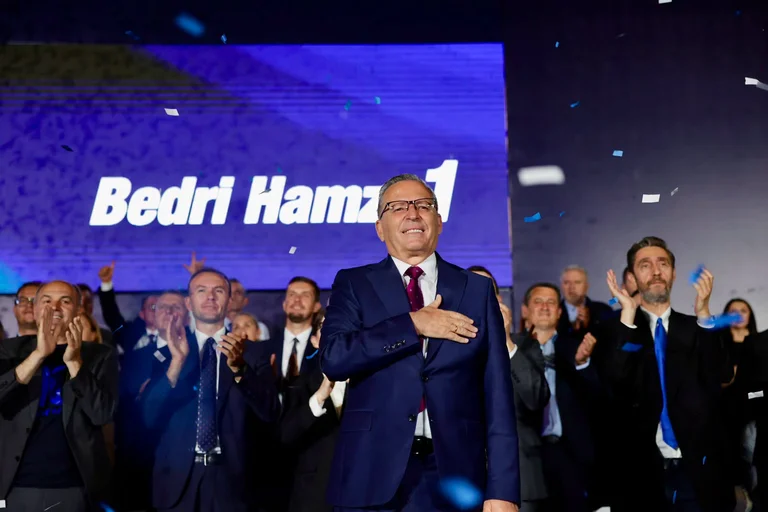
It has been 19 days since the President of the Democratic Party of Kosovo, Bedri Hamza, said even a single word. There has been no reaction on social media. No statement to the media. Total paralysis.
Along with losing the election and around 35,000 votes compared with the previous election, Hamza has also lost his voice.
This is the state in which the Democratic Party of Kosovo finds itself today: a loss of the ability to articulate political opinions, even on the country’s most important issues.
The same goes for the party’s central figures, such as its number two, Vice President Uran Ismaili. It also applies to the PDK’s own social media accounts. The party’s latest Facebook post was on June 19—8 days ago—announcing a meeting between Hamza and the German ambassador to Kosovo, Rainer Rudolph.
And if you search for the latest news story produced by the PDK in the media, you will find “PDK MP candidate Qëndrim Kryeziu complains to the ECAP/Supreme Court,” where he “claims that his votes were stolen.”
The last time Bedri Hamza addressed the citizens of Kosovo was on June 8. The day after the parliamentary elections, in which the PDK came second with just over 19 percent and 22 parliamentary seats.
Around midday, Hamza appeared at a press conference with an unusual calm.
The PDK received tens of thousands fewer votes than in the December elections. One of the weakest results in its history, despite being perhaps the party with the most loyal electorate.
It is true that the PDK managed to retain its 22 MPs. But this was due to low voter turnout.
The PDK also performed poorly in its strongholds, such as Drenas and Skenderaj, where the number of votes was nowhere near what it had been in previous elections.
It did even worse in Mitrovica, Bedri Hamza’s birthplace and the municipality he led for 4 years (2021-2025). There, Vetëvendosje received a higher percentage than in any other municipality: a full 62.92 percent. The PDK was left with 24.77 percent.
“The result we achieved is in no way in line with our expectations,” Hamza said on June 8, indicating that he might step down as party president to open up the contest for the party’s top position.
Unclear about what he stands for, a figure who avoids confrontation, stays silent when he should speak and, when he does speak, says nothing extraordinary, Bedri Hamza has turned the PDK into an undesirable mirror in which to see itself.
And, worst of all, no one in the PDK challenges his leadership. Nor could it be otherwise, since his own rise to the top of the PDK came about through a consensus that is unusual for a political party: the previous president stepped aside to make way exclusively for one person, in this case Bedri Hamza, and there were no challengers in the so-called contest.
Since the PDK’s historic leader, Hashim Thaçi, and its President, Kadri Veseli, were arrested (November 5, 2020) by the Special Court in The Hague on charges of alleged war crimes—a process that has yet to reach a conclusion—the party has been in an identity crisis and has never managed to create a serious platform to become a governing alternative and challenge Albin Kurti’s extremely strong regime.
In an attempt to avoid internal clashes, the PDK has chosen all its presidents since the arrests of Thaçi and Veseli by consensus, without a contest. First Enver Hoxhaj as acting president, then Memli Krasniqi, and most recently Bedri Hamza.
Most likely, the PDK will remain in this paralysis for some time. Whether or not things will change depends—above all—on The Hague, which is expected to deliver its verdict on Thaçi and Veseli very soon—by July 20, unless more time is requested.








