
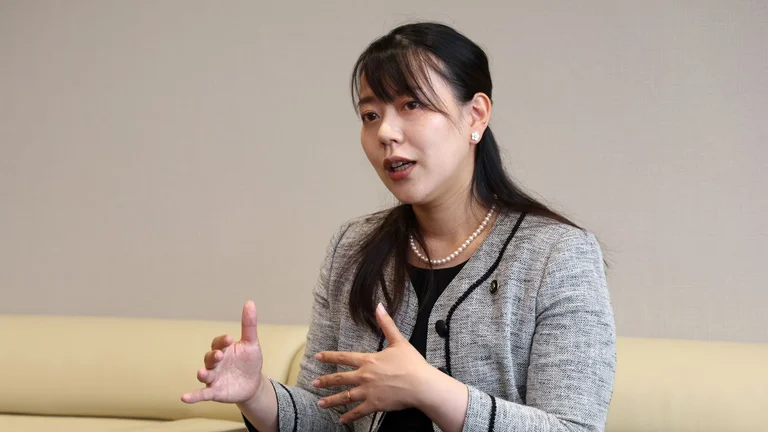
Japan’s youngest elected municipal mayor is making history again – this time by taking time off work to become a mother for the first time.
Shoko Kawata, the 35-year-old mayor of Yawata in Kyoto Prefecture, has announced that she will take maternity leave before and after the birth of her child, putting her at the center of a national debate and highlighting gaps in Japan’s traditionally patriarchal workplace and political systems.
Kawata, elected in 2023, is expected to give birth in mid-September and will take 16 weeks off – eight weeks before and eight weeks after the birth. This is believed to be the first case of a sitting mayor in Japan taking maternity leave.
While maternity leave is guaranteed for public employees, there is no legal framework guaranteeing it for elected officials.
Kawata said she hopes her case will serve as a “catalyst for changing the system” at a time when Japan is facing a rapid decline in birth rates and persistent gender inequality in political leadership. The country elected its first female prime minister only last year, while women make up less than 15 percent of the House of Representatives.
“Through this case, I hope to encourage not only employees, but also business owners, managers and everyone involved in the world of work to accept childbirth and raising children as normal parts of life, while maintaining a proper balance with work,” Kawata told CNN.
She plans to appoint a deputy to run the city of around 70,000 residents during her absence. However, she has said she will continue to check her emails regularly even while caring for her baby.
Following her announcement, criticism appeared on Japanese social media, with some arguing that a public official’s absence from work amounts to a waste of taxpayers’ money. But Kawata said the people she has spoken to in person have shown a great deal of understanding.
“In fact, people have told me to take the leave without hesitation. Administrative staff and residents have encouraged me to take time off,” she said.
Slow to change
According to Sawako Shirahase, a professor of sociology at the University of Tokyo, many Japanese attitudes toward governance are still based on outdated assumptions that do not fit the needs of modern women in the labor market.
“The legal framework itself does not provide for mayors or heads of public institutions to take maternity leave. But at the same time, no one can stop them from doing so. It is a gray area,” she said.
The professor hopes that future Japanese leaders will follow Kawata’s example in promoting a better work-life balance culture.
Meanwhile, researcher Stefanie Schwarte of Ludwig Maximilian University in Germany says that although Japan has been slow to move toward gender equality, more and more women are breaking traditional norms in politics.
Over the past five years, the number of female mayors has increased from around 50 to nearly 80, out of the more than 1,700 municipalities in the country.
“We are seeing more and more female mayors win second, third or even fourth terms. They are showing younger generations that anyone – man or woman – can serve their community and do the job well,” she said.
The debate over the Yawata mayor’s maternity leave comes at a time when Japan has been struggling with declining birth rates for decades.
In 2025, only 671,236 births to Japanese nationals were recorded in Japan – the lowest figure ever recorded and the tenth consecutive year of decline.
The government has taken numerous measures to encourage births, offering childbirth subsidies and housing assistance, and encouraging more fathers to take parental leave.
However, many experts attribute the decline in birth rates to a culture of overwork and the high cost of living. Many young people choose to focus on their careers instead of starting families.
In Japan, there is even the term “karoshi,” meaning “death from overwork,” used for cases where stress and long working hours cause fatal heart or brain problems.
Kawata says changes are happening slowly because Japanese workplaces and institutions have yet to adapt to the needs of women who want to become mothers.
According to World Bank data, around 56 percent of Japanese women are in the labor force, compared with 72 percent of men.
“If they want to have a child, they have to give up their career. If they want a career, they have to give up having a child,” Kawata said, arguing that women should not be forced to choose one or the other.
“We are gradually working to improve this situation, and I believe we are moving toward creating systems that ensure genuine gender equality.”








