
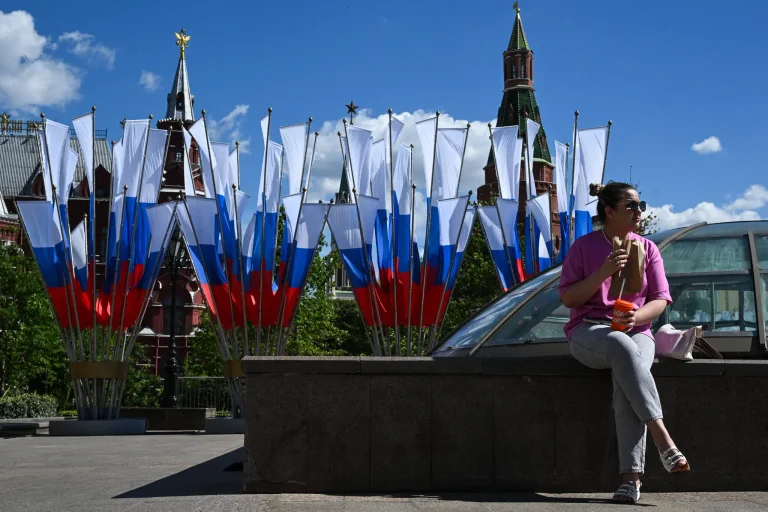
The war in Ukraine is called a “Special Military Operation”, even though it is the biggest conflict in Europe since World War II.
Across Russia, officials explain fuel shortages as being due to “unscheduled maintenance at refineries”, without mentioning the real cause, as Ukrainian drones strike fuel-processing facilities in the country, the New York Times writes.
Even the governor of the Central Bank of Russia has spoken of the “structural transformation of the economy”, an expression used as code for military spending, which has risen significantly and steered the Russian economy toward the military-industrial complex.
For years, President Vladimir Putin has tried to shield Russian society from the consequences of the war in Ukraine, using euphemisms as a psychological shield.
But as the war is increasingly being felt inside Russia itself, the gap between rhetoric and reality is becoming a source of discontent for ordinary citizens.
For several days, Putin did not mention at all the long-range drone attack on Moscow on June 18, when Ukraine used nearly 200 drones.
He also did not respond when Ukrainian officials promised to turn Crimea – the peninsula that Russia illegally annexed in 2014 – into an isolated island through drone and missile attacks.
When he appeared in public last Tuesday for the first time after the June 18 attacks, the largest of the entire war, Putin used the occasion to blame the West.
“These drones, these attacks on civilian infrastructure – what are they for? To destabilize society and create uncertainty about the actions of the Russian armed forces,” he said.
At the time, he said nothing about fuel shortages in at least 56 regions of Russia, according to Mediazona, an independent Russian media outlet.
On Sunday, however, Putin acknowledged that fuel shortages existed.
At a meeting with senior executives and government officials, he said that “systematic measures commensurate with the scale of the current challenges” needed to be taken, adding that a working group was working around the clock to ensure supplies, particularly for the agricultural sector.
However, Putin has not publicly delegated to officials the task of preparing shelters or early-warning systems for future attacks.
In the Moscow suburbs of Kotelniki and Lyubertsy, which were hit by drones in mid-June, authorities said they would not make shelter locations public and would not use air-raid sirens, because the country is technically not in a state of war.
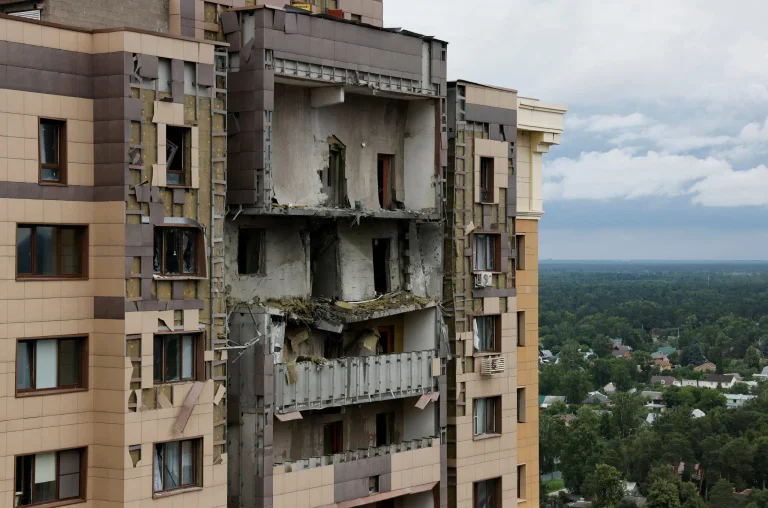
According to them, this information will be published only during a “mobilization period” or in wartime.
The administrator of Lyubertsy suggested that residents consult a PDF document published on a government website, which provided practical instructions for drone attack scenarios.
The head of the Republic of Bashkortostan, a region of four million people between the Volga River and the Ural Mountains, where Ukraine has attacked oil refineries, said his administration had decided not to activate the air-raid sirens every time so as not to cause stress among residents, also citing the increased use of antidepressants in Russia.
After a drone attack in the Yaroslavl region in late March, in which a child was killed and three adults were injured, a local newspaper reported that the Ministry of Regional Development had not activated the siren warning systems “to avoid panic and further injuries”.
Russian authorities said they shot down 213 Ukrainian drones overnight on Saturday, while Kyiv claimed it had struck a major refinery in the Krasnodar region, an attack in which one person was killed. During the same period, Russia attacked Ukraine with eight missiles and 142 drones.
On social media, residents have expressed surprise and anger at official statements explaining why sirens are not used during drone attacks or why shelters are not being built. Others have complained that SMS alerts often arrive too late or not at all.
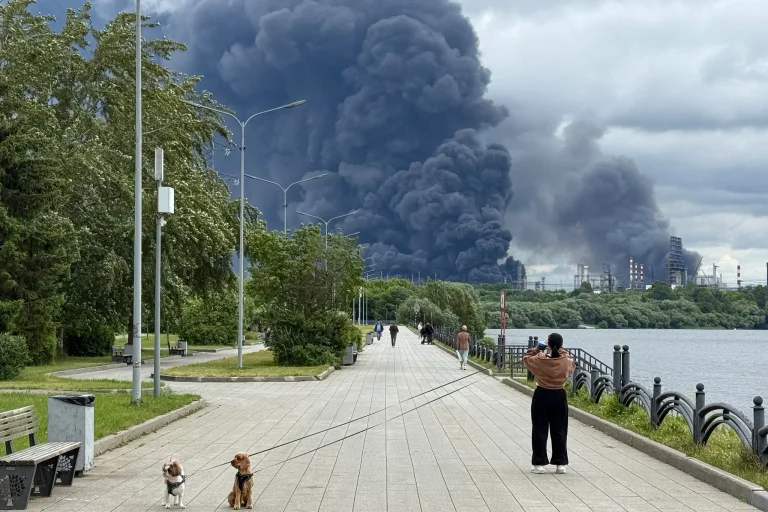
Downplaying the risk and using euphemisms to describe drone attacks and economic difficulties constitute a “performance of obedience” to Putin and his regime, says Aleksandra Arkhipova, a social sciences researcher at the École Normale Supérieure in Paris.
She has compiled a list of new terms and war euphemisms, in which “explosion” is replaced with “impact”, “killed” with “deprived of life”, and “drone” with “aerial target”.
“Russian political authorities today are focused on the image created in the news,” says Arkhipova. According to her, they do not want to create mass panic that could appear on local television and then in national news, with crowds of people crying and running through the streets.
On state media, the recent attacks on Moscow received very little attention. Channel One, the Kremlin’s main cultural and political megaphone, aired only a short report on the morning of June 18 and then fell silent until Putin’s statement several days later.
According to the Telegram channel “Agentstvo News”, during the main evening newscasts on June 18 on Channel One, Rossiya 1 and NTV, “not a single word” was said about the attacks.
According to Arkhipova, officials and state media use vague and sometimes misleading language to describe events related to the war. In the first days of the war, many shops that had closed as a result of Western sanctions put up signs saying they were “closed for technical reasons”, and these signs remained for months or even years.
Recently, Russia’s Federal Air Transport Agency announced a “schedule adjustment” at Krasnodar Airport, which is located about 240 kilometers from the front line and often lies in the path of Ukrainian drones.
At Sochi Airport, authorities do not announce that flights are delayed because of drones, but use the phrase “operating according to the current schedule”, a confusing formulation that distinguishes between the planned and actual schedule.
When Moscow’s airports are temporarily closed because of drone attacks, the term used is that flights are being accepted “by agreement”, while travelers are told that delays are related to incoming flights and not to the fact that the city is under attack.
Arkhipova calls this linguistic technique “neutralization”. According to her, it is a deliberate ambiguity.
“People may understand that something is happening, but they are not exactly sure what is happening,” she explains.
Many Russians complain that the lack of information is directly affecting their lives.
Maria, a 25-year-old from Ryazan, about 190 kilometers from Moscow, recalls that one day she was stuck in a taxi in a traffic jam that doubled her travel time to the city center. She checked the news, but there was no mention of traffic anywhere. Finally, the driver told her there had been a drone attack and the authorities were clearing debris from the road.
“Drones have become a kind of taboo,” said Maria, who asked that her surname not be published for fear of the consequences. After that experience, she said she had stopped following the news.
According to Tatiana Stanovaya, a senior fellow at the Carnegie Russia Eurasia Center, the gap between what Russians are increasingly seeing with their own eyes and what the authorities are telling them is a problem for the Kremlin.
Nevertheless, she considers it unlikely to destabilize its hold on power.
If the attacks continue, she said, the Kremlin will likely try to exploit them to further inflame anti-Western and anti-Ukrainian sentiment, giving Putin an additional reason to justify escalating the war.








