
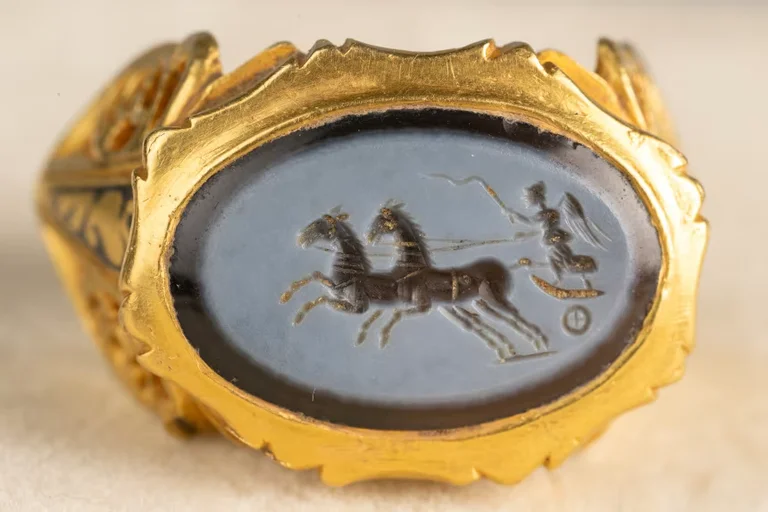
An amateur metal detectorist discovered an “extraordinary” gold ring dating from the Roman Empire in a field in Somerset, southwest England.
Kevin Minto, a truck driver and former soldier, made the astonishing discovery while exploring a plot of land near Ilminster.
The ring has now been purchased by the South West Heritage Trust and will be displayed at The Museum of Somerset in the future.
Unusual in size and finely crafted, the ring weighs 48 grams. Its centerpiece is a gemstone engraved with the figure of the Roman goddess of Victory, Victory, riding in a chariot drawn by two horses.
Minto, 68, who found the ring in 2018, told CNN that it took him “a little while to fully grasp the significance of the discovery.”
He explained that a year earlier he had found a hoard of Roman coins in the same field and had returned to the area several times as part of a group of military veterans who went metal detecting.
“Every detectorist’s dream is to find a hoard,” he said of his first coin discovery.
Later he found a lead-lined coffin in the same area and, finally, the impressive ring as well.
Under British law, people who find “treasure” with metal detectors are required to report it to the local finds liaison officer, after which a coroner conducts a formal inquiry.
National or local museums can apply to purchase the object in the public interest. The process is managed by the British Museum and, once the purchase is completed, the reward is usually divided between the finder and the landowner.
This was also the case with the ring and coins. Minto said he shared his portion of the reward with his “treasure-hunting” friend, but still received enough to pay off his mortgage, after receiving just over £19,500 (about $26,200).
“It’s a little unbelievable,” he said. “It was only when I went to the British Museum and saw them all displayed together with the coins that I really understood their significance. It’s a unique ring in Britain—there isn’t another one like it.”
He explained that one of the reasons he enjoys metal detecting is that it helps him switch off from everything else.
“When you find something, your heart pounds. You never know what it is until you turn over the soil and see the object you’ve found,” he said.
The ring was purchased by the South West Heritage Trust. According to a statement released by the organization this week, it is an “extraordinary” and “unprecedented” discovery for Britain.
The organization raised £78,010 to purchase the ring and coins found by Minto. The amount paid was then divided equally between the landowner and Minto, who shared his portion with his friend.
Amal Khreisheh, senior curator at the South West Heritage Trust, said the discovery “sheds light on how the Roman inhabitants of South Somerset coped with a period of upheaval from 286 to 296.”
She described the ring as “spectacular,” adding:
“It is very likely that the ring was buried a little later, in 297, as part of a hoard that included coins, lead objects and pottery.”
Speaking to CNN, she added:
“We think the ring belonged to a wealthy person, perhaps someone involved in the local administration of the region or a large landowner in South Somerset, which was a fairly wealthy area at the time. There were many Roman villas and large estates, and the Roman road Fosse Way also ran through it, which meant there was a great deal of trade activity.”
The ring and coins, which will eventually be displayed at The Museum of Somerset, are currently being presented to local schoolchildren as part of an educational program for the community.
After a visit to a primary school, Khreisheh said:
“The ring is such an astonishing object that the children really enjoyed holding it and looking closely at some of the coins. They have started guessing who wore it and why it was buried, which has been really lovely.”








