
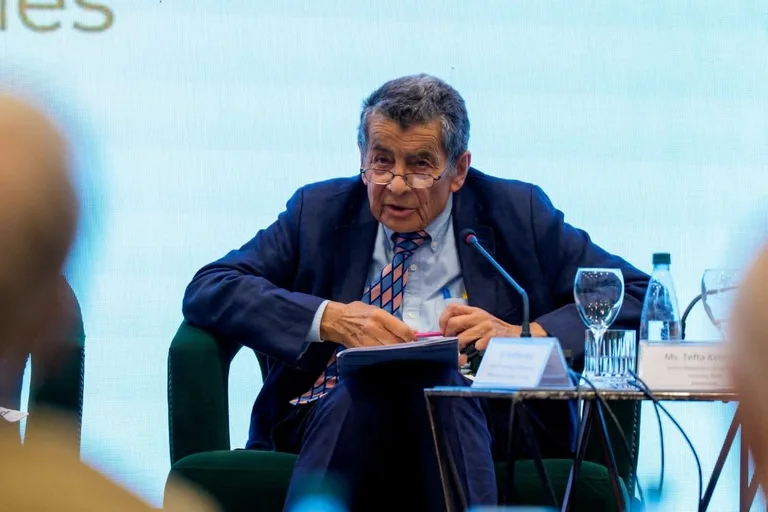
According to Geoffrey Nice, the former British prosecutor at the Hague Tribunal for the former Yugoslavia, “the Specialist Court, by the way it was created, reflected hidden political objectives from the outset.” He agrees with the views that the Prosecution’s indictment against the KLA leaders “reflects a narrative focused on Serbia’s interests.”
“I had no reason to follow the charges brought in the case against Thaçi and the others, and I did not do so. At the conference I heard arguments that the Prosecution’s indictment against Thaçi and the others reflects a narrative focused on Serbia and that the characterization of the Kosovo Liberation Army (KLA) as an organized military structure engaged in a Joint Criminal Enterprise is not supported by the previous judgments of the International Criminal Tribunal for the former Yugoslavia (ICTY). Nothing in my recollection of the evidence presented during Milošević’s trial, or of subsequent developments, suggests to me that these arguments are inaccurate,” says Nice.
In an article published in the online newsletter of the “Bridge of Remembrance” conference, organized by KIPRED and “Freedom Has a Name,” Nice says the Specialist Chambers were created solely as a result of constant pressure from the European Union and the United States of America.
“In a later intervention concerning the Kosovo Specialist Chambers (KSC), I corrected a speaker who had claimed that this Court was established as the result of a sovereign decision by the Kosovo Assembly. I reminded those present that Kosovo’s elected representatives were, in reality, forced to accept this court under constant pressure from the European Union and the United States,” says Nice.
“As part of Kosovo’s negotiating team, I witnessed firsthand that the Specialist Chambers’ Statute was not, in any meaningful sense, the result of an agreement with Kosovo. As soon as the European negotiators encountered substantial objections from the Kosovo side to the draft statute, discussions practically stopped. What followed, in my experience, was the political imposition of a statute drafted in advance, shaped exclusively by EU and US actors,” he adds.
According to Nice, “Kosovo had no real voice in adopting the statute of the Specialist Court,” even though “it was the one that paid the price for the imposed actions,” without any assurance, he says, that the proceedings would deliver justice.
As he puts it, “Serbia clearly seemed to be the state most likely to benefit from a court imposed in the way the Specialist Chambers were imposed, focused on only one ethnicity for the 1998–1999 war.”
Sir Geoffrey Nice is an internationally renowned lawyer and barrister, with a long career in the fields of international criminal law and public international law.
He served as a prosecutor at the International Criminal Tribunal for the former Yugoslavia (ICTY), where he led the prosecution in the case against Slobodan Milošević.








