
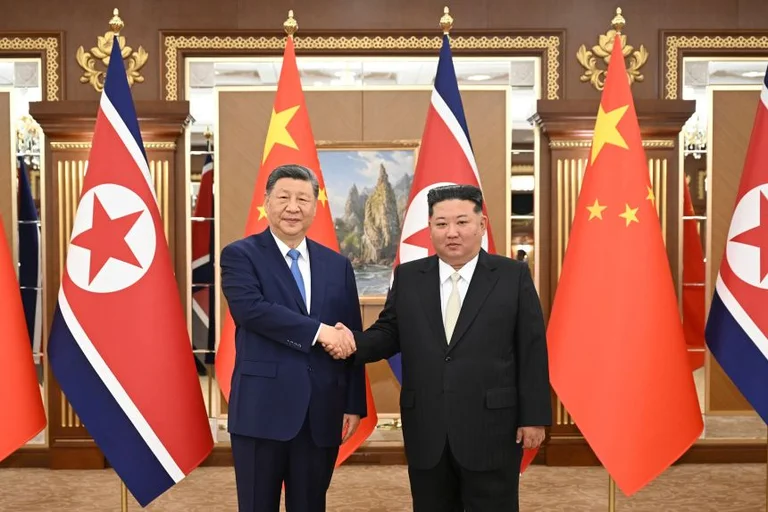
The first visit by Chinese leader Xi Jinping to North Korea in seven years was not simply filled with rhetoric about the historical ties between China and its only formal treaty ally.
On the contrary, the two-day state visit was an opportunity for Xi to lay out his vision for the future of relations between China and its nuclear-armed neighbor, at a time of major global changes.
“Faced with profound changes unseen in a century, both sides should open up brighter prospects for the socialist cause in the two countries, as well as for regional peace and development,” Xi told North Korean leader Kim Jong Un during talks in Pyongyang.
To achieve this, China is ready to expand cooperation in trade, agriculture, construction, science, technology and healthcare, strengthen strategic coordination, and deepen military, diplomatic and law-enforcement exchanges.
This is a more concrete vision than the one Xi presented during his last visit to Pyongyang in 2019.
One significant detail was the absence of any reference to the “denuclearization of the Korean Peninsula,” a phrase Xi had used seven years earlier.
This could be considered a victory for Kim Jong Un.
Under his leadership, North Korea has continued to expand its nuclear program in defiance of United Nations sanctions. In 2023, the country even enshrined its policy of developing nuclear weapons in its constitution.
This change also reflects how Beijing is adapting its diplomacy to a world very different from that of 2019—a world in which China is in strategic competition with the United States and Pyongyang has drawn significantly closer to Moscow.
A diplomatic spectacle
Xi’s visit comes at a time when China’s international influence is growing.
This year, a large number of world leaders have visited Beijing. In a short period, Xi hosted both the American and Russian presidents on state visits—something few leaders in the world could do.
For Beijing, the visit to North Korea is another opportunity to show that China is a global power capable of engaging with very different leaders, from the head of the world’s most powerful democracy to the authoritarian leader of an isolated, sanctioned state.
Experts say China’s calls to strengthen diplomatic, military and security cooperation with Pyongyang show Beijing’s desire to bring North Korea more actively into the economic and security bloc that China aims to build and lead.
This also enables China to show the United States and its allies that it still has considerable influence over North Korea.
Donald Trump has repeatedly expressed interest in resuming dialogue with Kim Jong Un, after his first-term effort to dismantle North Korea’s nuclear program failed.
However, China does not currently appear interested in pressuring Kim Jong Un to give up nuclear weapons.
According to experts, Xi Jinping now sees more risk in putting pressure on North Korea than in allowing its current policy to continue.
Nonetheless, closer ties with Pyongyang give China more cards to play in negotiations and strategic rivalry with the United States.
Xi chose North Korea for his first foreign trip of the year, a gesture Kim Jong Un hailed as evidence of the importance Beijing attaches to the friendship between the two countries.
China has long been North Korea’s main economic and diplomatic backer. The two countries describe their relationship as an alliance “forged in blood,” dating back to when they fought together in the Korean War.
However, behind the warm rhetoric lies a clear strategic interest: Beijing wants to ensure that its influence over its unpredictable neighbor does not wane.
This is because relations between Pyongyang and Moscow have grown significantly closer in recent years.
In 2024, Kim Jong Un and Russian President Vladimir Putin signed a mutual defense treaty, while North Korea sent thousands of troops and large quantities of ammunition to support Russia’s war in Ukraine.
Analysts see Xi Jinping’s visit as a clear effort by China to reaffirm its position as North Korea’s main strategic partner.
Some experts even believe Xi’s statements about strengthening military exchanges could signal a significant shift away from China’s traditional policy of supporting denuclearization of the Korean Peninsula.
In their view, this could mean a new security rapprochement between China and North Korea, aimed at counterbalancing South Korea, the United States and Japan, while tacitly accepting Pyongyang’s status as a nuclear power.
However, analysts stress that Xi Jinping’s visit does not amount to unconditional support for Kim Jong Un.
Beijing expects Pyongyang to respect Chinese interests and avoid policies that could destabilize the region.
“Xi’s visit is a strategic embrace of Kim Jong Un, but not a blank check for North Korea,” experts say.








