
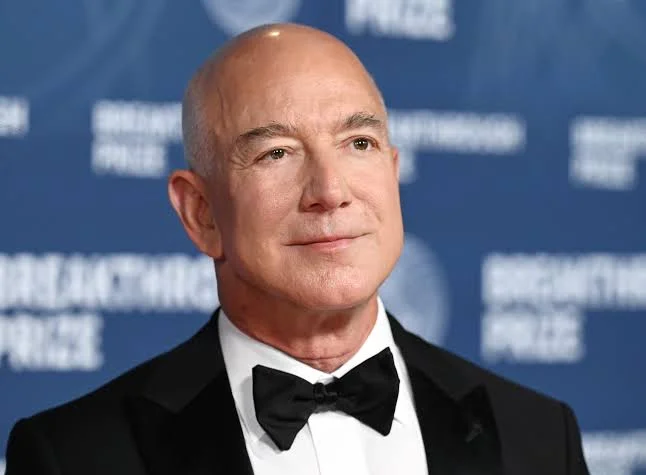
Amazon founder Jeff Bezos said at the VivaTech conference in Paris that moving heavy industry off Earth is the only way to reconcile economic growth with preserving a habitable planet – and that the Moon is the starting point for this vision.
Bezos took the stage on Wednesday to argue that humanity must move toward the Moon and then farther into space, not only for the sake of exploration, but also to save the planet from the consequences of technology and industry.
Speaking alongside Blue Origin CEO Dave Limp in a session moderated by former NASA astronaut Mike Massimino, the Amazon founder and Blue Origin executive chairman said that moving heavy industry off Earth is the only scenario in which economic growth and environmental protection can coexist.
“Our garden planet can return to the state it was in before the Industrial Revolution,” Bezos said.
“This is the only way in which the world is worse today than it was 500 years ago. We can have both,” he added, stressing that quality of life has improved for all of humanity, but the planet has paid the price for this progress.
His message was clear: the Moon must come before Mars, and skipping this step would be a mistake.
According to Bezos, the Moon’s proximity – reachable in about three and a half days – makes it accessible at any time, unlike Mars, which offers travel windows only once every two years. Moreover, its low gravity makes it an ideal starting point for more distant missions.
“When you skip steps, you don’t get faster. The Moon is a gift because it is so close to Earth,” he said.
Materials extracted from the Moon’s surface require 28 times less energy per kilogram than materials launched from Earth, Bezos stressed. This makes the Moon not just a destination, but also a potential supplier for future deep-space missions.
He also spoke about the Apollo program, arguing that the first Moon landings were accelerated by geopolitical rivalry with the Soviet Union and were carried out at a cost that reached as much as 4.5 percent of the U.S. federal budget, a model that was unsustainable.
According to him, what Blue Origin is trying to do now is entirely different: not a race driven by rivalry, but a permanent settlement driven by necessity.
“The idea is not that we have been to the Moon before. The point is to stay there forever. Now is the right time to do it,” he said.
According to Bezos, the economic case for the Moon is just as compelling as the environmental one.
Water ice found on the Moon can be converted into liquid oxygen – one of the main propellants for space travel – and sent into orbit at a much lower cost than from Earth.
Moreover, the Moon’s surface, bombarded by meteors for about 4.5 billion years, contains almost all the minerals needed to build space infrastructure.
The long-term vision Bezos outlined is ambitious: large space habitats similar to those proposed by physicist Gerard O’Neill in the 1970s, where thousands or even millions of people would live and work in orbit; computer centers built in space; solar energy generated outside the atmosphere; and microchips manufactured off Earth, with the results transmitted back to the planet.
Mars and other destinations will come later, but only after a base has been established on the Moon.
“We will build colonies on Mars and elsewhere. But the Moon is the important first step,” he said.
Bezos also used his appearance to talk about Prometheus, his artificial intelligence venture, founded last year.
He described it as a tool that could significantly shorten the engineering development cycle – from 10 years to five, then to two, and potentially to just one year.
Unlike large language models trained on text, Prometheus is based on specific engineering data and aims to significantly accelerate the pace of invention.
Bezos concluded his speech with characteristic optimism.
According to him, civilization’s prosperity has always come from inventions – from plows 6,000 years ago to the steam engine – and the present moment offers more opportunities than ever before.
“Every young person today should be extremely excited,” he said. “There has never been a better time to be an entrepreneur.”








