
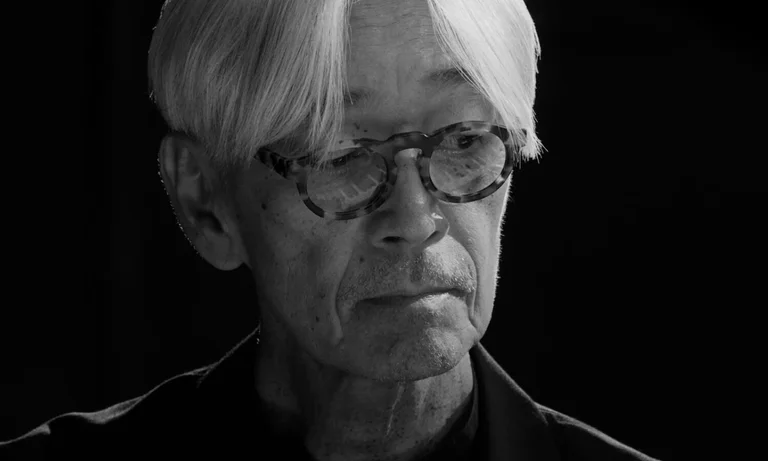
In the final weeks of his life, Oscar-winning composer Ryuichi Sakamoto sat down with his son, director Neo Sora, to record his final concert film and album, titled “Opus”.
This is an almost wordless tribute to an extraordinary career.
As “Opus” was being recorded, a sense of urgency was present. Sakamoto and his team knew that the weeklong sessions planned for September 2022 might be the last time the 70-year-old composer, whose cancer had advanced to stage four, would have the energy to record. But this urgency did not stem only from the feeling that time was running out. Although he was physically so weakened that he could perform only a few pieces at a time, Sakamoto felt full of ideas and creative energy.
Slow and meditative, it offers a moving testament to his spirit and perseverance.
Some albums ask to be heard. Others ask to be understood. Ryuichi Sakamoto’s “Opus” does neither. It asks to be lived.
Recorded near the end of the composer’s life and accompanied by a clear awareness of impermanence, “Opus” is not simply a collection of piano works. It is a long dialogue between man and time, between a fading body and a sound that seeks to survive. In every note, we hear not only Sakamoto’s virtuosity, but also his fragility. The piano sounds not like an instrument, but like an organism breathing slowly.
In the Western tradition, music often strives for a climax, an explosion, a triumph. In “Opus”, the opposite happens. Each piece seems to let go of something: excess, ego, the desire to impose meaning. Only the essence remains. A simple melody can carry the weight of an entire life.
Listening to the album, one gets the impression that Sakamoto is not playing for an audience. He is playing for memory. For those inner places where time is measured not in hours, but in losses and returns. Every pause is as important as every sound. Silence is not an absence of music; it is the material from which music is born and to which it returns.
In this sense, “Opus” is more than an album. It is a meditation on mortality. Not a dark meditation, but a quiet acceptance. Sakamoto does not fight against the end. He contemplates it with an almost painful clarity. And that is precisely where the work’s greatness lies: in its ability to turn the end into an art form.
“Opus” is the elegy of an artist who does not seek immortality. And for that very reason, it comes close to attaining it.
For “Opus”, Sakamoto created new arrangements of some of the best-known works of his career, prepared three compositions and considered ways to stage them. He imagined the studio lighting changing along with the daylight during the performance, moving from the darkness of early morning to the afternoon sun and then to the gloomy dusk. This cyclical movement creates a sad echo of the film’s subtext: everything must come to an end.
In 2016, after decades of work that had left its mark across various genres and media, Sakamoto said that he still hoped to create a “masterpiece” before he died. It seemed that he viewed his live performances in the same way.
“I try to get as close to perfection as possible,” he told The Fader in 2017.
What makes “Opus” interesting is that Sakamoto seems to have let go of technical perfectionism in order to achieve something more intimate. In some pieces, he plays hesitantly, stops, searches for the right tone; and it is precisely there that the album gains its emotional weight. It is not a display of virtuosity, but a document of presence. His performance is emotionally powerful and carefully considered. He avoids flashy displays of technical virtuosity, choosing instead an intimate portrait of the man behind the piano.
The most moving moments on the album “Opus” happen at the edges of the music, as in “Andata” – originally recorded for his 2017 album “Async” – where the sound of his breathing can be heard over the piano notes. In other pieces, amid the quiet, one can hear the movements of the piano pedals and the slight shifts in his position on the stool. The presence of these sounds makes the recording feel profoundly physical and human. They convey the energy he was drawing from himself at a time when such an effort cost him a great deal. “Andata”, as well as “Bibo no Aozora”, sound like reflections on time, memory and the body gradually fading away.
Two of the new compositions also offer reflective glances toward the past, honoring lost friends and collaborators: “BB” is dedicated to director Bernardo Bertolucci, while “For Jóhann” is dedicated to composer Jóhann Jóhannsson. In each, Sakamoto manages to evoke powerful emotions through just a few chords. They are intense documents of grief and love, made all the more moving by the fact that their first recording was very likely also the final performance.
In “Opus”, the music, played by the artist himself, is entirely sufficient for the time in which it was recorded and for everything that remains, along with the occasional completely human mistake or missed note. When he says he needs a break, exhausted after a performance, his fatigue becomes visible, audible and almost tangible.
An interesting aspect of “Opus” is the way silence becomes part of the music. There is a great deal of space between the notes, a great deal of patience. The album demands full attention and an introspective state of mind. It is not background music. It is music for stopping.
This Ryuichi Sakamoto album is not simply a live recording or an intimate “best of”. It is an artistic farewell. It carries a rare sense of calm, weariness and elegance. It is a quiet, weary and extraordinarily beautiful album. There is no artificial drama. Just an artist approaching the end with dignity and emotional clarity. It is a final testament.
Sakamoto wrote that a month after filming “Opus”, his physical condition worsened and he felt “completely empty”. Yet between the chords, he continues to breathe and, for the last time, the melodies flow from him as naturally as ever.








