
President Donald Trump’s ability to shock and anger Washington’s political elite is a superpower when it comes to strengthening his political base.
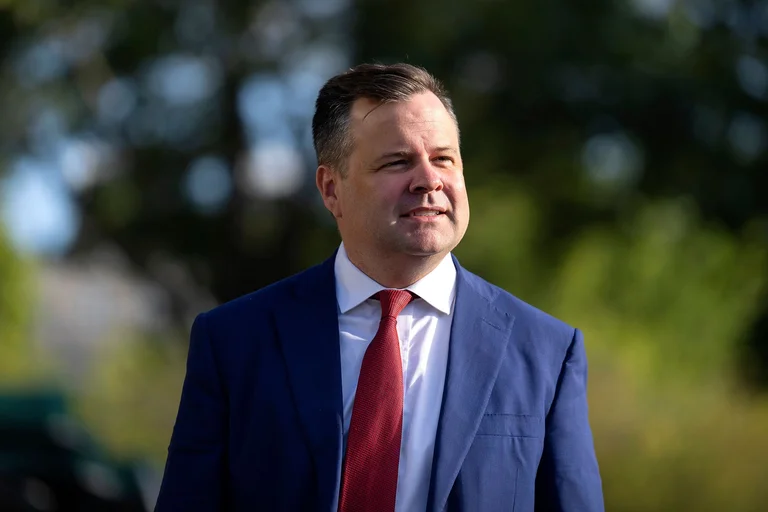
So Tuesday’s appointment of Bill Pulte, director of the Federal Housing Finance Agency (FHFA), as acting head of the US intelligence community was a characteristically political move by Trump.
Senators from both parties publicly expressed surprise at the selection of an official with no apparent qualifications for such an important role. Pulte has no experience in intelligence, espionage or national security. Republican Senator Susan Collins of Maine said she did not know whether he had ever held a security clearance.
CNN reported that Trump’s reasoning was simple: he wanted a loyalist he could trust. Sources also said Trump sees Pulte as someone who could play a role in election security.
This has alarmed Democrats, as Trump is escalating his baseless claims that November’s midterm elections could be compromised by election fraud. Pulte has shown in his current position that he is willing to use federal power to spur politicized investigations against the president’s opponents.
“Americans have every reason to be concerned when the person overseeing everything from counterterrorism to foreign threats to elections is chosen for his willingness to advance the president’s political agenda rather than for his experience,” said Democratic Senator Mark Warner, vice chair of the Senate Intelligence Committee.
Trump’s vision for the post of Director of National Intelligence (DNI) is, to put it mildly, unusual.
By law, the DNI is the most senior intelligence official in the US. His duties can include briefing the president on potential terrorist attacks, assessing adversaries’ movements during wartime, overseeing the most secret counterintelligence operations and securing presidential approval for covert operations.
The post was created after the September 11, 2001 terrorist attacks, which killed 2,977 people in Washington, New York and Pennsylvania. The attacks exposed the failure of US intelligence agencies to coordinate information.
With the US embroiled in a new war in the Middle East, there were already concerns that the politicization of the Trump era was weakening the DNI’s ability to fulfill its founding mission.
The law that created the Office of the Director of National Intelligence requires the director to have “extensive expertise in national security”. Trump declared on social media that Pulte had “deep experience managing America’s most sensitive matters”, referring to his oversight of financial markets and $10 trillion in funds at Fannie Mae and Freddie Mac. Nevertheless, his career in finance appears far removed from the legal requirements for the post.
Why Pulte is a characteristically Trumpian choice
Nevertheless, Pulte is an ideal choice for Trump because he embodies many of the characteristics of the president’s other high-level appointees.
In Trump’s political world, a lack of traditional qualifications can paradoxically be considered an advantage.
Pulte is an unwavering loyalist, part of the Mar-a-Lago inner circle, known for aggressively defending Trump on television and for his willingness to use state power against the president’s opponents. As FHFA director, he sent criminal referrals to the Justice Department over mortgage fraud allegations against several of Trump’s political opponents.
His appointment also reflects Trump’s political evolution. Trump’s first Director of National Intelligence was Dan Coats, a respected former Republican senator with whom Trump often disagreed. Coats had stated that Russia interfered in the 2016 election, a position unacceptable to Trump’s camp.
Trump made clear with his second-term cabinet that he would no longer tolerate officials who tried to restrain him. That is how MAGA figures such as FBI Director Kash Patel and Defense Secretary Pete Hegseth ended up in important national security positions. Pulte fits squarely into this tradition.
Democratic Senator Jack Reed called Pulte “the least qualified official in the history of the intelligence community” to take on such an important role. He added that Trump’s desire to surround himself with unqualified “yes-men” was one of the factors that led the country into the catastrophic war with Iran.
Appointing someone with no intelligence experience is also considered an insult to the US intelligence community, which Trump has long distrusted. Nevertheless, the DNI remains a key institution that oversees the president’s daily intelligence briefing and coordinates agencies such as the CIA.
A move with political motives
The best way to understand Pulte’s elevation is as a political maneuver.
Trump has been under intense political pressure lately, including from his own base, particularly over the war and the Jeffrey Epstein case. By choosing Pulte, he is showing MAGA supporters that he remains an anti-establishment figure and an opponent of what they call the “deep state”.
Right-wing activist Jack Posobiec praised the choice of “Wild Bill” Pulte on Steve Bannon’s podcast, saying he is “the guy who gets the job done”.
One of MAGA’s earliest and most powerful themes is the idea that a permanent class of bureaucrats and elites blocks the will of ordinary Americans and has sabotaged previous Republican presidents.
Vice President JD Vance also backed the appointment, saying Pulte understands that “the bureaucracy of the intelligence community must answer to elected leadership, not the other way around”.
If the senators’ initial reactions are any indication, Pulte would have difficulty being permanently confirmed for the post. Ironically, many senators had also expressed reservations about the current director, Tulsi Gabbard, who is leaving to support her husband as he battles cancer.
Nevertheless, Gabbard is considered far more qualified than Pulte. She served four terms as a member of Congress, sat on key committees and took part in military missions in the Middle East and Africa.
But as acting director, Pulte does not need Senate confirmation. Under federal law, he can remain in office for at least 210 days, a period that includes November’s midterm elections.
This has alarmed Democrats, who fear the Trump administration could use claims of foreign interference as a pretext for extraordinary measures related to election administration.
Concerns are also heightened by the fact that Pulte has previously used his authority to refer Democratic figures who investigated Trump for criminal investigations, including New York Attorney General Letitia James, Senator Adam Schiff and Fulton County District Attorney Fani Willis.
Mark Warner warned that the president had chosen an official who had shown not only a willingness but also a desire to use state power for political revenge.
Ironically, this concern aligns with the praise from Trump’s supporters, who describe Pulte as the man who “gets things done”.
Both perspectives suggest that Pulte’s rise should be viewed more through a political lens than a national security one. And they show that, despite claims that Trump is entering the final phase of his political influence, he intends for the remainder of his second term to be just as turbulent as the first year and a half of his return to power.








