
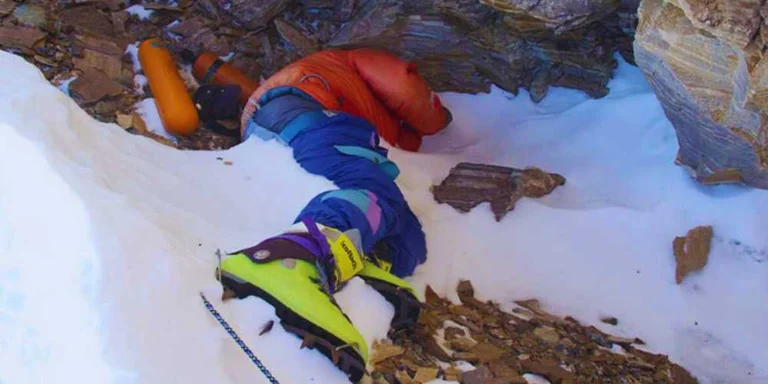
Indian authorities are seeking to recover the body of a climber known as “Green Boots” from the upper slopes of Mount Everest, nearly 30 years after a fatal expedition.
The Indo-Tibetan Border Police, a paramilitary force, has issued a tender for an agency specializing in extreme-altitude operations, with the aim of bringing down the body believed to be that of Dorje Morup from the Tibetan side of the mountain.
However, many members of the mountaineering community believe that “Green Boots” is actually another Indian climber, Tsewang Paljor.
Morup and Paljor were part of a six-member expedition that encountered a deadly storm near the summit of Everest in 1996.
All six climbers were members of the Indian paramilitary force. While three turned back because of worsening weather, Morup, Paljor and Tsewang Samanla continued the ascent.
They are said to have come very close to the summit before being forced to turn back. All three lost their lives on the mountain.
The remains of “Green Boots” lie in Everest’s so-called “death zone,” above 8,000 meters, where extreme conditions make recovery extraordinarily dangerous.
The tender invites agencies with experience in rescue or recovery operations at similar altitudes, preferably on Everest during the past five years.
The operation is expected to be complicated further by the need to coordinate with Chinese authorities to transport the body across the Tibet-Nepal border, take it to Kathmandu and then repatriate it to India.
The operation is expected to take place between June and September.
“Green Boots” got this nickname because of the bright green boots he was wearing when he died. His body has become a well-known landmark on Everest’s northeast route.
In the years after the tragedy, it was reported that some Japanese climbers had found Morup still alive, but suffering from severe frostbite and struggling to descend. They helped him use the fixed ropes along the route.
They are also said to have found Samanla dead above the area known as the “Second Step,” a steep rocky outcrop at an altitude of 8,610 meters on the mountain’s northeast ridge.
A Sherpa later claimed that Tsewang Paljor had also been seen alive, but in a delirious state.
During their descent, the Japanese team passed Morup again below the “First Step” and believed he would make it back to camp, but he died later that day.
Paljor’s remains were never found. It has been suggested that he may have fallen from the cliffs of the Kangshung East Face, fueling debate over whether the body known as “Green Boots” is actually Paljor or Morup.
Because recovering bodies from Everest’s extreme altitudes is extraordinarily dangerous, “Green Boots” has remained on the mountain for decades.
He has become a stark reminder of the dangers of high-altitude mountaineering and the difficulties of rescue and recovery operations in the mountain’s “death zone.”
Recovering the remains is considered extremely dangerous because helicopters cannot land at that altitude. This means Sherpas and experienced climbers must carry the body down the steep terrain manually, facing risks such as avalanches, storms and a lack of oxygen.








