
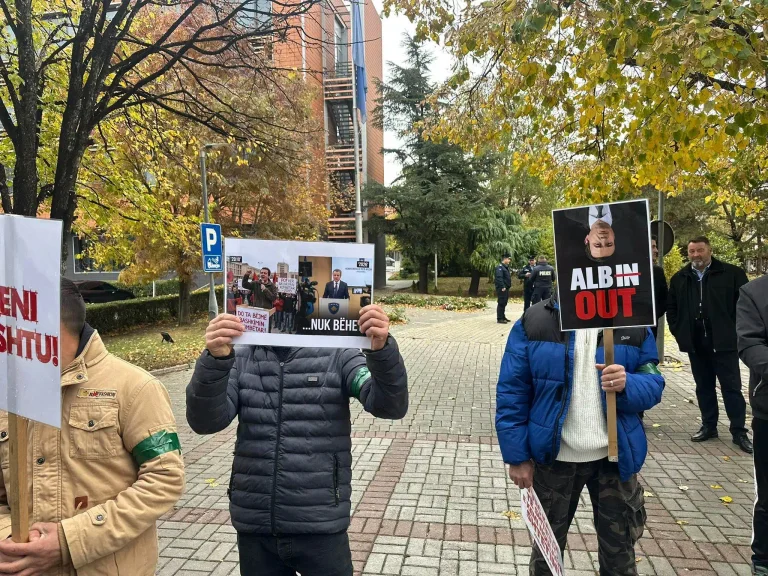
At midday on Sunday, in Skanderbeg Square opposite the Government, there were more banners than voices. “Albin Out”. “You have failed”. And one handwritten sign that seemed more like a confession than a slogan: “I don’t entrust you with my future, but I’m not leaving; I will resist”.
Not even fifty people were there, calling for Prime Minister Albin Kurti’s resignation. The protest was driven by economic hardship. But once images of the protest spread far and wide, no one paid attention to the reasons anymore. On social media, people began counting heads, mockingly.
At first glance, this was another failed protest. Beyond the online jokes, the protest raises a much more interesting question: How is it possible that in a society where dissatisfaction with the government is so evident, mobilization against it is so small?
Dissatisfaction with the dire economic situation is not made up. According to data from the Kosovo Agency of Statistics, around 200,000 people have left Kosovo from 2021 to 2026. Kosovo has imported more than 1 billion euros’ worth of electricity over six years. It has the lowest average wage in the region. The highest unemployment. The highest inflation…
So why, then, do these thousands of dissatisfied people, amid all these negative statistics, never become a “we” in the square? A protest is precisely this: the transition from “I am dissatisfied” to “we are dissatisfied, and here we are”. It seems that this transition is much harder than it looks.
Social sciences emphasize a fundamental distinction between individual dissatisfaction and collective action. The fact that many people are dissatisfied with a political situation does not necessarily mean they will be willing to take joint action to change it.
Why is it so difficult?
For a group to come together even to discuss organizing collectively, individuals must be able to state their preferences openly. The first step is also the first problem.
In a country like Kosovo, where the party controlling the Government has secured between 40 and 50% of the vote in several consecutive elections, publicly expressing a desire to bring it down is accompanied by fear of social judgment. Thus, collective decision-making is undermined by what social sciences define as “Preference Falsification”.
“Preference falsification,” explains renowned political scientist Timur Kuran, “is the act of misrepresenting one’s desires because of perceived social pressures”.
A simplified example is saying “yes” to a movie suggested and accepted by most of your friends, even if you don’t like it, because you’re afraid of their reaction and worry that even if you say you don’t like the movie, the choice won’t change.
The Threshold, the “Free Rider” Problem and Decisive Participation
When a protest is called, individuals’ decision whether or not to participate becomes the next problem.
The “threshold”, which according to Mark Granovetter is “the proportion of the group a person would need to see at the protest before joining in themselves”. In other words, how many people someone would need to see in order to consider joining the protest worthwhile.
The “Participation Threshold” of Durim Aliu, the organizer of the latest protest, is zero. He is willing to protest even if no one else does. Someone else might need to see 100 others in the square before becoming the 101st. A large difference in the value of this threshold poses a threat to a successful protest.
Let’s say 100 citizens are dissatisfied with the Government. Durim Aliu is willing to protest alone, while the other 99 would join the protest only if there were at least 50 people in the square.
The result? Durim goes to the square, but the other 99 stay home, waiting for one another. Although they are all dissatisfied, the protest remains with only one participant.
Beyond the value of the Participation Threshold, economist and political scientist Mancur Olson, in his 1965 book, “The Logic of Collective Action”, also highlights another challenge: the “free rider” problem; the person who benefits without contributing.
“A free rider is someone who benefits from a collective or public good without contributing to the cost of providing it,” is sociologist Pamela Oliver’s definition.
Put more simply, it is like a resident of a building who wants the elevator to be clean but refuses to contribute to its cleaning, hoping the neighbors will cover the expense. In the end, they enjoy the same benefit as those who pay, without paying themselves. A citizen dissatisfied with Kurti may wait for others to bring him down and thus benefit without protesting.
In a study published in 2013 in the scientific journal Cognitive Science, researcher David Lagnado and his co-authors explain that an individual’s participation becomes decisive only when the number of other participants is exactly one fewer than the number needed to achieve the goal.
Let’s assume that bringing down the Government would require 10,000 citizens. If a citizen believes that 2,000 people will take part in the protest, they will decide not to go because their presence would make no difference. The same happens if they predict that 15,000 people will attend, meaning the citizen perceives their presence as unnecessary.
So the citizen chooses to participate in just one of three scenarios: when they predict that 9,999 people will be at the protest and their presence will bring the number to 10,000. Their contribution becomes decisive precisely at the boundary between success and failure—a difficult point to determine.
Why are squares sometimes full?
Society in Kosovo has demonstrated an extraordinary capacity for mobilization several times. The streets of Pristina have often filled with thousands of people. The mass protests following the Special Court’s scandalous decision against former leaders of the Kosovo Liberation Army are one example.
A study published in the journal Nationalities Papers (Cambridge) counted protests in Kosovo from 1999 to 2012. According to the study, around two-thirds of the protests were related to security, transitional justice, political status and group representation. Only 11.3 percent centered on economic demands, including jobs, wages and pensions.
“The average size of demonstrations organized around ethnic grievances was 6,608 participants, while the figure was 986 for protests mobilized around demands for good governance and 731 for those focused on economic justice,” says the article by Pëllum Kelmendi and Elton Skendaj.
Kosovo very rarely takes to the streets to protest the subject that Sunday’s protest was called around. Historically, turnout at such protests has been low compared with other issues. This inertia may have been another reason so few people turned out.
Sunday’s protest may reveal more about Kosovo’s society than about its dissatisfaction with the Government. The small number of participants does not necessarily demonstrate an absence of dissatisfaction, just as a full square would not necessarily prove that the whole society thinks alike.
On social media, it was easy to mock the few people who turned out in the square. It is harder to understand why the others did not. And this is a question that cannot be answered by counting heads in a photograph.
Because, ultimately, an empty square does not tell us how many people are dissatisfied, but only how many of them have decided to express their dissatisfaction publicly. And so, thousands of individual decisions nevertheless produced a collective result. Nothing.








