
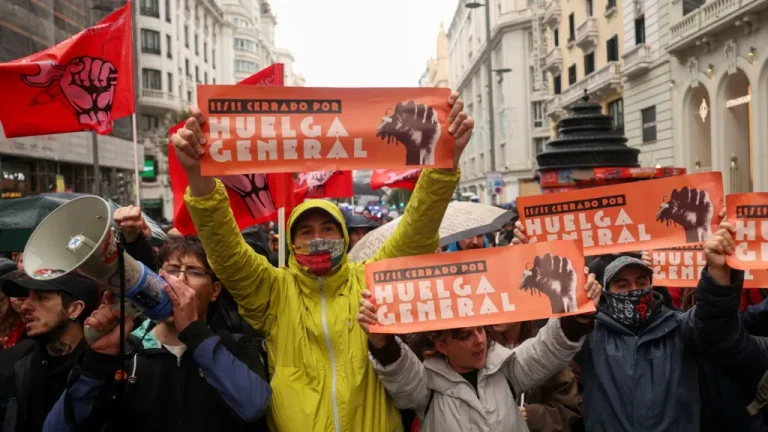
Transport and other public services across Spain have faced major disruptions during the first general strike in 14 years, called by the main trade unions over the housing crisis and the high cost of living.
Protests were also planned for Wednesday, with the largest rallies expected in Madrid and Barcelona. Spaniards are expected to vote in parliamentary elections on November 29.
The head of the major UGT trade union, Pepe Alvarez, said the strike had been successful, with “massive” participation, while Unai Sordo of the CC OO union described participation as “highly significant,” the BBC reports.
However, the Spanish Confederation of Business Organizations said participation was “low and uneven,” depending on the areas and sectors involved.
Some of Wednesday’s biggest disruptions were recorded in Madrid’s main industrial hubs and in the northeastern region of Catalonia, where traffic came to a standstill on several major roads.
The Interior Ministry announced that dozens of people had been arrested over various incidents, while Spanish media reported that real estate agencies had been attacked at their offices.
The strike was prompted by widespread protests for affordable housing and against the rising cost of living, following the eviction of 87-year-old Maricarmen Abascal from a home in Madrid where she had lived for seven decades. She died in hospital several weeks later.
Rental prices in the Spanish capital have risen sharply in recent years, the BBC article continues. According to the real estate portal Idealista, the monthly rent for a 50-square-meter home in Madrid averaged 1,170 euros in October, while the average gross monthly salary in Spain is around 2,460 euros.
This amount accounts for nearly half the average gross salary, well above the 30 percent of income that housing experts and public institutions often recommend as the affordability threshold.
Socialist Prime Minister Pedro Sanchez called an early election last month after parliament failed to approve his plan for reforming the housing sector.
Spain had not organized general strikes since 2012, during the government of conservative Mariano Rajoy.
And although previous strikes have been problematic for the government in power, this one is different. Sanchez and his ministers have even urged workers to stop work and demand affordable housing.
“Your eight-hour workday. Your pension. Public healthcare… These are collectively won rights,” he wrote on social media, praising those who took part in previous strikes.
The leader of the People’s Party (PP), Alberto Nunez Feijoo, called the general strike “madness,” while describing the trade unions as “mafias” and “garbage.”
Feijoo’s party is leading in the polls, while its spokesperson, Miguel Tellado, accused the government of exploiting the strike to warn voters not to allow a right-wing government to form, a scenario that appears most likely after the November 29 election.
Sanchez told Spanish television this week: “Madness is calling into question workers’ right to go on strike.”
Among those taking part in the general strike was 27-year-old Gonzalo Alvarez, who visited various strike picket lines in central Madrid.
Although he works in sales, he has volunteered with a housing union that seeks to protect tenants and inform them of their rights.
The eviction of Maricarmen Abascal at the end of September was “the little spark” that ignited this protest, he told the BBC.
Alvarez knew the 87-year-old, whose rent had tripled after new owners took over, and says he was deeply shocked by the way she had been treated.
He rents a small one-bedroom apartment with his girlfriend, who works as a dental hygienist, in the Arganzuela neighborhood in the south of the city. The couple pays 1,000 euros in total, meaning each spends around half their salary on housing, not including other bills.
“It’s completely crazy… with food, electricity, water and gas.”
He sees no possibility of buying a property: “You have to save an astronomical amount of money to be able to buy a house. So, with these salaries, it’s impossible.”
With current rental and property prices, he believes buying a home is “completely impossible.”
Meanwhile, the vice president of CEOE, Spain’s largest business association, Miguel Garrido, criticized the strike, complaining that businesses have little to do with housing prices.
“This is not a strike over work-related issues, but for political reasons, and it is closely linked to the calling of an early election,” he said.
Protests were also planned in some of Spain’s largest cities during the day, while the level of support is expected to be widely seen as an indicator of public discontent on the eve of the election.
Another reliable indicator of support for the strikes is the level of demand for electricity from Spain’s industrial sector.
According to data from operator Red Electrica, electricity consumption in Spain fell by 7.5 percent during the early hours of Wednesday. During the last general strike, 14 years ago, consumption during the same period had fallen by more than 15 percent.








