
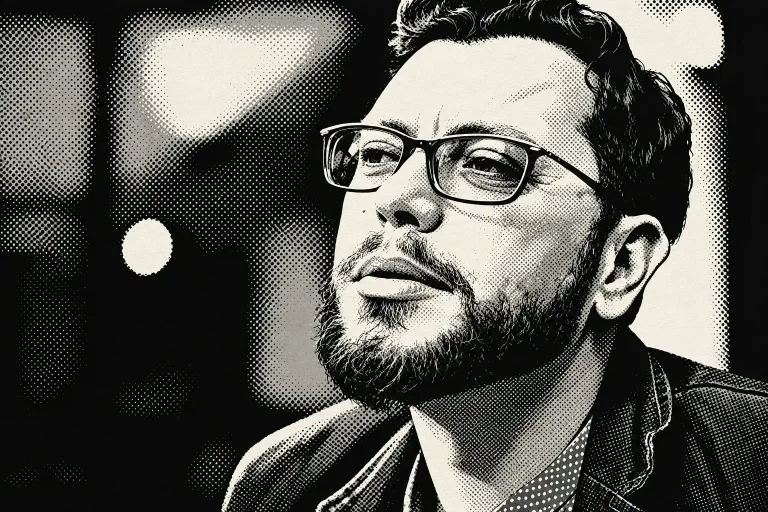
One piece of advice before you read this article: watch Përparim Rama’s video at this link:
https://www.facebook.com/share/v/1DxFYvNzwm/?mibextid=wwXIfr
Pristina has been declared a cancer city several times, or a city with cancer. A city that cannot develop or make room for itself on its roads. A city that suffocates its citizens.
But even without this characteristic, we are consuming every millimeter of it with concrete.
We are masturbating Pristina ourselves, in Pristina: with us, frustrated, narrow-minded, clannish, and partisan.
In fact, if we compare it with our telephone company, with the post office, as we called it in our childhood in Pristina, it is the same thing. Some “revolutionaries” ruined the market for the sale of this company with their protests. And today, in our hands, it is one of the greatest failures, judging by our experience of using it.
Likewise, RTK was one of Pristina’s assets, covering all of Kosovo, as was the Assembly; through the abuse of its budget and the abuse of power over it, it was destroyed beyond repair. Until it became a tumor in this city.
During the time of UNMIK, Albanians were known as hardworking people, people with an iron will, but in the end things always turned out wrong for us. Perhaps because we kept trying to do something good, but always in the same way.
What is left of Pristina today? Skanderbeg copied from Tirana.
The Cathedral, which was supposed to protect Albanians from religious incursions among the population, and perhaps also from contempt from Serbia and others.
And what we will see in a year or so: the destruction of Pristina, with the wild construction of buildings everywhere and in every conceivable way.
And here I would ask a question, in an effort to be fair: what is the world-famous architect doing in the post of mayor of Pristina?
It is an accident between our narrow-minded, isolated mentality and Përparim Rama’s work culture as mayor of Pristina.
There are thousands of photos of people who have passed by a pile of rubbish, or some other problem in Pristina, and decided that this mayor is no good.
There are thousands of photos and attempts by passersby in Pristina who have seen how Pristina is “deteriorating” under his leadership.
There are thousands of banalities involving Rama that circulate in the jargon of Pristina’s passersby.
But I would ask a question here: why, why is this happening?
Let us take as an example the square, approved by the governments of Pristina and Kosovo, which is to extend from the Assembly building to the roundabout at the former secondary medical school in Pristina.
The paradox of narrow-minded thinking: while every square in every country in the world is considered a way of getting away from concrete and adding greenery, in Pristina it is called the opposite: concrete overdevelopment.
Furthermore, many Pristina residents complain about traffic congestion. With traffic stopped and them waiting in their cars in queues, even though there are buses and taxis everywhere you look in Pristina.
Furthermore, Ulpiana, the most carefully planned neighborhood in Pristina, has recently become an arena for the defense of Pristina’s residents.
Përparim and I grew up together in Ulpiana, a neighborhood of Pristina, in the late seventies and eighties of the last century.
The park in this neighborhood, besides being an architectural paradox (a park surrounded by roads carrying car traffic), is a relic of the improvisation of our lives and of our paradoxical acceptance of it, until the debate made it famous.
However, in this debate, this paradox is precisely the essence of the side that will defend itself from itself.
Starting with comments like “he’s a failure, don’t trust him,” “he’s corrupt,” “he’s given to corruption”—aren’t they talking about us ourselves? Aren’t they our very own public and private discourse, and our own psychology?
In foreign languages, people like us are often described as inclined to see the bad. To bring out the bad in you. Why shouldn’t we ask ourselves: are we under the violence of a mentality traumatized by war and the absence of any sense of organization, unable to see beyond the monochrome of our society’s anxiety about being consumed by this cancer of Pristina?
Përparim Rama knows several cities, just as he knows Pristina.
But which cities do we know?
A person must be in a state of terrible anxiety to think the way people think in Pristina today.
But the antidote to anxiety is the excavators belonging to that same Përparim Rama, which we see at work every morning.
Building and rebuilding Pristina, not only ours, but his too.
The views expressed in this text are the personal views of the author and do not represent the views of the Vox Kosova editorial team.








