
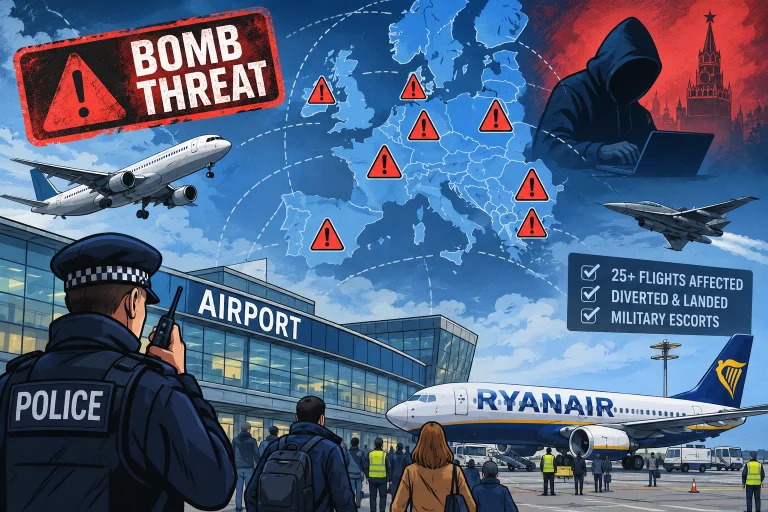
A series of hoax bomb threats hit European airlines, from Ireland to Bulgaria, on Thursday morning for the second time this week, with at least 25 affected flights making emergency landings or being escorted by fighter jets.
Although no state has directly accused anyone over the threats, they come at a time when many European officials have accused Russia of orchestrating sabotage and “hybrid attacks”, often low-cost and easily deniable, and not expected to trigger an armed response.
Denmark, Poland and Romania, all affected by Thursday’s disruptions, have previously accused Moscow directly, while Germany blamed Russia for an attack at Leipzig Airport in August, Reuters reports.
Britain has blamed Russia in the past, but linked Iran to an alleged plot to attack a US air base. Both Russia and Iran deny any involvement.
Eric Schouten, director of aviation security group “Dyami”, said that most of the countries affected support Ukraine in its war against the Russian invasion.
“Geopolitically, I think the hybrid warfare scenario should always be considered, where a country in this way, today we’re talking about Russia, right? – attacks us on multiple fronts, from railways to supermarkets and banks recently. The energy, internet and aviation sectors are among them,” he said.
Bulgaria’s air force said its fighter jets had escorted three aircraft to the ground. Officials said Ryanair flights from Copenhagen and Madrid to Sofia landed as scheduled, while a flight from London to Sofia was diverted to Plovdiv, Bulgaria’s second-largest city.
Spanish authorities received three bomb threats by email in less than 20 minutes, starting at around 09:00, involving two Air Europa departures from Madrid to Paris and four incoming Iberia flights from Rome and Milan, Spain’s Civil Guard said.
Several aircraft were stopped or returned to their stands and passengers disembarked while the planes were being inspected.
Two easyJet flights from Britain, one from Ireland and one from Greece landed on schedule in Prague after receiving bomb threats. Czech police said they had assessed the credibility of the threats as low.
Italy’s air force escorted a Finnair aircraft arriving from Helsinki to its scheduled landing in Rome, according to a source familiar with the matter. Rome’s airport operator said there had been no disruption to services.
Another Finnair flight from Helsinki, operated by Jettime, landed normally in Vienna after receiving a bomb threat, Finnair said.
Italian news agency ANSA reported that two aircraft had landed safely in Milan after receiving threats.
A LOT flight from Warsaw landed on schedule in Brussels after a security alert, the Polish airline said. It added that in Warsaw, a LOT flight to Paris was stopped while taxiing toward the runway for takeoff, and passengers were transferred to another aircraft as a precaution.
Aer Lingus flight EI402 from Dublin to Rome landed safely on Thursday at Evreux Airport, 100 km west of Paris, the Irish airline said.
Meanwhile, in Denmark, a military bomb disposal unit inspected two aircraft at Copenhagen Airport but found no suspicious devices, police said.
Eliran Almog, chief executive of aviation cybersecurity firm “Cyviation”, said repeated bomb threats could serve both to disrupt operations and to observe how airlines, airports and national authorities respond.
“These threats against aviation are also happening at the same time as cyberattacks on supermarket refrigeration systems across Europe,” Almog said.
“Various essential services are experiencing disruptions that carry economic costs and could undermine public trust.”
On Tuesday, at least seven flights and a cruise ship received bomb threats, causing disruption at airports across Europe, although no explosive devices were found.
Earlier this week, unidentified hackers switched off refrigerators in supermarkets in several European countries for the second time, also affecting French banks.








