
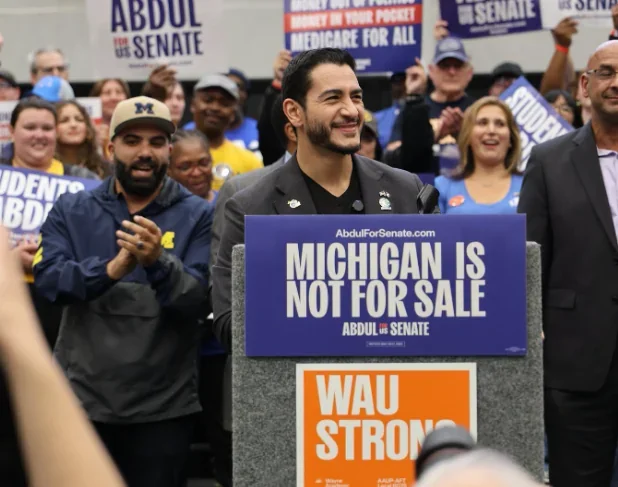
Democrat Abdul El-Sayed has defeated Republican Mike Rogers in a heated campaign for the open U.S. Senate seat from the state of Michigan. The victory marks a significant success for the left wing of the Democratic Party in one of the most important states, where races between the two parties are usually close, Associated Press reports.
El-Sayed, the son of Egyptian immigrants, will become the first Muslim senator in the history of the United States. The former public health official, who has never held an elected office, has gone from a double-digit defeat in the Democratic primary for Michigan governor eight years ago to winning a seat in the U.S. Senate.
“You took a risk by trusting me, the candidate who was least likely to win,” El-Sayed told supporters gathered in Detroit in the early hours of Wednesday as he declared victory. “Thank you. This is all yours.”
El-Sayed managed to withstand the massive spending of outside groups in both the Democratic primary and the general election through a campaign built on grassroots activism, pledges of universal health care, and sharp criticism of Israel.
Backed by progressive figures, including Congresswoman Alexandria Ocasio-Cortez, his victory could give the movement momentum ahead of the 2028 presidential election, demonstrating that candidates who embrace its agenda can also win in pivotal swing states. Democrats across the country scored sweeping victories, triumphing in both closely contested states and traditionally Republican ones to take control of both chambers of Congress.
Republicans had avoided a divisive primary to clear the way for Rogers, the former congressman who had narrowly lost a Senate race to then-Congresswoman Elissa Slotkin two years earlier. However, Rogers struggled to balance loyalty to President Donald Trump with concerns over rising prices linked to the war in Iran and economic turmoil caused by the president’s tariffs.
The campaign was also marked by fierce attacks over El-Sayed’s criticism of Israel. Trump and other Republicans repeatedly tried to link him to terrorist organizations, despite there being no evidence of such ties, and questioned his loyalty to the United States.
In his victory speech, El-Sayed said Republicans had “gone all in on one of the ugliest campaigns we have seen in our lifetimes.”
“They may have targeted my name and my faith, but we all know that my name and my faith aren’t the reason you can’t afford gas,” he said.
The race became one of the main battlegrounds in the national fight for control of the Senate after two-term Democratic Senator Gary Peters decided not to seek reelection.
El-Sayed emerged victorious from the August primary, which was marked by fierce clashes with Congresswoman Haley Stevens, who was backed by the party establishment. Outside groups spent nearly $60 million in the race.
The American Israel Public Affairs Committee (AIPAC) spent nearly $30 million opposing El-Sayed, its largest-ever investment in a single race. El-Sayed has been a staunch critic of Israel.
The primary exposed divisions within the Democratic coalition. El-Sayed faced criticism from some members of Michigan’s Jewish community over his rhetoric, including the statement “hurt people hurt people,” which he made after an attack on a Michigan synagogue earlier this year. He later apologized, saying he was sorry for “anyone who thinks my comments may have been hurtful.”
His campaign appearances with Hasan Piker, a well-known online political content streamer who has made provocative comments about Israel, Jews, and the September 11 attacks, also became a target of criticism.
The clashes peaked two days before the election, when Stevens endorsed Rogers after appearing with him at a church. She said El-Sayed had not done enough to address the concerns of some communities.
Some Democrats expressed concern that El-Sayed might fail to secure sufficient turnout among Black voters in Detroit, after Stevens won Wayne County in the primary. Former President Barack Obama and former Vice President Kamala Harris were among the prominent Democrats who campaigned with El-Sayed in the city in an effort to mobilize voters.
El-Sayed campaigned on an openly progressive platform that had raised concerns among some moderate Democrats. At the center of his platform was “Medicare for All,” a proposal aimed at replacing the current system of private and public health insurance with a single system funded and administered by the government.
Independent Senator Bernie Sanders helped build momentum for El-Sayed early in the campaign, while Ocasio-Cortez joined him in the campaign’s final days in Michigan’s Upper Peninsula and the Detroit area.
This victory will give progressives a powerful argument ahead of the 2028 presidential election: that their agenda can win even in the country’s most competitive states.
Republicans decided to bring Rogers back into the race after his narrow loss in 2024, when Slotkin won even though Trump carried Michigan by more than one percentage point.
Rogers, who had previously been a CNN commentator and criticized Trump, had moved closer to the president in recent years.
He tried to broaden his support among Democrats and independent voters, particularly among Black and Jewish voters.
But the political climate posed a new challenge for the Republican candidate. Rogers, who had chaired the House Intelligence Committee and built much of his career around national security issues, was forced to confront high gas prices and an unpopular war with Iran while maintaining his political closeness to Trump.
“The war with Iran must end, and as soon as possible,” Rogers had written on social media in September.
El-Sayed savored his victory, telling the Republican to enjoy “retirement.”
“You chose hate, while Michigan chose hope,” El-Sayed said. “I hope we never have to see people like you in this state again.”








