
The Government of Kosovo has warned that during the winter months, the country is expected to import increased amounts of electricity, which consequently means higher supply costs. According to the Government, this situation follows the failure to return Unit B1 of the “Kosova B” power plant to operation on time, for which the Government blames the European Union.
“Unit B1 of the “Kosova B” power plant is out of operation due to works on the project for electrostatic precipitators and NOx reduction, financed by the European Union, and delays in these works create uncertainty about its timely return to operation, which is expected to increase the need for imports during the period of highest consumption. Therefore, the Government considers that there is a public interest in imposing a temporary public service obligation on KEK, pursuant to Article 5, paragraph 1.1, of Law No. 05/L-085 on Electricity, to secure the cross-border capacity needed to import electricity from 1 December 2026 to 31 December 2026,” reads part of the Government’s rationale for the emergency measures introduced to ensure electricity supply.
DOCUMENT:
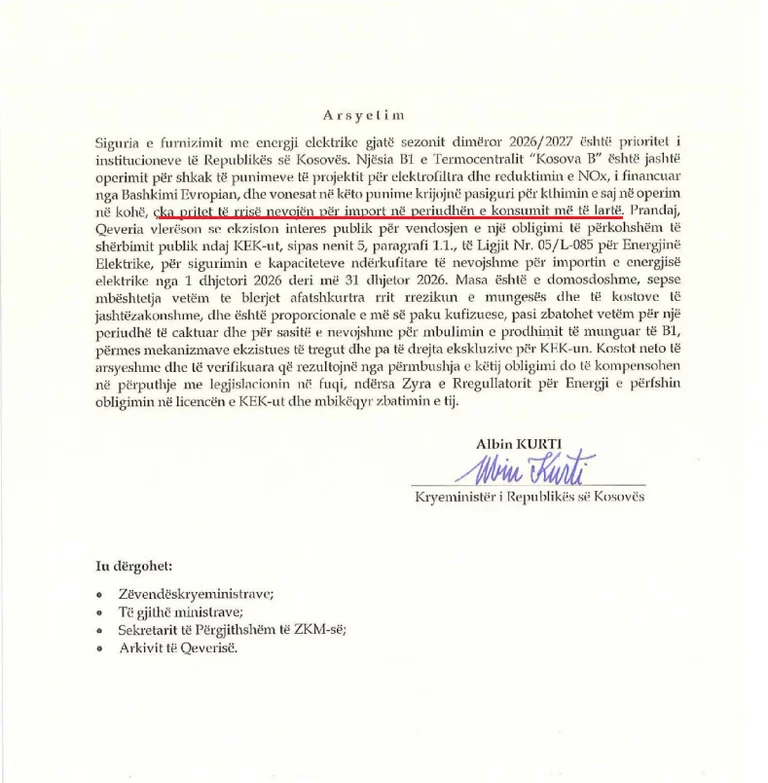
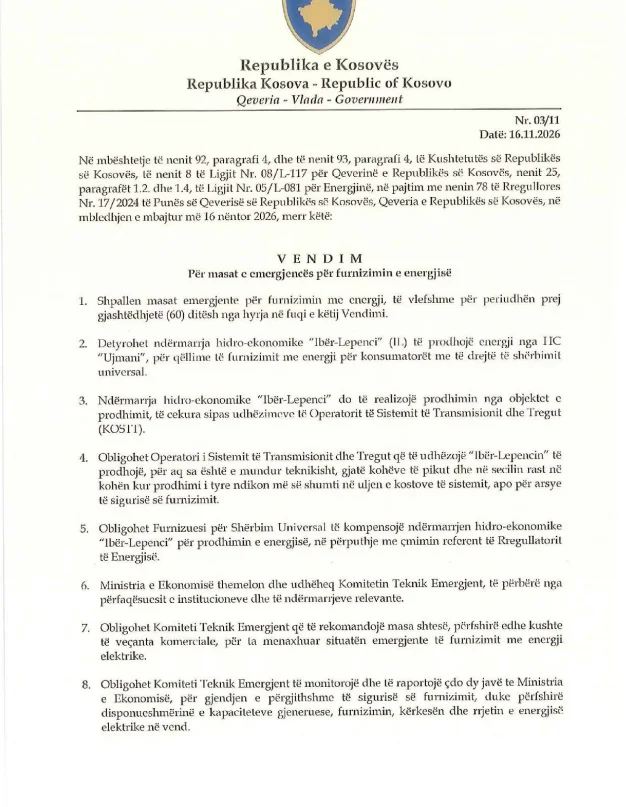
As part of the emergency measures, the Government has imposed an obligation on the Kosovo Energy Corporation to secure cross-border transmission capacity to address the shortfall in generation planned from Unit B1 of the “Kosova B” power plant. This will take place during December.
Other measures include:
The hydro-economic enterprise “Ibër-Lepenci” (IL) is required to generate electricity from the “Ujmani” hydroelectric power plant to supply consumers entitled to universal service.
The hydro-economic enterprise “Ibër-Lepenci” will generate electricity from its production facilities as specified in the instructions of the Transmission System and Market Operator (KOSTT).
The Transmission System and Market Operator is required to instruct “Ibër-Lepenci” to generate electricity, insofar as is technically possible, during peak hours and in each instance when its generation has the greatest impact on reducing system costs, or for reasons of security of supply.
The Universal Service Supplier is required to compensate the hydro-economic enterprise “Ibër-Lepenci” for electricity generation, in accordance with the Energy Regulator’s reference price.
The Ministry of Economy shall establish and lead the Emergency Technical Committee, composed of representatives of the relevant institutions and enterprises.
The Emergency Technical Committee is required to recommend additional measures, including special commercial terms, to manage the emergency electricity supply situation.
The Emergency Technical Committee is required to monitor the general state of security of supply and report to the Ministry of Economy every two weeks, including on the availability of generation capacity, electricity supply and demand, and the country’s electricity grid.
DOCUMENT:
B1 out of operation.
Minister of Economy Artane Rizvanolli has acknowledged that the Government failed to return Block B1 of the Kosovo Energy Corporation to operation on time. According to Rizvanolli, the European Union is to blame, as it financed and contracted the project. The final deadline for bringing this block back into operation was 25 November.
“As you know, this project was financed and contracted by the European Union back in 2019. According to the agreement between the EU and the contractor, the contractual deadline for completing the works, and consequently enabling the block to return to operation, was 25 November,” Rizvanolli said.
“However, the contractor for this project has experienced ongoing delays in carrying out the works. Since the European Union is the contracting authority for the project, as well as for the project’s supervising company, KEK’s focus, and ours as the Ministry and Government, has been on regular, close monitoring of the project and identifying shortcomings and concerns,” she added.
KEK is currently operating with three generating units: A3 and A4, as well as B2.








