
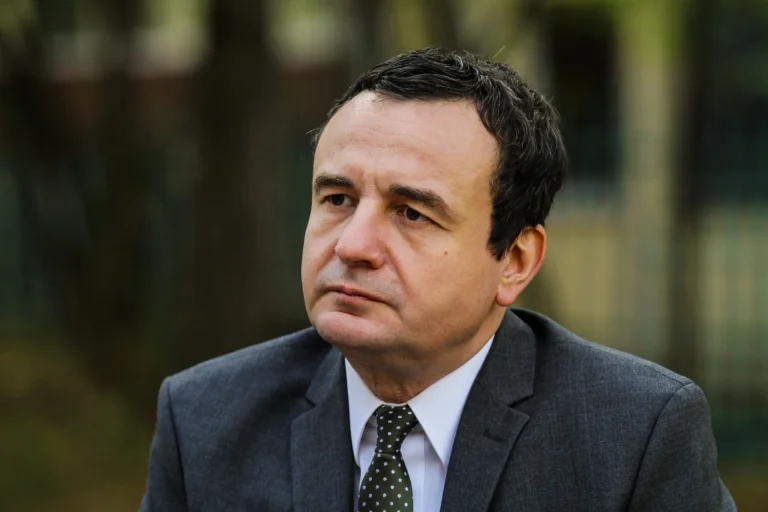
Kosovo’s Prime Minister, Albin Kurti, said in an interview with the prestigious French newspaper “Le Monde” that he welcomed Aleksandar Vučić’s defeat in Serbia’s elections, but said he did not know who had won, despite the winners—the Student List—having made their positions on Kosovo clear.
“We know who lost, but we still don’t know who won,” Kurti told “Le Monde” on Tuesday, November 10, as described, “in the basement of a luxury hotel in Paris’s eighth arrondissement.”
In Serbia’s parliamentary elections on October 25, the Student List won decisively, bringing an end to Aleksandar Vučić’s 14-year regime. But on Kosovo, the list has no differences whatsoever with Vučić. During a visit to Kosovo on November 8 and 9, its representatives, using Vučić’s rhetoric, propagated that Kosovo “is part of Serbia.”
Kurti also spoke about the five European Union countries that do not recognize Kosovo’s independence. He said that Slovakia is the country putting up the greatest resistance.
In this regard, “Le Monde” points out that Slovak Prime Minister Robert Fico makes no secret of his ideological closeness to Vladimir Putin, as well as to former Hungarian Prime Minister Viktor Orbán. “The Slovak went so far as to recently appear alongside Serbian nationalist leader Aleksandar Vučić during the election campaign for the October parliamentary elections, which ended with the opposition’s victory,” the prestigious French newspaper writes.
“These positions mean that Pristina continues to wait to be granted candidate-country status for membership in the European Union,” the “Le Monde” article continues.
Speaking about EU membership, the Prime Minister emphasized that he supports a merit-based process, without shortcuts.
“We do not want shortcuts, accelerated procedures or back doors into the European Union, but a merit-based process,” Kurti insists, who, according to “Le Monde,” “wants to preserve his reputation for integrity, which has made him popular in his country.”
For him, the European integration process is just as important as membership itself: “We must complete reforms in justice, public administration and education. These are our three priorities for the next four years.”








