
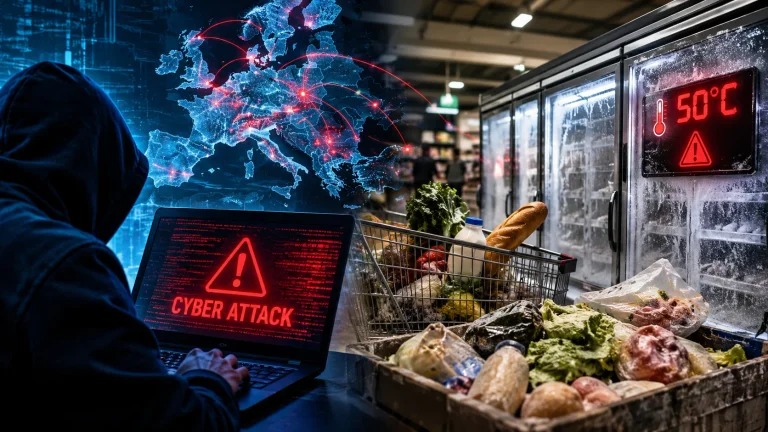
Supermarket refrigerators and freezers across Europe have been targeted in a cyberattack that raised the temperature of internet-connected equipment, destroying and damaging large quantities of food.
On Monday, refrigerators and freezers in more than 100 stores in several European countries began warming up. Cyberattacks on supermarkets began last month, when hundreds of French supermarkets were left with spoiled food and damaged equipment after their refrigeration systems overheated. The damage amounted to millions of euros.
So far, it remains unclear why the hackers targeted supermarkets, but the attacks have spread across the continent and even to the United States.
Which European countries have been targeted?
On Monday, several supermarkets in Europe were affected by the attacks, including:
Dutch supermarket operator Delhaize said dozens of its stores in Belgium and Luxembourg were hit by an “information technology incident”.
French retail chain Carrefour said around 15 of its 700 locations in Belgium experienced problems with their refrigeration systems.
Colruyt Group, which operates Spar stores in Belgium through a franchise system, said five of its stores were affected.
Swedish chain Coop said the refrigeration systems in seven of its 800 stores were affected, with disruptions ranging from complete shutdowns to partial operation.
Swedish furniture giant IKEA, which also operates restaurants in its stores, said one of its locations in Mons, Belgium, had been affected by a cyberattack.
De Laet & Van Haver, the Belgian meat chain, said the temperature in the refrigerators at its store in Hove, south of Antwerp, had risen to 18 degrees Celsius, rendering around 15,000 euros ($16,764) worth of meat unusable.
Food wholesaler Musgrave said a cyber incident had affected the refrigeration systems in 13 of its SuperValu stores in Ireland.
In October, hundreds of French supermarkets were hit by cyberattacks that caused tonnes of food to spoil, fires to break out and parts of refrigeration equipment to melt.
What happened in the US?
In August, freezers at a market in Fort Huachuca, a US military base in Arizona, switched to defrost mode, causing all the frozen food inside them to spoil, according to a notice posted by the base on Facebook.
That same month, the naval station in Newport, Rhode Island, said on Facebook that its refrigeration system had been affected, leaving only products that did not require refrigeration available for sale.
News agency Reuters reported late last month, citing four officials familiar with the matter, that the Pentagon considered freezer malfunctions at military bases to be a suspected cyberattack.
One official said Pentagon investigators were communicating with French authorities about the matter.
How are hackers attacking refrigerators and freezers?
Hackers can infiltrate the control systems of refrigerators and freezers that use internet-connected software and raise their temperature, causing frozen food to spoil.
In some cases, hackers have managed to raise equipment temperatures to as high as 50 degrees Celsius (122 degrees Fahrenheit) in European supermarkets, causing them to melt and even sparking fires.
Awais Rashid, a professor of cybersecurity at the University of Bristol in the United Kingdom, explained that many supermarket refrigeration systems, which are managed remotely and often by third-party companies, have not been equipped with the necessary software updates to protect them from hackers.
“In line with established cybersecurity practices, these systems should be managed through secure networks. However, that is not the case here, and they are accessible via the internet,” Rashid told Al Jazeera.
“A party carrying out remote management can access a web server located in the control unit to configure the system, including changing the temperature and carrying out maintenance. There are known vulnerabilities in some control units, many of which are already past their end-of-life date,” he said.
Rashid added that the vulnerabilities also include passwords that can be easily guessed, meaning that anyone could gain access to these systems.
Why are hackers doing this?
The motive behind the attacks remains unclear, but authorities believe it may be a deliberate attempt to disrupt food supplies.
On Monday, European Commissioner for Agriculture and Food Christophe Hansen said the attacks on refrigerators constituted a “deliberate attempt to disrupt” food supplies in the European Union and undermine consumer confidence.
He added that although “food security is not currently at risk, food waste and the impact on businesses are real”.
Rashid said that while little information is available about who may be behind the attacks or their motives, the main aim is highly likely to be causing disruption.
“This has financial consequences for supermarkets, but also social consequences in terms of the security of the food supply chain. Above all, it risks undermining confidence in the infrastructure on which people depend every day,” he said.
Who is behind the attacks?
On Monday, the Belgian Public Prosecutor’s Office announced that it had launched a criminal investigation into the recent cyberattacks on refrigerators.
However, no one has claimed responsibility for them so far.
Theories linking state actors to cyberattacks in general have emerged.
North Korea was recently accused of being behind the theft of $6.3 billion worth of cryptocurrency from the Binance platform last week.
The attack forced the cryptocurrency company to freeze accounts.
European intelligence officials have also warned that Russia is escalating its hybrid warfare across the continent amid its ongoing conflict with Ukraine. Cyberattacks are among the methods Moscow uses in this campaign.
On Tuesday, the United Kingdom’s National Cyber Security Centre warned that Britain must prepare for an artificial intelligence (AI)-enabled cyberattack that could hit its critical national infrastructure within the next two years.
“By 2028, Russia, China and other states are highly likely to routinely use AI-enabled cyberattacks to achieve their geopolitical objectives. The United Kingdom will face an increase in the scale and speed of sophisticated cyberattacks,” the National Cyber Security Centre’s report says.
The report was published shortly after the United Kingdom launched its “Be Ready” campaign, urging citizens to build up a three-day supply of canned food, bottled water and cash in case of a cyberattack or national emergency.
Rashid said that as our infrastructure becomes increasingly digitalised, the risk of disruptions caused by cyberattacks has also increased, particularly against “cyber-physical infrastructures, such as refrigeration systems”.
“However, we should emphasise that a large part of our digital infrastructure operates securely every day precisely because good security practices make this possible. The world works because cybersecurity works effectively. It is therefore important for all businesses to implement good cybersecurity practices,” he said.








