
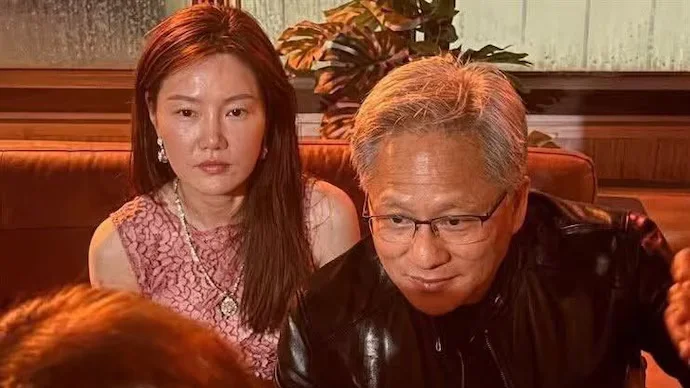
Nvidia said Sunday that it had launched an investigation into Jensen Huang, its chief executive and co-founder, after he admitted to the company’s board that he had had an intimate relationship with a businesswoman whom U.S. intelligence determined was a Chinese spy.
Huang’s relationship with the woman, who is known as Alice Huang, became a concern for the U.S. government after wiretaps revealed that she was passing information directly to Beijing.
The revelation raised concerns because Huang is one of the most powerful figures in the Artificial Intelligence revolution, as well as an influential ally of President Trump.
In a message to the company, Huang apologized.
“I have been unfaithful to my wife,” he said. “My actions hurt her and our children. There is no excuse for what I did. I am deeply sorry.”
Nvidia’s board said it had “no reason to believe that national security or Nvidia secrets have been compromised,” but that “the board’s investigation will examine all available information.”
The board said Huang “fully supports the review and has pledged to cooperate with it.”
The independent board members will select outside legal counsel to conduct the investigation. John Rizzo, a company spokesman, said Huang would not be part of the selection process, the New York Times reported.
Huang, 63, will continue to lead the company during the investigation, the board said.
As a co-founder, he has built a unique structure at Nvidia in which he dictates every aspect of its business, while overseeing around 60 people who report directly to him.
“Today’s news will not slow Nvidia down,” Mr. Rizzo said. “Jensen is committed to continuing to lead Nvidia as C.E.O. without interruption.”
In a brief statement to reporters Sunday evening, as he was preparing to leave Florida, Donald Trump came to Huang’s defense.
The president said he would “definitely take him” with him on his next trip to China. “I haven’t heard that he did anything wrong,” Trump said.
“He had a relationship with someone, but, you know, everybody else does the same thing.”
Trump said he had not spoken with Huang about the situation.
“I just know that he’s a good man, but you never know what’s going on,” Trump said.
He added that he did not regret his inaction when he was informed about a year earlier that the U.S. intelligence community was electronically surveilling Huang.
“I think he’s an honorable man. I think he probably has an explanation for it. You have to hear him out. No, you can’t do this to people,” Trump said.
“He’s done an extraordinary job for our country.”
Asked whether Huang should continue as Nvidia’s chief executive, Trump said:
“I think so. Yes, definitely.”
Public attention to Huang’s ties to Alice Huang began after The New York Times first reported last month that U.S. intelligence agencies had discovered that Huang had developed a close relationship with a Chinese national and chip buyer whom U.S. officials concluded was gathering secret information for Beijing.
The chip buyer was Ms. Huang, or Huang Le, whose biography said she had worked in China as a television journalist before becoming a senior executive at a Singapore-based data center company that had become one of Nvidia’s biggest customers in Southeast Asia. She had bought more than $4.8 billion worth of chips since June 2024.
Nvidia has continued doing business with Ms. Huang’s company, Megaspeed, even after The Times reported last year that the Commerce Department was investigating how much the company was helping China smuggle restricted Artificial Intelligence chips. (Mr. Huang and Ms. Huang are not related.)
Nvidia and Mr. Huang initially said there was nothing problematic or unusual about his relationship with Alice Huang.
In an interview with Bloomberg News last month, he said his interactions with Ms. Huang had been “related to Megaspeed, and everything was completely normal and not unusual.”
The relationship and affair are a rare misstep for Mr. Huang.
Over the past three years, he seemed unable to make a mistake.
His chipmaking company, which creates the technology for building artificial intelligence, grew into one of the world’s most valuable companies and the high-speed engine of data centers powering the U.S. economy.
Trump became an ally and invited him aboard Air Force One. People began following him around public events to get his autograph. And his black leather jackets, which he wears every day, became collector’s items.
As his business rapidly grew, Huang put his family at its center. His son, Spencer, is a director of product management and plays a leading role in the company’s robotics efforts.
His daughter, Madison, is a senior director of product marketing, and also works on robotics as well as the company’s communications and marketing efforts.
His son-in-law, Nico Caprez, is part of the company’s business development team.
Huang has credited his wife, Lori, whom he married in 1985, with making it possible for him to build the company. They met when he was a teenage engineering student at Oregon State University. She was one of three women in a 250-person engineering lab. Huang, who had skipped two years of high school, arranged to be in her lab group and tried to impress her with his intellect.
“I know I look like a kid, and so her first impression of me is that I’m pretty smart,” Mr. Huang said during a 2024 discussion about his career at the Hong Kong University of Science and Technology. “I sat next to her and said, ‘Would you like to see my homework?’ Then I made her a promise: ‘If you do homework with me every Sunday, I promise you’ll get straight A’s.’”
Huang also promised her that by the time he was 30, he would be the chief executive of a company. He fulfilled that promise when he co-founded Nvidia in 1993, shortly after turning 30.
“Lori took care of everything, and I don’t remember her complaining even once,” Mr. Huang said on the “How I Built This” podcast. “That’s the gift she gave me.”
The U.S. government, which had been investigating Megaspeed over the possibility that it was diverting Nvidia’s advanced AI chips to China, began surveilling Ms. Huang more than a year ago. During the surveillance, they discovered that she was communicating with a U.S. citizen identified as Mr. Huang.
Officials who had seen that classified information said they were certain the relationship was romantic.
This contradicted Nvidia’s earlier misleading statements to The Times and others over the past year about the nature of Jensen Huang’s relationship with Alice Huang.
This spring, Secretary of State Marco Rubio oversaw the drafting of a highly classified memorandum detailing intelligence showing that Alice Huang had been recruited by China’s Ministry of State Security to target Mr. Huang.
That memorandum was circulated not long before the president’s trip to China earlier this year.
As news of the U.S. surveillance of Ms. Huang became public, Mr. Huang’s room for maneuver almost completely disappeared.
Congress wanted him to testify, possibly under oath, and reports about the surveillance raised the possibility that U.S. intelligence knew the nature of his relationship with Ms. Huang.
This also put pressure on Nvidia’s board.
In a social media post last month, Senator Elizabeth Warren, the Massachusetts Democrat who is the ranking member of the Senate Banking Committee (which oversees chip sales overseas), said Mr. Huang and the company’s board “owe Congress answers” about his relationship with the spy.
Megaspeed was established in 2023, when a Chinese online gaming company spun off its Singapore subsidiary. Shortly before that, the U.S. government had issued its first broad ban on the sale of Artificial Intelligence chips to China.
Ms. Huang was listed as Megaspeed’s managing director when it was established, and later described herself as its chief executive.
Information about Ms. Huang’s background is largely absent from the Chinese internet, but according to an online biography, she worked at several of China’s major banks.
She later joined a Shanghai-based fund with ties to wealthy investors and technology companies involved in data center projects in China, according to a review of corporate and trade records compiled by the WireScreen and Sayari platforms, as well as an analysis by the Center for Advanced Defense Studies, a Washington-based nonprofit.
The network of those companies has helped build a massive data center outside Shanghai that serves the Chinese company Tencent.
It also has financial ties to China’s military organizations through an investment in a cybersecurity subsidiary of China Electronics Technology Group, one of the country’s largest military technology manufacturers.
As Megaspeed’s chip purchases continued to grow, Huang and Alice Huang began spending time together.
In June 2024, he joined her at a bar in Taipei after a local technology trade show. They drank whiskey with other AI executives.
A year later, they had dinner at a restaurant in Taipei with other executives. Taiwanese media caught her giving him a kiss on the cheek and standing behind him as he spoke to reporters.
Their relationship became a preoccupation in Washington, where officials were already alarmed by the sheer volume of Megaspeed’s purchases.
“This is a classic move from the Chinese Communist Party (CCP) playbook — and another example of why it can never be trusted,” Representative Michael McCaul, a Texas Republican who is vice chairman of the House Homeland Security Committee, wrote on social media.
“The U.S. must immediately suspend shipments of advanced AI chips to China until we can get to the bottom of this incident and ensure our national security is not being undermined.”








