
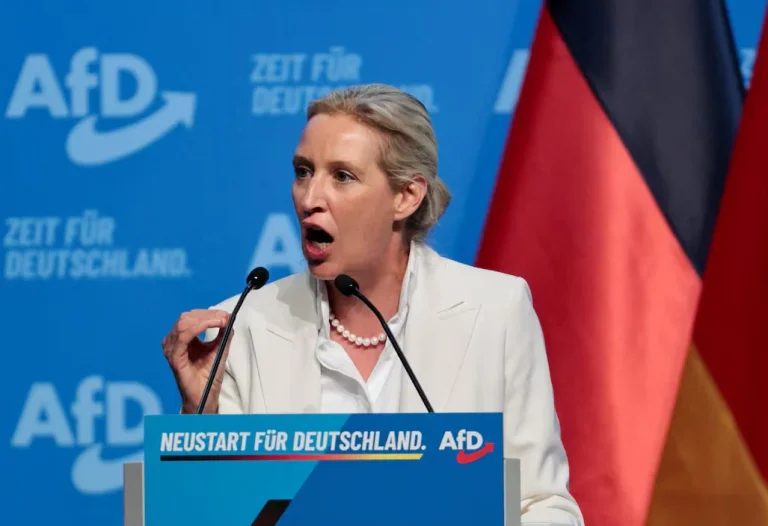
The far-right party Alternative for Germany (AfD), founded more than a decade ago in opposition to the way the European Union handled the euro crisis, is recalibrating its vision for Europe as it and its right-wing allies in other countries gain influence, Reuters writes.
After a historic victory in regional elections in Saxony-Anhalt in September, the party, Germany’s most popular according to national polls, now appears closer than ever to entering the federal government before the end of this decade.
This prospect has sparked debate about how to balance its anti-establishment identity with the need to present itself as a credible partner for potential allies at home and abroad.
Founded in 2013 amid discontent over financial bailout packages for heavily indebted eurozone member states, the AfD began as a movement against the common currency.
It later expanded its criticism to the European Union itself, but gained support above all through its opposition to immigration—a stance that its opponents and Germany’s domestic intelligence agency say dangerously approaches supremacism and xenophobia, which have left a dark mark on Germany’s recent past, the Reuters article continues.
The AfD rejects accusations of extremism, while many of its members now argue that the growing acceptance of more radical right-wing views and the increasing influence of similarly oriented parties in other parts of Europe make reforming the EU from within more useful than abandoning it entirely.
“At no time since the end of the Second World War have the prospects for reforming the EU in line with our vision been better,” said AfD member of the federal parliament Sebastian Muenzenmaier.
However, the goal of leaving the euro—a significant one for many of the AfD’s founders and early supporters—has proved more difficult to address.
Younger members, such as Jean-Pascal Hohm, the 29-year-old who leads the party’s youth wing, Generation Deutschland, argue that hard-line positions on Europe could complicate the AfD’s more realistic path to federal power: eventual cooperation with Chancellor Friedrich Merz’s conservative Christian Democrats (CDU), who currently rule out any alliance with it.
Last month, AfD co-leader Alice Weidel presented a strategic document in the European Parliament in Strasbourg for a “New Deal for Europe”, together with her allies in the Europe of Sovereign Nations (ESN) group.
The document shifts the focus away from leaving the eurozone and the EU, concentrating instead on renegotiating treaties to create a looser union.
It proposes a mechanism allowing member states that oppose common policies to opt out of implementing them, for example in the areas of defence spending or immigration, as well as stricter enforcement of budget rules. This leaves open the possibility of keeping the euro as the currency.
If reform efforts fail, the document suggests that the question of Germany’s future direction in Europe be decided by referendum.
Weidel told reporters that the AfD and ESN are committed to “a European union, a Europe of the fatherlands”, but refused to say whether she still wants Germany to leave the eurozone or the European Union.
By setting aside its opposition, the AfD would follow a path already taken by far-right parties that have succeeded in other eurozone countries.
France’s National Rally campaigned for a long time to abandon the euro, but gradually dropped this demand under Marine Le Pen’s leadership in an effort to broaden its support. The party is now considered the favourite to win next year’s presidential election.
In Italy, Prime Minister Giorgia Meloni’s Brothers of Italy party has toned down its Eurosceptic rhetoric since coming to power, choosing instead to pursue its objectives within the EU.
Closer to Germany, Austria’s far-right Freedom Party (FPOe), which has close ties to the AfD, dropped most of its anti-European positions on its way to gaining a share of power in national governing coalitions.
“Austria serves as a model for the AfD,” said Wolfgang Schroeder, a professor of political science at the University of Kassel.
“In this sense, it is perhaps only a matter of time before they abandon these positions,” Schroeder said, adding that he does not believe this will provoke significant resistance.
In any case, Germany’s economy is so interconnected with the global market and so dependent on exports that leaving the EU or the euro would be a catastrophe, he said.
“A move toward autarky, like the one Hitler pursued in 1933, is practically impossible under these circumstances, unless someone is willing to risk the collapse of the entire national economy.”
Hohm and his younger colleagues in the AfD make a similar argument. They say that changing political realities in Europe, as well as growing competition from China and an unreliable United States, make greater cooperation within the EU necessary, not less.
“If we were to essentially abolish the common currency and everyone were once again to go their own way, that would be completely utopian and would also cause us great harm,” Hohm said.
“Young Europeans, regardless of nationality, increasingly see themselves as Europeans and are less willing to carry on their grandparents’ conflicts.”
However, within the party itself, the issue is far from settled.
At a congress held in August, Hohm put forward a resolution stating: “Generation Deutschland is committed to the European idea… Europe is more than an economic area, more than a monetary union, and more than the European Union.”
However, although the resolution was drafted to emphasise the EU’s role in strengthening shared history and heritage, rather than economic cooperation, it was withdrawn after failing to secure sufficient support.
“The euro issue proved more contentious than we had expected,” he said.








