
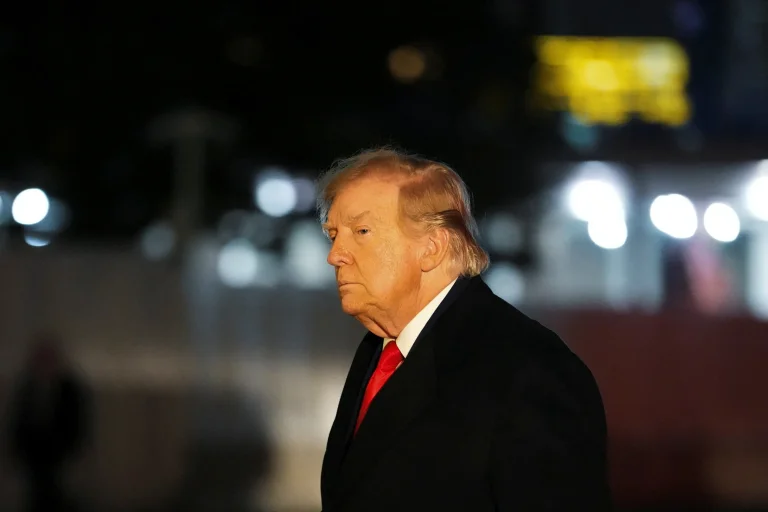
From Texas to Maine, Democratic voters flocked to polling stations on Tuesday.
Independent voters turned their backs on President Trump. Meanwhile, Republicans seemed to be gradually freeing themselves from the influence of a president who has defined American politics for a decade, The New York Times writes.
In interviews and at the ballot box, citizens said they were unhappy with the direction their country was heading and wanted change.
In 2024, Joshua Buchanan, 39, a train design engineer in Woodruff, South Carolina, voted for Mr. Trump. Two years later, he had begun to regret it.
“I most likely made the wrong choice,” said Buchanan, who this time voted for Annie Andrews, the Democratic Senate candidate.
Her victory over Darline Graham, the Republican candidate backed by Trump, would have been unimaginable until not so long ago.
Donald Trump shook up the American political system a decade ago, electrifying working-class voters with his populist and hard-hitting message.
But as the second half of his second presidential term approaches, support for him has fallen sharply under the weight of unpopular economic policies and the war with Iran.
Democrats, who had been demoralized just two years ago, were now filled with anger and determination to head to the polls. The candidates for governor, Senate or House of Representatives themselves seemed to have almost taken a back seat.
“I’d crawl on my belly over broken glass just to vote against that terrible man,” said Ronan Donohoe, 85, a retired high school history teacher in Portsmouth, New Hampshire.
He said his vote for Democrats on Tuesday was meant to “make it clear to everyone that we’ve had enough of everything the Trump administration represents and that we want something better.”
In interviews, voters often expressed dissatisfaction with the high cost of living.
Prices remain significantly higher than before the pandemic, but voters said Trump, who had promised to lower prices in 2024, now seemed to be dismissing their concerns.
“He doesn’t know what it means to stop at a gas station and fill your car with gas,” said Suzanne Murray, 78, a retired hairdresser in Phoenix.
“He doesn’t know what it means to go to a grocery store and buy food on a limited income.”
She added: “He is so irresponsible in the way he treats the United States.”
Murray leans Democratic, but Republicans also voiced dissatisfaction with Trump. Their reasons included the cost of living, the Epstein files and corruption. Meanwhile, a number of more traditional Republicans said in interviews that they no longer recognized their party.
“The Republican Party has lost its way,” said Van Z. Hampton, 71, a registered Republican in Dodge City, Kansas, who said he had voted for all Democratic candidates for the first time since the days of Jimmy Carter, in 1976.
Hampton, a retired former Kansas state judge, had voted for Trump twice but had now turned away from him because of what he described as rampant corruption.
“The ship has been hijacked by thieves,” he said, referring to how the Trump administration was running the U.S. government. “It’s heading in the wrong direction—toward their shore, so they can loot it and empty it.”
For Dan Bailey, a garbage truck driver from Glen Cove, New York, the reasons were Trump’s cavalier dismissal of the Epstein files and the makeup of his cabinet, which, he said, included “a secretary of war who knows nothing about war.”
“I’m tired of being lied to,” said Bailey, who said he had hardly voted throughout his adult life but went to the polls on Tuesday and voted for all the Democratic candidates. “I feel there has to be some kind of change. I hope my small contribution will make a difference too.”
Although election night may have brought a sweeping victory for Democrats, it was far from a clear political mandate.
Many Republicans and independent voters said they had crossed over simply to stop a president who, they felt, no longer represented them.
For example, Hampton, the former judge from Kansas, had some advice for the Democrats who won on Tuesday: They won the votes “not because we love you, but because we need you to do the right thing. Be wise in how you handle the support you’ve received.”
Many voters expressed deep concern about where they fit in the political system.
Many of them said they felt as though they no longer had a political home.
Trump has so thoroughly defined the identity of the Republican Party that it is difficult to predict what it will stand for after he leaves office.
Many other voters also found it difficult to define the Democratic Party beyond its opposition to Trump.
“There are no Republicans or Democrats anymore,” said A.J. Asci, 49, who works in the hospitality industry in Savannah, Georgia. “America seems more uncertain than ever.”
Asci immigrated from Turkey and became a U.S. citizen 18 years ago. He said everything he had learned about life in America, he had learned from his former neighbor, whom he still visits in a nursing home. But life in America today seems unstable to him: he does not believe he will be able to afford to retire in this country.
He also believes that the money flowing into politics is obstructing the workings of American democracy.
“You can’t ensure justice and enforce laws if you’re being paid by someone else,” he said. “It’s a corrupt system.”
Many voters spoke of their concern about the harsh language and hatred that have taken over political discourse, saying that one of the reasons they voted was to oppose this climate.
Sheldon McCormick, 68, a handyman who was standing outside the polling station in Waldo, Maine, said he would vote for anyone who stands up for civility and respect in communication.
“Dignity and courtesy mean a lot to me,” he said.
“There is good in this world, and it’s time we returned to it.”
McCormick, a registered independent voter, said he split his vote between the parties: he voted for Susan Collins, the Republican senator, and Matt Dunlap, the Democratic candidate for Congress.
Lamont Fisher, 46, an independent voter in Austin, Texas, expressed the same dissatisfaction with the angry politics in the country.
“Why do we have to be so extreme that we can’t accept someone else’s views?” said Fisher, a broadband internet network technician who grew up in a Republican family. “At the end of the day, we all live in the same country.”
He said he had voted for James Talarico, who will be the first Democratic senator from Texas in several decades.
“His view is: I want purple,” said Fisher. “I believe in that too.”
Still, not everyone thinks that way. A number of Republican voters said they were completely satisfied with Trump and had voted for all Republican candidates without hesitation.
“I don’t live with that man,” said Ofelia Armendarez, a registration clerk at an elementary school in Visalia, California, who had voted for Trump three times. “If he’s doing the job right, that’s all that matters to me.”
One of their biggest concerns was the possibility of Democratic Socialists taking power, a concern that far outweighed any dissatisfaction with Trump.
Patricia Fay, 69, a retired software engineer in Phoenix, said she usually did not vote for all Republican candidates, but on Tuesday she had done so.
“I don’t want Arizona to turn into another New York or Southern California,” she said. In her view, socialists want “everything for free.”








