
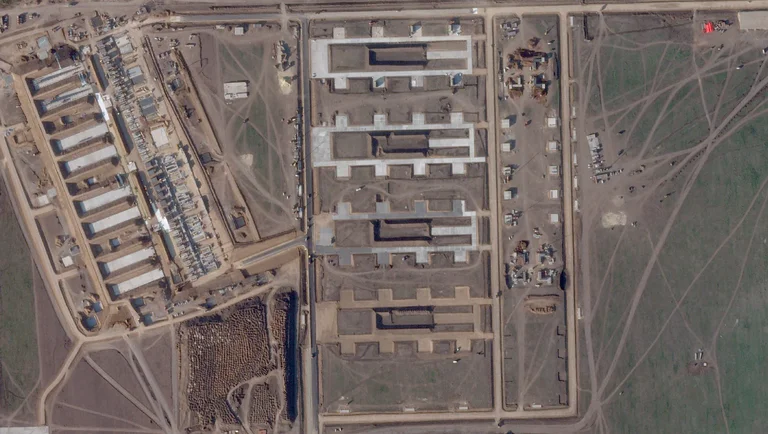
Russia is close to completing construction of a major new base for launching jet-powered drones in just six weeks, according to defense experts and a Reuters analysis of satellite images. This is the latest expansion of its offensive capabilities near Ukraine, Reuters reports.
According to commercial images obtained from Planet Labs and Airbus, the site that was an empty field on August 31 in Russia’s southwestern Rostov region had, by Wednesday, been transformed into a large complex covering an area equivalent to about 126 football fields.
The construction coincides with the increased use of Russian jet-powered attack drones against Ukraine, which is struggling to intercept these faster weapons, capable of reaching speeds of up to 600 kilometers per hour, the Reuters report continues.
Mike Monnik, founder and chief executive of private intelligence company DroneSec, said the facility shown in the images could be used to launch the Geran-4 and Geran-5, Russia’s newest types of jet-powered drones.
He said eight launch platforms with rails, capable of launching these drones, were visible at the western edge of the complex. This would add to Russia’s existing network, which includes at least 11 permanent launch bases used for drone attacks against Ukraine.
“The speed of construction … demonstrates how easily Russia can rapidly bring its already established offensive capabilities into use,” Monnik said.
According to him, the facility appeared close to completion and “it will probably take only a few weeks, if not less, to become fully operational.”
Reuters says construction of the facility “coincides with deteriorating relations between Russia and the NATO military alliance.”
European governments accuse Moscow of intensifying a campaign of sabotage, drone incursions, and cyberattacks against them. Meanwhile, Russia warned last month that it could use nuclear weapons if NATO tried to wrest away its Kaliningrad exclave, the Reuters report continues.
Monnik said that the combination of industrial production of jet-powered drones, their increasing sophistication, and the relative lack of comprehensive anti-drone systems in many NATO countries poses a challenge to the West.
“This ability to rapidly bring into operation a capability to carry out large-scale attacks using unmanned aerial systems (UAS) constitutes a strategic vulnerability for NATO countries,” he said.
Monnik noted that the facility may have the capacity to launch 100 or more jet-powered drones within 24 hours, although Russia typically launches them in small numbers throughout the day. This would also depend on factors such as available supplies and the targets of the attack.
The main difference between jet-powered drones and their piston-engine predecessors, Reuters says, is their higher speed. The share of faster drones has increased significantly, while the use of slower drones has declined.
Rob Jordan, program director at the London-based research institute RUSI, said the concrete platforms and two possible launch rails visible in the images matched the configuration of launch runways for Russian Geran drones.
“This scale of construction in such a short time is impressive,” he said. “It shows the relative confidence Russia is placing in its capacity to carry out deep strikes into enemy territory, perhaps at the expense of its conventional ground forces.”
Military analysts say Russia has shifted its drone production capabilities toward jet-powered models, while Ukraine is struggling to counter them.
According to Ukrainian military data reported by Reuters last month, Russia increased its use of jet-powered drones about sixfold during the three months of this summer. The data showed that Kyiv and the surrounding region were targeted the most.
These drones pose a problem because they are too fast to be intercepted by Ukrainian-designed interceptor drones, which are intended to cheaply shoot down their slower, piston-powered predecessors. Kyiv is now urgently trying to find a solution.
Aerial images of the new facility taken on August 31 showed several vehicles in a field, but no signs of construction work. Images taken the following morning showed that construction had begun.
The facility, which covers an area of about 0.9 square kilometers, is located about 3.5 kilometers from Russia’s Millerovo air base, where the 31st Guards Fighter Aviation Regiment is stationed.
According to DroneSec, the new launch base is likely to be within the air defense “umbrella” provided by systems deployed at the air base, making Ukraine’s efforts to strike the new facility more difficult.
A Reuters analysis showed that two of the eight launch platforms already had rails installed. Rails were also being built on two other platforms, while further construction work could be seen from space during three days this week.








