
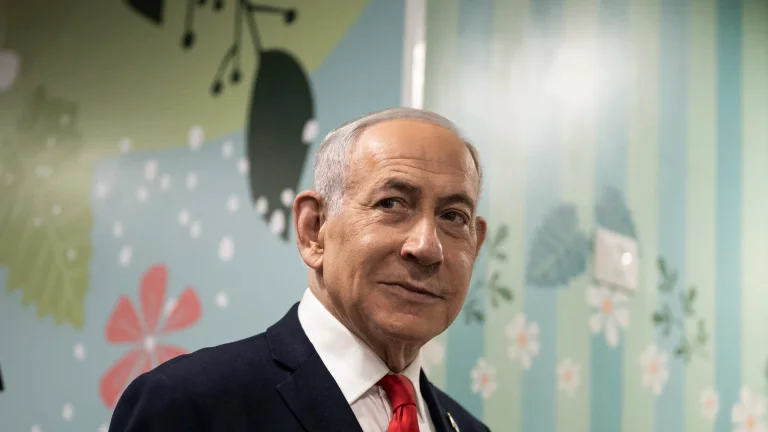
The bloc of Israeli Prime Minister Benjamin Netanyahu is maintaining its lead as vote counting nears completion.
As The Jerusalem Post reports, Netanyahu and his allies are expected to have 53 seats in the Knesset (the Israeli parliament), while the opposition bloc is expected to win 48 seats.
According to Israel’s Central Elections Committee, more than five million votes from Tuesday’s elections have been counted so far.
Both blocs fell short of the 61 seats needed for a majority in the Knesset, unless they secure the support of the Arab parties, which, according to the latest count, have won a combined record number of 19 seats.
Official vote counting reached 97% on Thursday afternoon, with only the votes cast in double envelopes yet to be included.
These ballots allow eligible Israelis, including soldiers, hospital patients, prisoners and some election workers, to vote outside their designated polling stations. They could significantly affect the final election result.
According to the official count, Netanyahu’s Likud party is projected to win 27 seats, once again becoming the largest party in the Knesset.
The United Torah Judaism and Jewish Power (Otzma Yehudit) parties were expected to win seven seats each, while the Religious Zionist Party and Shas were each expected to win six seats.
Most of the polls published by television channels before the election projected that Likud would win significantly fewer seats, while the other parties in Netanyahu’s bloc were expected to get more.
Data from the Central Elections Committee show that the opposition bloc, made up of Yashar, B’Yachad, Yisrael Beytenu and the Democrats, will win 48 seats.
Yashar, led by Gadi Eisenkot, is expected to win 21 seats. B’Yachad, headed by Naftali Bennett, is expected to win 12 seats. Yair Golan’s Democrats are projected to win eight seats, while Avigdor Liberman’s Yisrael Beytenu is projected to win seven.
Ofer Winter’s People of Israel party and Yoaz Hendel’s Reservists’ Economy party are likely to fail to cross the 3.25 percent electoral threshold. This could make it even harder for Netanyahu’s bloc to secure a majority.
Despite the results, the possibility of forming a unity government between Netanyahu and Eisenkot is slim, Israeli media write. Eisenkot has refused to serve in a government led by Netanyahu, including one with a rotating prime ministership. Other opposition leaders have also ruled out joining a coalition led by Netanyahu.
The political deadlock could eventually lead to new elections, although the parties may still reach an agreement through coalition negotiations.
By law, the president must consult with the Knesset’s parliamentary groups before deciding whom to entrust with the mandate to form a government.
Israeli President Isaac Herzog urged political leaders on Wednesday to approach coalition negotiations with an open mind, warning that Israel must do everything possible to avoid another election.
“One thing must be understood, something I said before the election as well: we must do everything, especially after yesterday, to avoid another round of elections,” he said. “Therefore, I expect everyone who comes here to come with an open mind,” Herzog added.
He was referring to the consultations expected to take place at the Presidential Residence.
Golan confirmed on Wednesday that he would meet with three opposition leaders on Thursday. In an interview with Channel 12, he declined to identify them.
Earlier, on Wednesday morning, Golan called on the opposition bloc to form a government with the Arab parties. He said Netanyahu had lost the election, winning around 55 seats compared with the opposition’s 65, including the Arab parties.
“Netanyahu lost,” Golan wrote on social media. “I know how to count to 120. Sixty-five is more than 55. That’s how Israeli democracy works. Period.”
“We have no future here unless we stop being afraid… We must no longer accept Netanyahu’s racist division between Jewish votes and Arab votes,” he added.
All the other opposition party leaders have said that including the Arab parties in a government is a red line for them, following the events of October 7, 2023.
Eisenkot has called for the leader of the largest party in the opposition bloc to become the bloc’s candidate for prime minister, although no agreement on this issue has been announced within the opposition.
On Tuesday evening, he declared victory for the opposition bloc after exit polls showed Yashar in the lead. Later that night, Netanyahu also delivered a victory speech, after the vote count showed his bloc with a clear lead.
The political deadlock has also raised the possibility of forming a minority government, which could win a confidence vote in the Knesset without having an absolute majority of 61 seats. In this scenario, the Arab parties could agree to support the opposition bloc.
Representatives of the Arab parties have said that everything possible must be done to prevent Netanyahu from remaining in power.
Objections within the opposition to relying on the Arab parties could make such an agreement difficult. Liberman openly opposed this possibility even before the election.








