
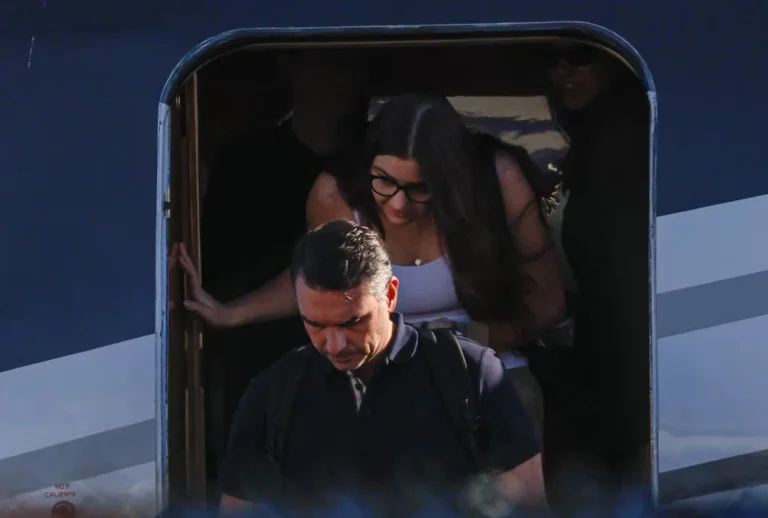
Brazilian Senator Flavio Bolsonaro declared himself Brazil’s legitimate leader on Wednesday after arriving in the United States. He claimed he was the victim of an electoral coup organized by the country’s Supreme Court and President Luiz Inácio Lula da Silva, who won the election by a margin of more than 4 million votes.
Bolsonaro arrived in Miami after leaving Brazil, where he had refused to comply with a Supreme Court order to surrender his passports. He thanked Argentine President Javier Milei for the assistance he provided in making the trip possible, as well as US President Donald Trump, who granted him and his family visas to enter the US and welcomed them there.
In an open letter, initially published on the social network X, Bolsonaro declared himself the “President-elect.” Later, Reuters reports, he deleted that version and replaced it with another letter, in which he described himself as Brazil’s “legitimate leader.”
“I want to tell not only my 60 million voters, but also the Brazilian people, that I am the leader and that the criminals who stole Brazil’s election are part of a criminal organization that has imposed a tyranny,” he declared in the updated version of the letter.
Lula’s victory has been recognized by Brazil’s federal electoral court, world leaders, international observers and Bolsonaro’s own party.
Brazil’s elections were conducted in full compliance with legal and constitutional requirements, the head of the electoral authority, Kassio Nunes Marques, said in a statement, without referring to Bolsonaro’s letter.
Asked by reporters at Joint Base Andrews about Bolsonaro’s statements, Trump declined to comment, but reiterated his earlier position that it had been a “very strange election.”
Bolsonaro’s statement, Reuters writes, poses a problem for Washington as the US administration tries to manage its rift with Latin America’s largest country, which possesses the world’s second-largest reserves of rare earth elements.
Lula has accused Washington of working with the Bolsonaro family to help them return to power. Ahead of Sunday’s election, Reuters reported on a US State Department campaign aimed at restoring the Bolsonaro family to power. Washington denies interfering in Brazil’s internal affairs.
Trump has previously claimed that Flavio’s father, former President Jair Bolsonaro, was the victim of judicial persecution.
Jair Bolsonaro traveled to the United States after refusing to accept his defeat to Lula in 2022. He eventually returned to Brazil, but was sentenced to 27 years in prison for plotting a coup after his supporters attacked government buildings in the capital, Brasília.
The US State Department had not immediately responded.
Lula, who had served a prison sentence on corruption charges that were later overturned, said this week that it was “shameful” that Bolsonaro had not stayed in Brazil to prove his innocence.
Bolsonaro left Brazil in secret after the Supreme Court issued the order related to a money-laundering investigation, in which he denies any wrongdoing.
Bolsonaro, who was widely considered the favorite to win Sunday’s election, presented no evidence for his claims of election fraud, Reuters writes.
He based his challenge to the result on the fact that a Supreme Court judge appointed by Lula had extended voting by two hours on Sunday. The decision followed claims by Lula’s campaign that voters were being prevented from voting in the northeastern states, where support for the left is high.
However, Bolsonaro’s campaign had also requested an extension of voting hours because of rain in the southern states, where conservatives enjoy strong support.
Bolsonaro lost to Lula by about 4.5 million votes. According to an analysis by Professor Pedro Burgos of the Insper Institute, fewer than 35,000 votes were cast during the extra two hours of voting ordered by the Supreme Court, or about 0.03 percent of the total.
Analysts say Bolsonaro’s request to annul the election result is unlikely to succeed.
In his letter, Bolsonaro denied that he had left Brazil to evade justice. He said he had left to protect himself and his family, and to avoid what he described as a “witch hunt,” which he accused Lula and Brazil’s Supreme Court of conducting against him.
“I want to make this clear: I did not flee Brazil. I left Brazil, but I did not abandon the Brazilian people,” he declared.








