
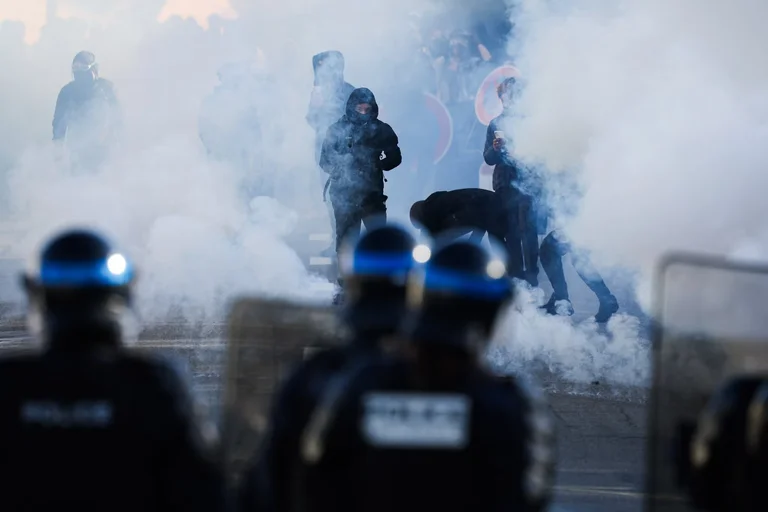
Demonstrations for a better-funded education system have led to school blockades, thousands of arrests and a political confrontation at the national level.
Student protests, which have lasted for weeks, against poor conditions in schools and a shortage of teachers in France showed no signs of slowing on Wednesday, as unions called for the action to continue, a day after mass rallies across the country.
Protesters marched on Tuesday in dozens of cities and towns, from Caen in the north to Marseille in the south, drawing around 250,000 people, according to the Interior Ministry. Union activists, who have come out in support of high school students, estimated the number of protesters to be much higher.
While officials said nearly 900 schools were closed on Tuesday, a student union claimed the figure was 1,800 and said that the protests would continue until their demands were met.
On Wednesday, protesters again took up positions in front of educational institutions in at least two cities, according to French media.
Classes were fully or partially suspended at 528 schools across the country, according to the French Ministry of Education.
Hundreds of people have been injured since the protests began last month, amid growing clashes with police.
Thousands of people have been arrested, most of them minors, law enforcement officials said.
The protests erupted amid a tense atmosphere, as the government tries to pass an austerity budget and France approaches next year’s presidential election.
The French government has acknowledged that some of the students’ demands are legitimate, but has condemned “urban violence” and accused the radical left-wing party France Unbowed of inciting the demonstrations.
The party has rejected the accusation.
Sébastien Lecornu, France’s prime minister, said regular classes would be “fully suspended” on Thursday and Friday so that school leaders could hold meetings with students.
“We cannot condemn the violence outside high schools if we do not have a political moment, in the noble sense of the word, inside each high school,” he said.
Why are students protesting?
Students are outraged by deteriorating infrastructure, overcrowded classrooms, packed timetables, a shortage of teachers and staff, as well as inadequate funding for schools, according to the student union, one of the movement’s main organizers.
Some are also calling for the abolition of state admissions platforms for higher education and universities, which they consider unfairly selective.
“We are not uneducated, they just don’t listen to us,” read a banner this week outside a school in Seine-Saint-Denis, a working-class area on the outskirts of Paris and one of the protest movement’s hubs.
“The classrooms have no ventilation and we can barely open the windows,” said Issam Makhloufi, 15, a student at Rosa Parks High School in Saint-Denis, to The New York Times.
Unions and left-wing parties have cast the protests as a broader expression of discontent as French President Emmanuel Macron, who cannot run for another term, approaches the end of his mandate.
“The public education system is in a catastrophic state after 10 years of Emmanuel Macron,” said Sophie Vénétitay, the head of a teachers’ union that has joined the students’ protests, on the sidelines of a recent march. “It lacks everything.”
Have the protests turned violent?
Many of the demonstrations began peacefully, but escalated after protesters threw mortar-style fireworks and attacked schools and other infrastructure, causing millions of dollars’ worth of damage, officials said.
The French Ministry of Education has said schools may set aside time from Wednesday through Friday to hold dialogue meetings, provided they meet “essential safety conditions.”
Contrary to the Education Ministry’s official figure of 900 schools closed on Tuesday, a French high school students’ union said more than 1,800 high schools — nearly half of the 3,700 such schools in the country — were closed that day. The protests, the union later said, would stop only “if the demands are met.”
At least 24 schools have been looted or set on fire, Édouard Geffray, the education minister, said in an interview with France 2 on Sunday. More than 5,000 people have been arrested during the protests, most of them minors, the Justice Ministry said in a statement on Monday.
Human rights organizations, including Amnesty International, criticized the use of tear gas and stun grenades to disperse minors.
In just over two weeks, more than 6,500 people have been arrested, while more than 750 police officers, as well as around 300 students and staff members, have been injured, according to French officials.
France has a long history of youth protests that have at times ended in violence, including the student-led protests in 1968, which nearly toppled the government and helped transform French society.
How have the authorities responded?
The French government has strongly condemned the violence and responded with tough measures.
Gérald Darmanin, the French justice minister, said on Friday that he had instructed prosecutors to pursue cases where possible and that parents should be held responsible for the damage.
But the government has also acknowledged some of the students’ grievances.
On Thursday, in an apparent effort to calm the rapidly spreading protests, Education Minister Geffray said the government would abandon plans to raise some higher education registration fees, announced just hours earlier as part of the 2027 budget.
After a meeting on Friday with representatives of student unions, Geffray announced plans to reform school democracy, with the aim of involving students more. He also said his office would draw up plans to address the teacher shortage.
On Tuesday, the Ministry of Education announced an anonymous national online survey through which high school students could voice their concerns.
Student leaders rejected the proposals, while a spokesperson for one of the student unions called it a “smokescreen.”








