
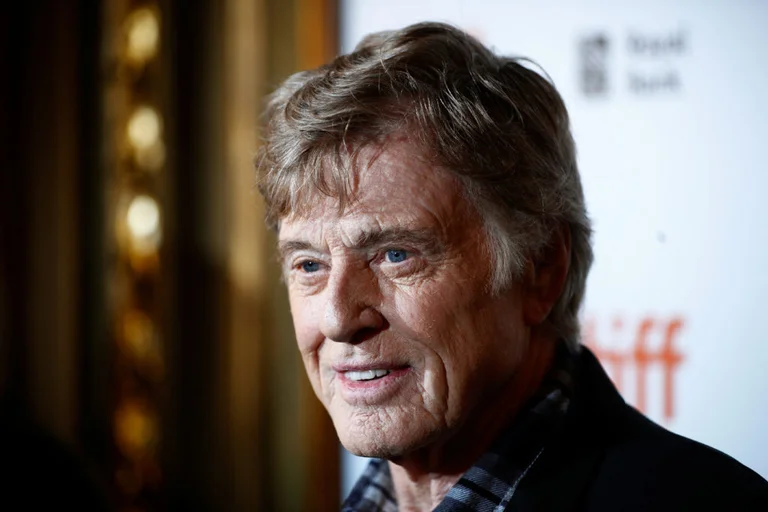
Robert Redford, the Hollywood actor who became an Oscar-winning director, liberal activist and “godfather” of independent cinema, has died at the age of 89. His role in the 1969 western Butch Cassidy and the Sundance Kid, alongside Paul Newman, launched him as one of the world’s best-known and best-loved film stars.
As the 1960s turned into the 1970s, it was not at all “cool” for famous actors to be handsome. The style was more about roughness, wrinkles, stubble, sweat, a paunch and a kind of “ugly reality”. The fashion was for stars like Gene Hackman, Jack Nicholson, Woody Allen. Even a very handsome man like Paul Newman had a rugged, plain quality. But Robert Redford was very different. He was an extraordinarily handsome movie star who went on to direct and produce, and then became the custodian and gatekeeper of American indie-commercial cinema at the Sundance Institute. And he was always distinctive.
When movie audiences were dazzled by George Roy Hill’s western, Butch Cassidy and the Sundance Kid, in 1969, they knew that in the newly emerging star Redford, they had a man who was almost indecently attractive, no matter how much he might disguise it with animal skins and a moustache, playing the role of the carefree, self-neglecting outlaw, the Sundance Kid himself. His sardonic charisma and sensuality shone through. And when he appeared cleaned up for other roles, teaming up again with Newman for the jazz-age con-man film The Sting in 1973, the effect was electric. Neat and clean-shaven, Robert Redford was simply insanely handsome, extraordinarily handsome – he was the embodiment of beauty. His picture was in the dictionary, next to the word “handsome”.
In Butch Cassidy and the Sundance Kid, Paul Newman could be allowed to entertain Katharine Ross with his ridiculous bicycle stunts, accompanied by the song Raindrops Keep Fallin’ On My Head. But it was the blond Redford who would actually have a relationship with her. Redford was a throwback to the era of Douglas Fairbanks and Tyrone Power, the Hollywood era of breathtaking idols and handsome men whose beauty seemed to have been grown in a Hollywood laboratory dish.
The American film industry, it was said, was trying to imitate the freewheeling, audacious style of the French New Wave directors – and for a while Redford became the Bardot of the American New Wave. He was a comic performer with a wonderful sparkle, but he was never well served by serious films such as The Great Gatsby (1974), in which he played Fitzgerald’s enigmatic plutocrat, or The Way We Were (1973), in which he was the shallow Protestant in love with Barbra Streisand’s Jewish intellectual. In those films, Redford sometimes seemed to retreat into himself, in a misty-eyed halo, like a very lonely and beautiful woman.
His best film of that period is undoubtedly Michael Ritchie’s brilliant political satire, The Candidate, a film released in June 1972, 12 days after Watergate. Redford plays Bill McKay, a young idealistic Democratic candidate for the US Senate, and the film shows him on the campaign trail gradually lowering his standards and diluting his principles as he gets closer to victory.
Redford’s own sheer beauty takes on a sublimely satirical quality in the film; politics is supposed to be show business for ugly people, but Redford’s physical beauty is a symbol of how the ruling class sees itself – and a symbol of the hollow, deceptive credibility of mainstream political ideas. In All the President’s Men (1976), he was Bob Woodward opposite Dustin Hoffman’s Carl Bernstein – another “buddy” duo of the kind he and Newman made fashionable in 1970s cinema. It was a liberal film with heart, where you knew who the good guys were, but without the edge and cold instability of Ritchie’s “The Candidate”.
Over the years, there was something rather too controlled and conservative about Redford’s acting style, although he always remained an A-list star. He starred opposite scene-stealer Meryl Streep in Out of Africa (1985) and was overshadowed by her; in the ’90s, he was still the romantic lead opposite Michelle Pfeiffer in Up Close & Personal, while in Indecent Proposal he was the wealthy businessman making a somewhat implausible “proposal” that seemed to offer audiences a contrived dilemma in which feminism had no place.
But this was the era in which Redford was expanding into directing. His film Ordinary People (1980) was a tense, troubled family drama-tragedy about an upper-class family, starring Donald Sutherland and Mary Tyler Moore. It was well received at the time, although film critics never forgave Redford for beating Scorsese’s “Raging Bull” for the Best Picture Oscar. The environmental themes of The Milagro Beanfield War (1988) and A River Runs Through It (1992) were again treated with respect, but did not generate much excitement.
Redford nevertheless enjoyed a major success as a director with the powerful media satire Quiz Show (1994), the story of the rigged television game-show scandals of the 1950s, with Ralph Fiennes as a talented academic corrupted by television fame and Paul Scofield as his grieving father. The film was not a commercial success, but it is genuinely good, and Redford’s direction of Fiennes is highly assured. He drew one of the actor’s finest performances from him.
But, of course, the Sundance Institute and its annual independent film festival are Robert Redford’s true and lasting legacy, built on land in the ski area near Park City, Utah, which Redford bought and on which he established an institution that administers funds and scholarships to help young filmmakers.
Sundance itself has been criticized in recent years; it is a festival that some have denounced for encouraging a stereotypical kind of “Sundance” film, with muted emotions, no humor, lower-class losers, filmed in faded colors – the equivalent of bleak British realism – while the festival has now been filled with studio-linked careerists eager for an “indie break”.
Well, so what. Who could doubt the extraordinary ambition and imagination of Robert Redford, who created something that outlived his tremendously successful career? He was always more than a pretty face. (The Guardian)








