
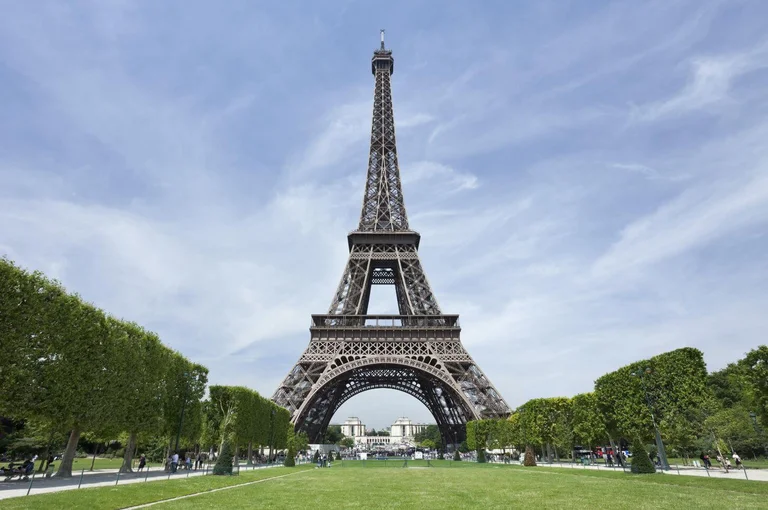
The structure known today as the Eiffel Tower was originally called Tour de 300 metres, or the 300-metre tower. The name was proposed by engineers Maurice Koechlin and Emile Nougier to Gustav Eiffel, who oversaw the construction of the tower. He hoped to build something extraordinary, a building that would set a new height record.
The Eiffel Tower was inaugurated at the 1889 World’s Fair to mark the centenary of the French Revolution.
Eiffel chose wrought iron for its construction, a material he knew well and had used in previous projects with good results. This material can withstand high levels of pressure, making it possible to build a large but lightweight tower that would be safe against the horizontal forces of the wind.
To give an idea of how light the tower is, its weight is close to the weight of the volume of air inside it, which is estimated to be somewhere around 6,300 tons.
The tower was built to serve as a lookout point, as well as a base for radio transmission.
All these structures expand when the temperature of the material rises. But unlike bridges, which behave in a more complex way, the Eiffel Tower experiences mainly vertical expansion. This phenomenon is known as thermal expansion.
Calculating how much it expands is simple. Typically, one metre of this material expands by 0.000012 metres when the temperature rises by one degree; 100 metres of this material expand by 0.12 metres when the temperature rises by 100 degrees. And 300 metres of this material would expand three times as much, or 0.36 metres. In other words, 36 centimetres. That is a noticeable difference.
Normally, a simple piece of material does not behave in the same way as a 300-metre-tall tower. The sun always shines on one side of the tower. This means that one side of the tower expands more than the others, causing the tower to bend, as if leaning in the direction opposite to the sun.
Experts have estimated that the Eiffel Tower grows by between 12 and 15 centimetres when comparing its size on cold winter days with that on hot summer days. This means that, besides being an iconic landmark, a communications tower and a symbol of Paris itself, the Eiffel Tower is also, in practice, a giant thermometer.








