
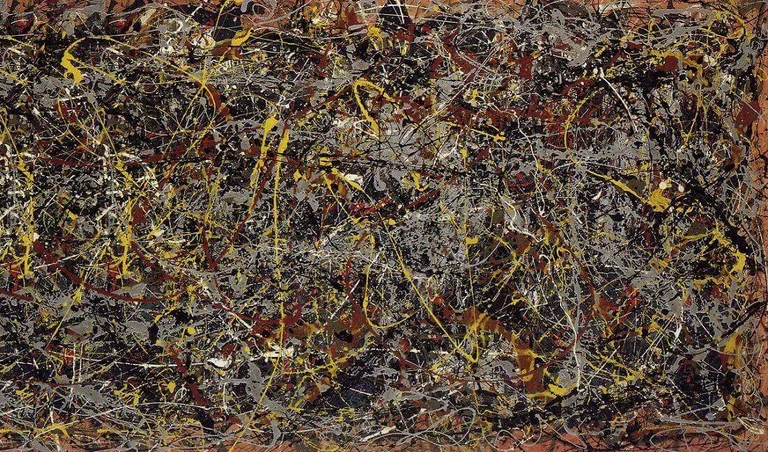
In a corner of mid-twentieth-century America, where frameworks were rigid and canvases usually sat in silence, a man with eyes clouded by alcohol and a soul painted with fire decided to remove art’s boundaries. He did not paint. He confessed. And in every drop of paint that fell from his brush, there was a heartbeat, a scream that could not be put into words.
Jackson Pollock (1912 – 1956) – is a name that does not stand upon the canvas, but bursts through it. It had no form, because for him form was a prison. He sought absolute freedom—that which neither government, nor religion, nor love can give: only a naked confrontation with oneself. And for Pollock, this confrontation took place only when he rose above the canvas like a drunken saint and shook the world with his arms.
He was no master of harmony, but a prophet of turmoil. The canvas was no longer a surface, but a battlefield, where paint was not placed, but thrown, splattered, poured like a raging river that knew no stopping. He invented another way of seeing: dripping – but more than a technique, it was a ritual. His paintings were not looked at; they were heard. They were heard like the noise of life that never stopped moving within him.
There was no figure, subject, or classical composition in them—but there was breath, chaos, impulse. An entire web of lines, circles, dots that seem to have been placed at random, but carry an invisible gravity. There lies the uncertainty of modern man, existential anxiety, the light that does not fall at the center but breaks apart into thousands of streams.
He was often broken—by himself, by alcohol, by fame. The man who sought to seize eternity for a few moments in a mad act of creation found himself falling into the abysses of what he could not control: himself. He died in a tragic accident, as often happens to those who live on the boundary between ecstasy and destruction.
But Pollock did not disappear—because he is not a name in art history. He is a shock to the very idea of art. He is the moment when form erupts, when meaning collapses, when art is no longer decoration, but an explosion—an existential act in which a person seeks to find themselves, or to lose themselves forever.
In a world that demands order, Pollock dared to show us our inner chaos—not to put it in order, but to accept it. And in that acceptance, perhaps, lies the deepest form of beauty.
In Nietzsche’s shadow and the roots of the loss of meaning
If we had to place a philosopher beside Jackson Pollock, it would be Friedrich Nietzsche—not only because of his rebellion against form, but because of the way both understood art as an act of salvation in a world without God. “If you gaze long into an abyss, the abyss will also begin to gaze into you,” Nietzsche said. And Pollock did not avert his gaze. He entered the abyss of himself with paint on his hands and a bare soul, wanting not to illuminate the darkness, but to make it heard.
In the work “No. 5, 1948,” we find no tree, no person, no horizon, but a universe that seems to be in perpetual turmoil. It is not just a painting—it is a map of the anxiety of being, an unheard scream turned into visual form. Each line is like a thought that cannot be completed, like a memory that appears and vanishes without warning. Here, precisely, Pollock draws close to Kierkegaard, the philosopher of anxiety and solitude. He seeks no solution, but accepts absurdity as a natural part of life.
“Blue Poles” (1952) – another monumental work – is perhaps the culmination of his confrontation with order and chaos. Tensions can be felt there: between light and darkness, between the attempt to hold on to an axis and the risk of losing control. The blue poles amid the turmoil seem like attempts to establish order, but an order that is never stable. They are figures of fate, perhaps the gods of a world that no longer hears humanity’s calls.
More than a painter: a medium
Pollock often said that he did not think while painting—he was simply there, in the act. He was the medium through which unconscious forces—perhaps even the Jungian archetypes themselves—took shape. In this sense, Pollock is not the creator, but the path through which creation takes place. He did not want to control the canvas, but to lose himself in it. He sought an untranslatable connection with nature, not nature as landscape, but as energy—as an inexplicable cosmic disorder speaking through his visual chaos.
An unclear ending, but luminous in its depths
Pollock died in a car accident in 1956, at the age of 44. Speed, intoxication, uncertainty—all were part of his spiritual journey. He did not want to become an example—he only wanted to be real. And in his authenticity, in that brutality of unguarded feelings, we find something nameless: perhaps the truth about modern man.
Jackson Pollock did not teach us how to see beauty, but how to accept turmoil, anxiety, and inner conflicts as natural parts of existence. In this sense, he remains not only a revolutionary of contemporary art, but a witness to an era that lost the divine and faced only itself—with all the trembling and light that this confrontation brings.








