
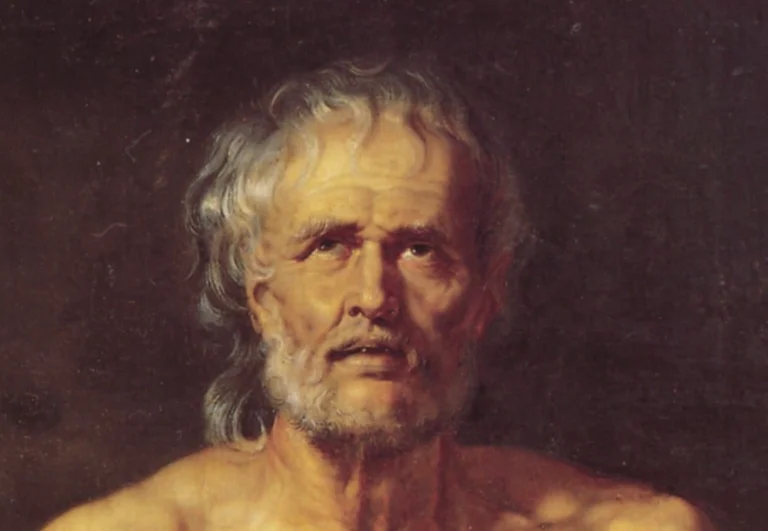
He was born in southern Spain over 2,000 years ago and educated in Rome. He was the son of Seneca the Elder, a renowned Roman writer, and the uncle of the poet Lucan. Seneca had a career in politics and became a high-ranking financial official. During that period, he also wrote tragedies, such as “Consolation to Marcia”.
His life took a sharp turn in 41 AD, after the new emperor Claudius exiled Seneca to the island of Corsica, accusing him of adultery with Julia Livilla, the emperor’s niece and Caligula’s sister. In exile, he wrote a letter to his mother to console her.
Eight years later, Agrippina, the mother of the future emperor Nero and Claudius’s wife, secured permission for Seneca to return to Rome. He became her son’s tutor and later his adviser. Nero would go on to become one of the most infamous emperors and tyrants in the history of the Roman Empire, raising even more questions about Seneca’s character.
It is no surprise that Seneca accumulated his wealth while serving Nero. His death in 65 AD came at Nero’s own command (Nero thought Seneca was part of a conspiracy against him).
Throughout all those turbulent periods, Stoicism remained a constant in his life. He was introduced to this school of thought by Attalus, a Stoic philosopher who was Seneca’s early teacher.
He was also an admirer of Cato, whose name appears regularly in his writings.
But Seneca was not limited to Stoicism alone.
In his philosophy, he freely borrowed from other schools, at times citing Epicurus.
After his death, Seneca influenced notable figures such as Erasmus, Francis Bacon, Pascal, Montaigne, and people up to the present day. Here are the 3 main pieces of advice he offers people for living a spiritually rich life.
1. Find a role model to follow
In his letters to Lucilius, Seneca urges him to choose a role model to provide a standard for how to live. This is not a unique idea of Stoicism. But the ancient philosopher thought it was a necessary step in the pursuit of a good life.
The person we choose as a role model can offer us principles that can help us get through even the most difficult circumstances, as well as standards by which we can judge our behavior every day. “So choose someone whose way of life, words, and very face reflect the character behind them as your model,” Seneca wrote.
2. Never be a slave to your wealth
Seneca wanted only the good side of wealth. He was always ready to use it, but he was never dependent on it. He was its master, not its slave. He believed that we should continually examine whether we are so fixated on the wealth we have that we are afraid of losing it, and for that reason turn it into our master.
As Seneca wrote in the book “On the Happy Life”: “For the wise man does not become infatuated with wealth. If he has it, it is a good thing. But he does not admit it into his heart.” He also stressed that we should be masters, not slaves, of our fate: “For the wise man considers wealth his slave, while the fool considers it his god.”
3. Fight your ego
Seneca understood very well how our ego can prevent us from learning and moving forward. In today’s culture, where everyone’s self-esteem is inflated, we have become accustomed to hearing only praise. And when you constantly hear that you are, in fact, a superhuman, you start to believe it yourself.
Seneca warned Lucilius about the dangers of such self-satisfaction: “The main obstacle is that we are too easily satisfied with ourselves. If we find someone who calls us a good, careful, and principled person, and we accept this praise, then we keep company with those who constantly call us the best and wisest, even though we know they often tell many lies. Therefore, we do not want to change anything about ourselves, because we believe that we are already excellent in every respect.
Quotes from Seneca
“Consider the path you have traveled through hardship: Difficult conditions can be eased, limited circumstances can be broadened, and heavy burdens can weigh less on those who know how to endure them.
“Let all your activity be directed toward some object, with a purpose in mind.”
“Often, a very old man has no other proof of his long life than his age.”
“We say that nothing happens to the wise man contrary to his expectations.”
“Believe me, it is better to understand someone’s balance of life than the corn trade.”
“We human beings have not been given a short life. It is we who shorten it by wasting it needlessly.” / DailyStoic – Bota.al








