
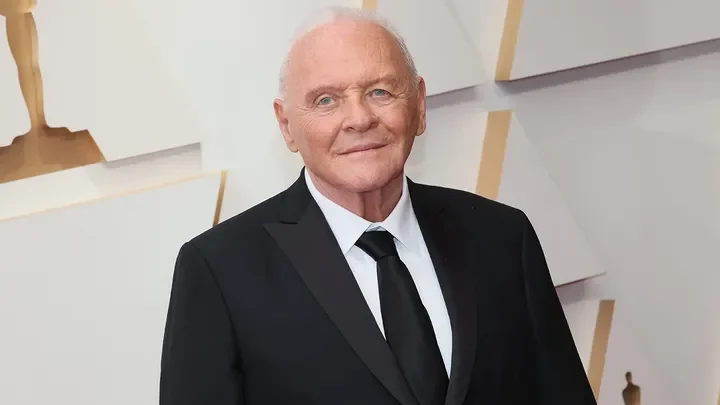
In so many of Anthony Hopkins’s greatest performances, he manages to suggest astonishing depths hidden within his characters. The spaces between what they know, what the audience knows, and what those characters are willing to express are where the magic of his art lies. This is true whether he is playing a manipulative monster, as in his three Hannibal Lecter films, or an emotionally timid butler, as in the moving film “The Remains of the Day.” These men think and feel things that, for many reasons, they keep to themselves.
The same can no longer be said of Hopkins. In his new memoir, “We Did OK, Kid,” the 87-year-old actor shares details about his difficult school days in Wales, his almost miraculous victory over alcoholism, his painful estrangement from his only daughter, and his slow but steady rise to success in Hollywood.
The book also reveals a somewhat reserved and solitary man, but one who is not content simply to recount the events of his life, what happened and when. He has thought a great deal about the big questions — why it all happened, and what it all means. And yet, even at this late stage, Hopkins remains beautifully awestruck by the sheer luck and impossibility of the dream he calls life.
We all have turning points in our lives, but you have a very specific one — a moment that changed everything for you. Can you tell me what happened on December 29, 1975, at 11 o’clock? I’m always a little reluctant to talk about this, because I don’t want to sound preachy. But I was drunk and driving here in California, in a blackout, with no idea where I was going, and I realized I could have killed someone — or myself, which I didn’t care about — and I realized I was an alcoholic. I pulled myself together and told a former agent of mine at this party in Beverly Hills: “I need help.” It was exactly 11 o’clock — I looked at the clock — and here’s the frightening part: a deep, powerful thought or voice spoke to me from within and said: “It’s all over. Now you can start living. And everything has been for a reason, so don’t forget a single moment of it.”
Was it just a voice out of nowhere? From inside me. But it was audible, masculine, reasonable, like a radio voice. The craving to drink vanished from me, or was lost. I have no other theory except the divine, or that force we all have within us that creates us at birth, the life force, whatever it is. It’s a consciousness, I believe. That’s all I know.
You grew up in a working-class family in Wales, the son of a baker. I imagine you didn’t know many artists or actors. Was the idea of becoming an actor something you or your family were doubtful about? No. As a 17-year-old boy who knew nothing, something ignited in me, and I got a scholarship to an acting school in South Wales. I had never acted in my life. But I auditioned and they gave me a scholarship. I remember going to see the great Peter O’Toole in a play at the Bristol Old Vic. He was playing Jimmy Porter in “Look Back in Anger,” and he came onstage like lightning: Peter O’Toole. A very dangerous actor. I thought, God, if he comes down off the stage, he’ll kill us all. Ten years later, I was at the National Theatre playing Andrei in Chekhov’s “Three Sisters,” in Laurence Olivier’s production. A knock at the door at the end of the evening — who was there? Peter O’Toole. Now, that’s strange. He said: “I want you to do a screen test for me. It’s a film with Katharine Hepburn called ‘The Lion in Winter.’”
Your first film. Exactly. So I showed up and did the test. He said — “You got the part.” When I watch that film, which I do sometimes, I think: How did that happen? Why me? I still don’t know. It’s all part of the game, the wonderful game called Life. No worries, no big deal. There are no big deals.
The idea that life is a game and that there are no big deals is a recurring theme in your book. But what should we take seriously? What matters? I don’t want to be irresponsible about everything. There are terrible difficulties in life, and you have to pay attention to them. But ultimately, as I approach the age of 88, I wake up in the morning and say: “I’m still here. How?” I don’t know. But whatever is keeping me here, thank you very much! Much obliged! Beyond my finite self, there isn’t much I can do. I had a gift when I was a boy. I could learn a lot of Shakespeare, poetry and everything. Now, at this age, I look at those poems and they bring back clear memories of my childhood, and I get very emotional. My eyes fill with tears, not from sadness, but from the wonder of having lived through those years. My clear memories of Wales, of my parents, of their struggles. I look back with great gratitude and tear up, because I remember the glory of being a child. I had a good childhood. I was teased a lot. I was beaten. But I look back and think — well, that’s part of growing up. In those days teachers could beat you. I remember being hit on the head several times by a teacher because I didn’t know something. And what I did was what they call in the army “passive resistance.” I didn’t react. I just withdrew into myself, stared blankly at them, and drove them mad. And now they’re all dead. [Laughs]
You won! I won.








